Quick Answer: The best Superside alternatives for marketing and design teams in 2026 are Teamtown (my company, best overall for a dedicated team at mid-market pricing), Rocketium AI Studio (best for resizing one design into many versions), Designity (best for creative-director-led strategy) and ManyPixels (best low-cost production). Superside now starts at a $15,000 monthly minimum on an annual term, roughly $192,000 in year one with fees. In my experience the teams that leave rarely have a problem with the work. They have a problem with committing to that number for a year.
Key Takeaways
- Superside is priced for continuous enterprise volume. Flex starts at a $15,000 monthly minimum on a 12-month term plus a $1,000 monthly software fee, so year one commits about $192,000. That is the subscription floor, not the cost of one project. A Dedicated AI-Native Team starts at $30,000 a month.
- The annual commitment changes the buying decision. Being able to spend $15,000 in a strong month is a different decision from committing to it across a year. For smaller and mid-market teams that term can be the bigger obstacle, even with three months of budget rollover.
- Alternatives split by what you are buying. Dedicated teams (Teamtown, Designity), resizing platforms (Rocketium), production queues (Design Pickle, Penji, Kimp, ManyPixels), do-everything subscriptions (Flocksy, Growmodo) and project studios (Bricx).
- Teamtown, my own company, is the best fit for mid-market marketing teams: a Creative Lead, a Project Manager and designers who stay on your account, from $3,000 a month, month to month with 15 days' notice. Book a demo.
I run a creative subscription company, so I have spent six years losing deals to most of the companies on this list and winning some back. That is the perspective here, for better or worse.
If you are already with Superside, you probably know your renewal date and are working out whether the number still makes sense. If you are still deciding, read this before you sign rather than after, because the commitment is annual.
The major Superside competitors work in several different ways: dedicated creative teams, services led by a creative director, production subscriptions, software that resizes designs automatically, subscriptions that cover many kinds of work, and project studios. They aren't interchangeable, and the right one depends on what you are short on.
Below are 12 alternatives with current pricing for each. Teamtown is first because it is mine, so discount that entry accordingly. Several of the others cost less than we do, and one or two do things we do not.
Superside Alternatives and Competitors at a Glance (2026)
Pricing checked against each provider's own pricing page in September 2026. Where a company does not publish a figure, this says so. Several run introductory rates that expire.
Why Companies Look for Alternatives to Superside
Superside does real work for large enterprises with continuous creative demand, and I would not pretend otherwise. Four things send teams looking elsewhere, and only one of them is the monthly number.
The commitment, more than the price. This is the one I hear most. Teams that could absorb $15,000 in a strong quarter often cannot commit to it across twelve months.
A budget you have to keep using. Rollover softens this for three months, but a team with uneven demand pays for a floor it does not consistently reach.
The creative-leadership model is different. Superside includes creative development, concepting and brand strategy within Flex, and your day-to-day contact is a Creative Project Manager. Teams that want a recurring Creative Lead or Creative Director on the account may prefer a dedicated-team model such as Teamtown or Designity.
Speed for fast-cycle work. Fast turnaround of 24 to 48 hours or under is available where the plan includes it, and complex production runs longer. Paid-media teams changing creative several times a week should confirm which tier they are on.
What Superside Reviews Say
Superside's overall ratings are strong, around 4.5/5 on G2 and 4.3/5 on Trustpilot, and I want to say that first. When I read through the critical reviews, they cluster around speed, flexibility and value rather than the quality of the work.
One verified G2 reviewer said Superside worked well for clearly defined creative tasks, but that agreeing on the scope could hold up the start of a project by several days. Another said urgent requests sometimes had to be handled in-house, because there was little room for fast turnaround.
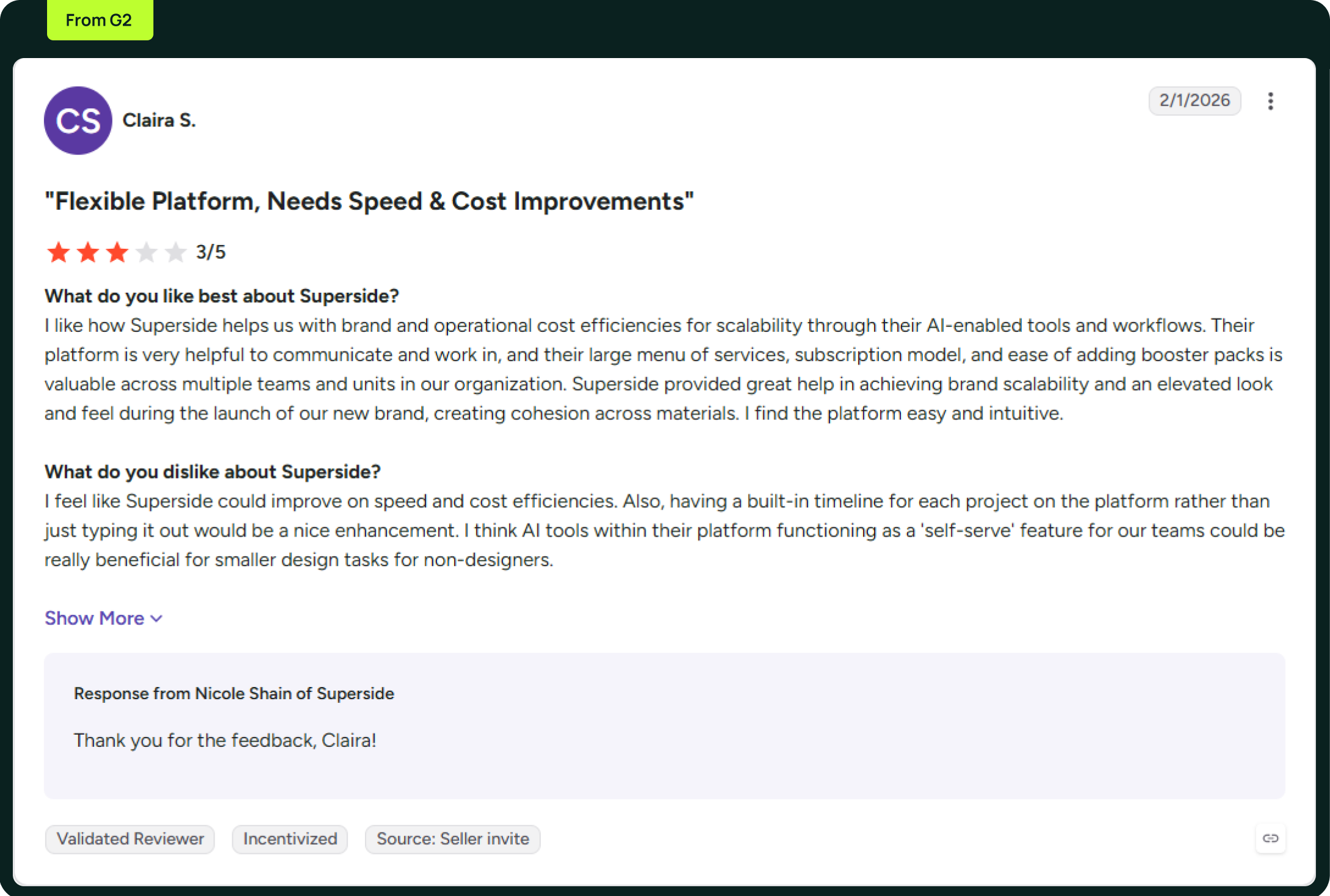
On Trustpilot, a reviewer in paid media raised the same problem from a different angle. They found Superside too slow for testing new ads quickly, and criticized both the cost and the contract terms.
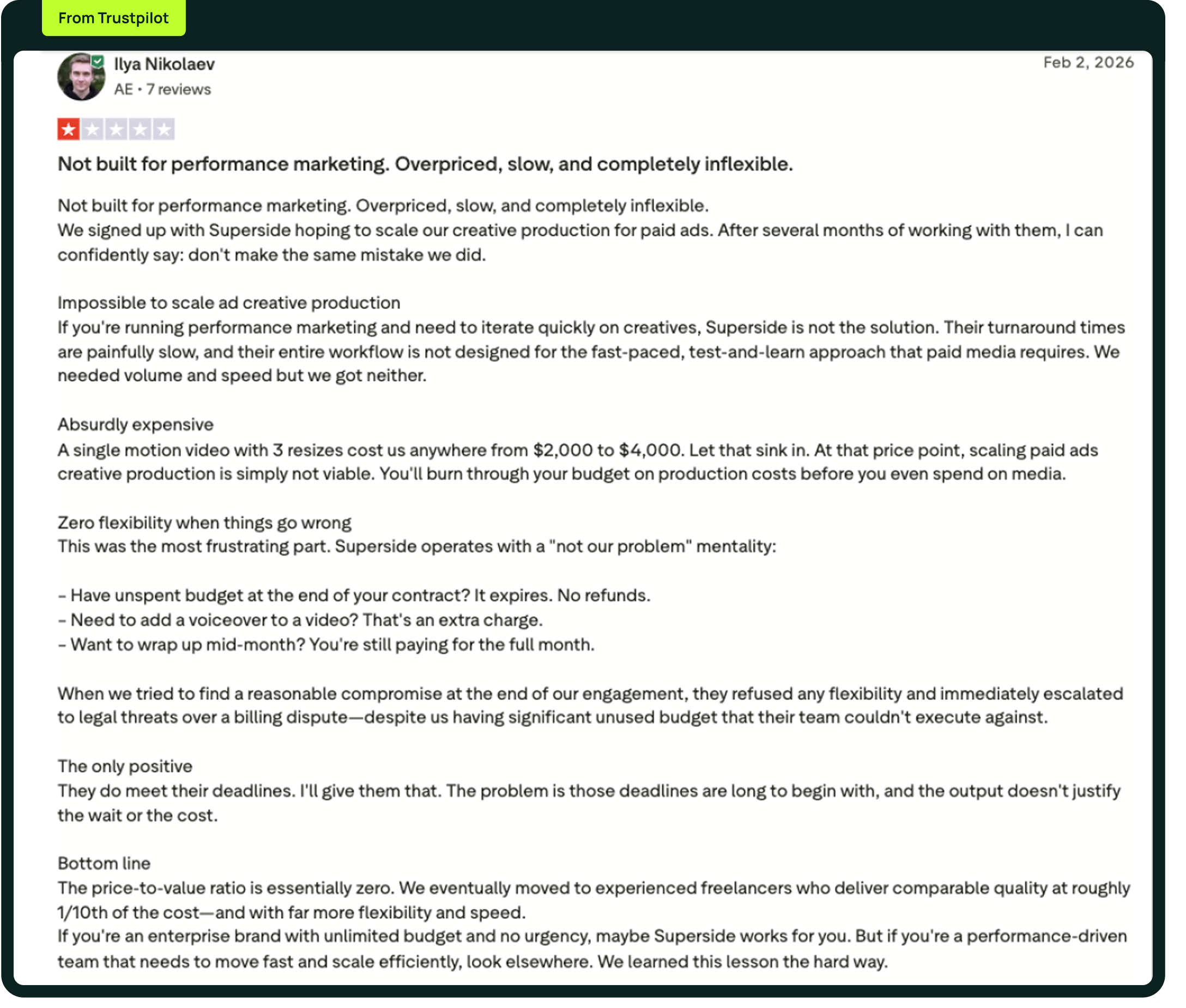
To its credit, Superside replied publicly and acknowledged its model had not matched the pace that team needed.
One Reddit post points the same way on value. In it, a startup customer described the service as easy to use and responsive, but said it "felt expensive for the volume of work I got." They also mentioned designers changing and revision rounds that sometimes dragged.
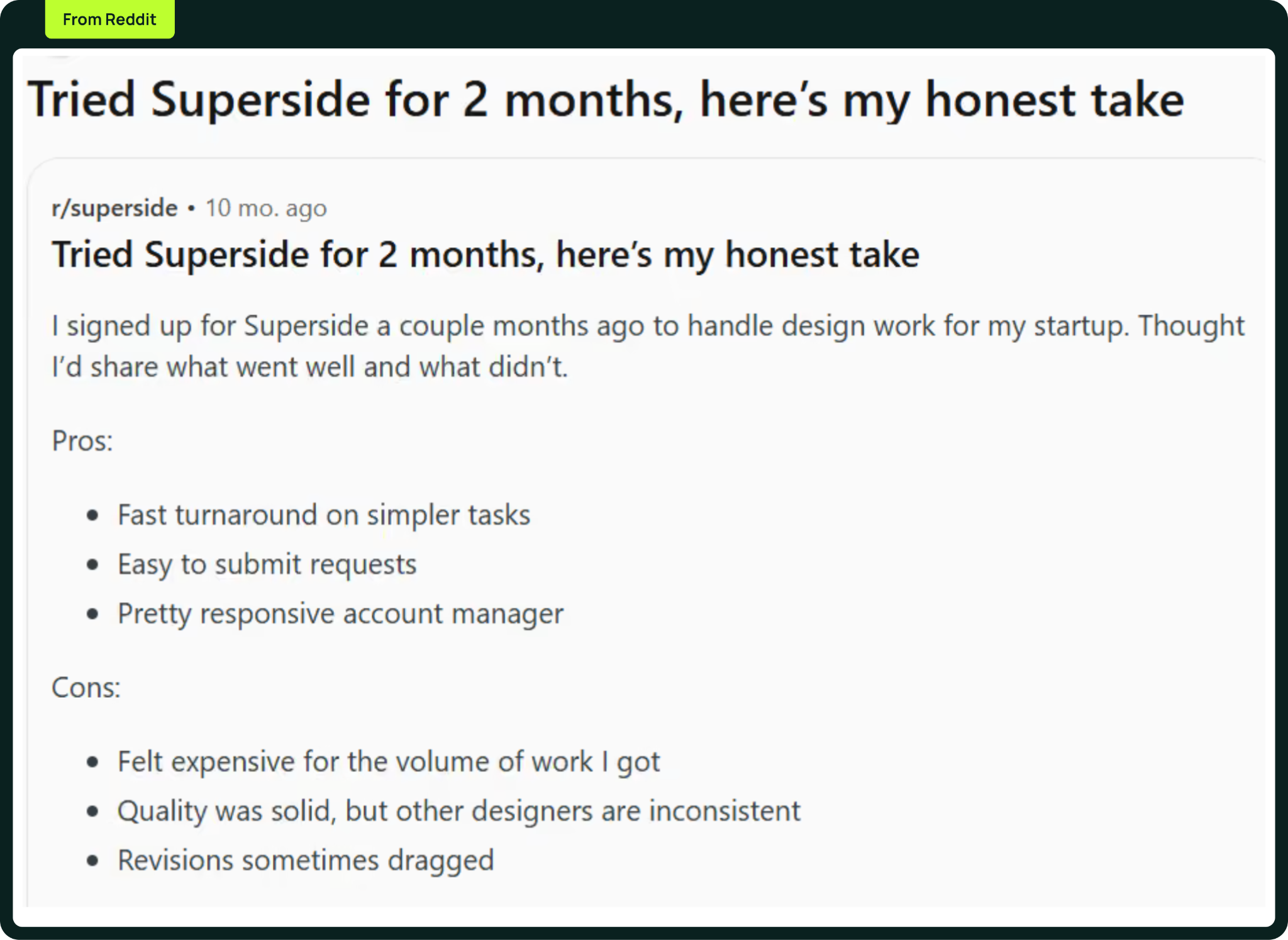
None of this says Superside does bad work. It says the model is a weaker fit for teams that need a lot of rush work, test new creative quickly, or want more flexibility over what they spend and how long they commit.
When Superside May Still Be the Better Fit
I will say plainly that Superside is sometimes the right answer.
It is built for a creative backlog that does not end, and if you are running continuous production across ads, decks, video, 3D and multiple markets, very few alternatives here match its breadth in a single contract. One budget covers day-to-day creative, more specialized work such as UI/UX, illustration, motion, 3D, AR and audio, plus concept work and brand strategy.
It also suits teams that want AI built into how the work gets done, with custom brand models, AI strategy support and upskilling included.
If that describes you, I would stay where you are. If it does not, you are likely paying for capabilities you are not using.
How I Evaluated These Superside Alternatives
I founded Teamtown, and Teamtown is the first entry. Discount it accordingly.
After six years in Creative-as-a-Service, these are the criteria I scored each platform on, the same ones I would use if I were the buyer:
- Pricing transparency: Is pricing public? Any hidden fees or minimums?
- Contract flexibility: Month to month, pause, or cancel without penalty?
- Team consistency: Same designers every month, or a rotating pool?
- Creative direction: Included by default, sold as an add-on, or not offered?
- What you are actually buying: Hours, active workstreams, daily output, or finished files?
- Turnaround speed: The real number, not the marketing promise.
- Service range: Design only, or also motion, video, web and copy?
- Verified satisfaction: Trustpilot, G2 and Clutch ratings from real users.
I checked every price and contract term against the provider's own pricing page in September 2026, rather than using figures from other roundups, because most numbers in this category are a year out of date. Where a company does not publish a number, I say so.
12 Best Superside Alternatives
1. Teamtown: Best Overall Alternative for Mid-Market Marketing Teams
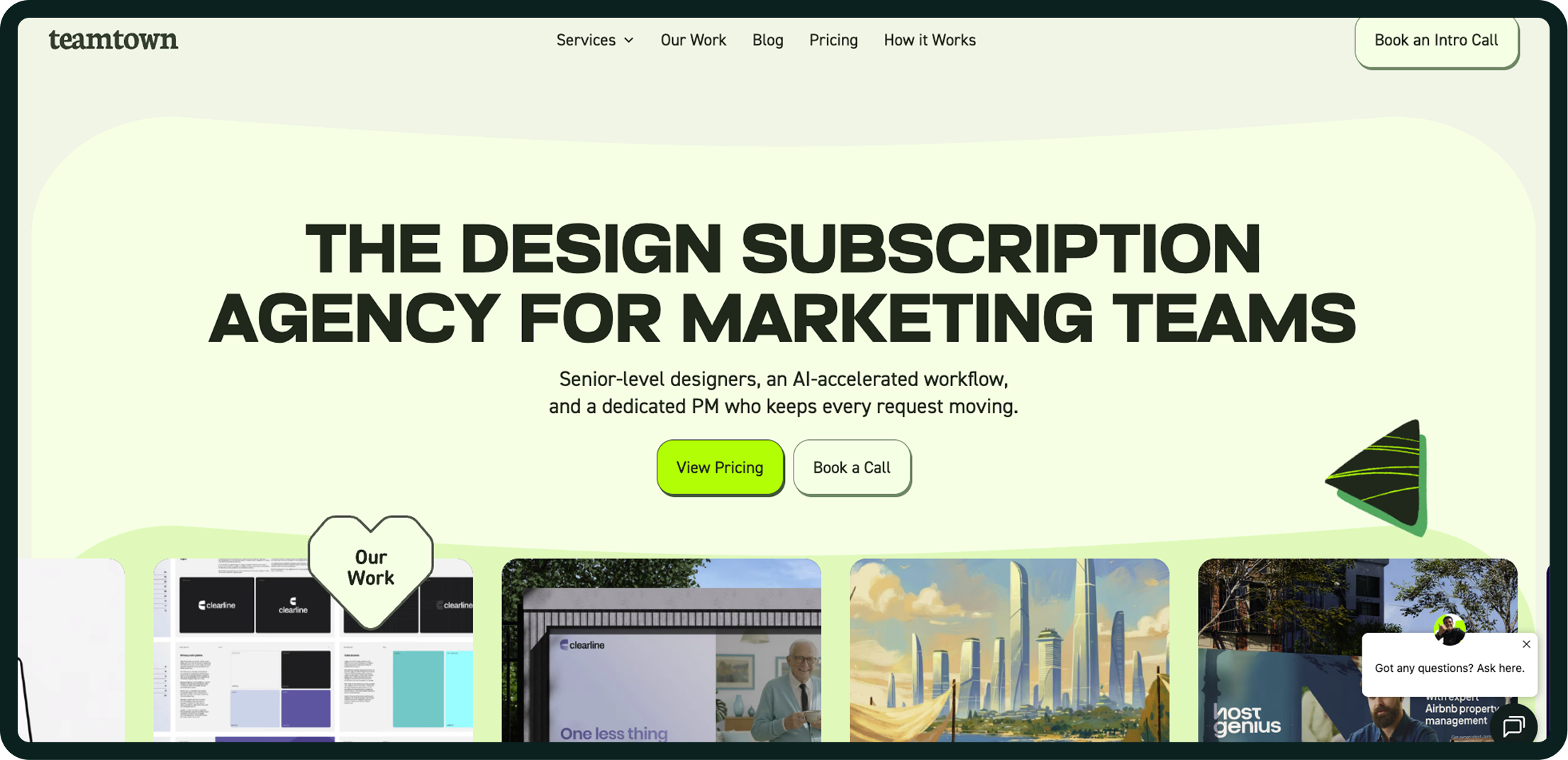
This is my company, so discount what follows accordingly. Here is the case as plainly as I can put it.
How it works. You get a dedicated team: the same Project Manager, Creative Lead and designers every month. They learn your brand, the people who sign things off and what you like, so there is no re-briefing and no question of who has your project this week. Work runs through a shared Slack channel or our portal, whichever you prefer.
Pricing. Essentials from $3,000 a month, Pro at $4,500, Studio at $9,900. Month to month with 15 days' notice to cancel, and a 15-day money-back guarantee. No annual commitment and no software fee.
How much work, how fast. Most requests land within 24 to 48 hours depending on complexity, and how much you can get done scales by plan rather than by buying hours.
What we do better than Superside. The commitment, mostly. Year one on our Essentials plan is $36,000 against a $192,000 Superside floor, and you can leave in fifteen days. The other difference is structural: because the Creative Lead is a fixed part of the account, the same person provides creative direction over time rather than drawing from a wider pool per project.
Where we fall short. If you need a constant stream of many kinds of creative at enterprise size, including 3D, AR and versions for many markets, Superside's bench is deeper than ours and few can match its breadth under one contract. We are a mid-market answer, not an enterprise one.
What our customers say. 4.6/5 on Trustpilot, from a small base of around 18 reviews, so read it as directional rather than settled. Reviewers praise the value of the subscription model, the team's responsiveness and the quality of work such as logos, pitch decks and marketing materials. The only critical note comes from one G2 reviewer who missed in-person ideation with the designers.
- Best for: Mid-market B2B marketing teams that want a dedicated recurring creative team without an annual enterprise commitment.
- Trade-off: If your creative spend really does justify five figures a month across many kinds of work, Superside is the more complete package and I would tell you so on a call.
Most people who call us are tired in a specific way. Tired of explaining the brand again to someone new. Tired of chasing a file that was due Tuesday. Tired of being the bottleneck their whole team is waiting on, when the actual problem is that design capacity was never sized for the work.
That is the part we fix first. You get the same people every month, and they stop needing to be told. We have been doing that for over 200 companies, across more than 5,000 projects.
Book a demo and we will look at what you are producing now and tell you honestly whether we are the right fit, or whether something cheaper on this list is.
Want to go deeper? Here’s our full Teamtown vs Superside comparison.
2. Rocketium AI Studio: Best for Turning One Design Into Hundreds
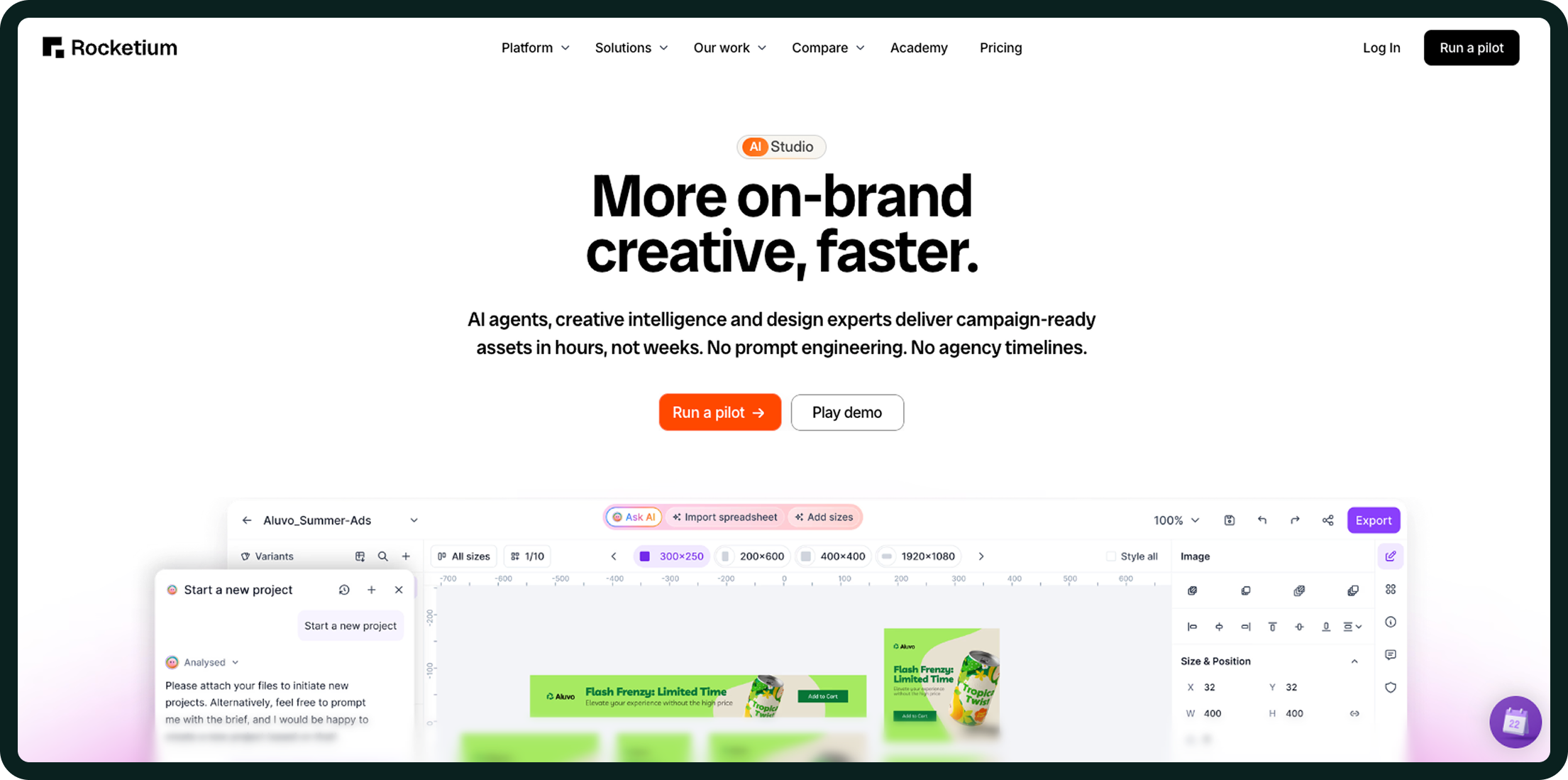
Rocketium sells finished files rather than hours. You upload a master design and it produces every required size and format, with a human review layer and automatic checks against your brand rules and each retail platform's requirements.
- Services: Resizing and reformatting, retail media creative, video versions, concept generation
- Pricing: Credit based. A simple resize starts at one $9 credit, so 500 simple resizes begin around $4,500 and rise with complexity. No lock-in.
- What reviewers say: 4.2/5 on G2 across 102 reviews. Praise is narrow and consistent: turning one master creative into every size in minutes and keeping campaign deadlines on track.
- Best for: Consumer retail brands producing high volumes across Amazon, Walmart, Target and retail media networks.
- Trade-off: Its own material says it can concept as well as resize, but where I see it win is repetitive ecommerce and performance creative. If your work is mainly brand, decks or web, a broad partner will serve you better.
3. Designity: Best for Strategy and Creative Direction
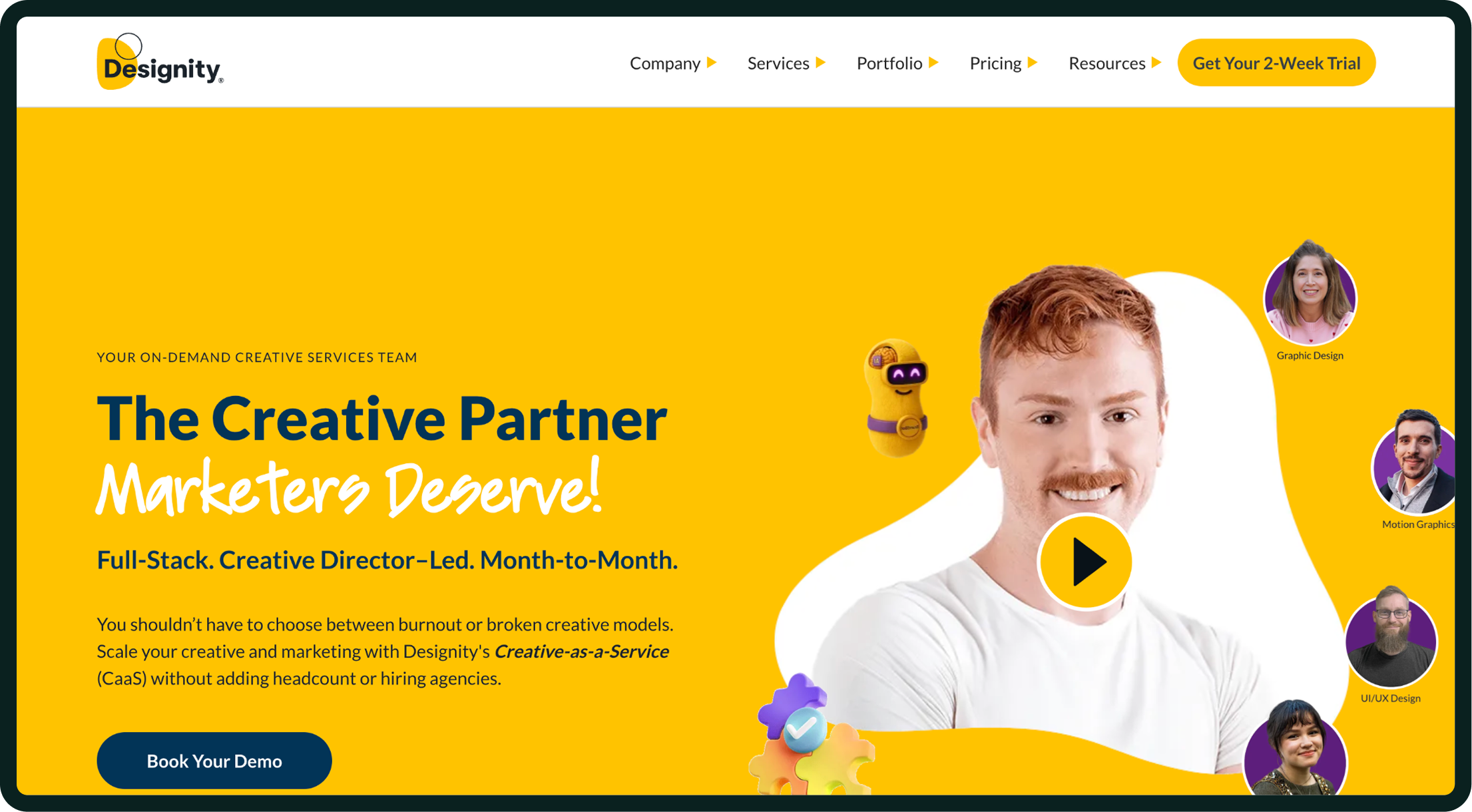
A dedicated Creative Director leads every account, sets direction and brings in the right people per brief across 100+ services. US-hours team, month to month, with a two-week trial and nothing paid upfront.
- Services: Design, branding, web, video, motion, marketing strategy, copy
- Pricing: From about $5,995 a month for 120 dedicated hours, $8,995 for 180. Seven days' cancellation notice.
- What reviewers say: 4.7/5 on G2 from around 30 reviews. The Creative Director relationship and strategic guidance are the most cited strengths; the few critical reviews concern cost.
- Best for: Mid-market teams that want someone senior owning the brand, not just the queue. This is the competitor I lose to most often when direction is the deciding factor.
- Trade-off: The hours are a hard ceiling that a video-heavy month burns through, and it depends on clear briefs.
4. Design Pickle: Best for Routine Production at Volume
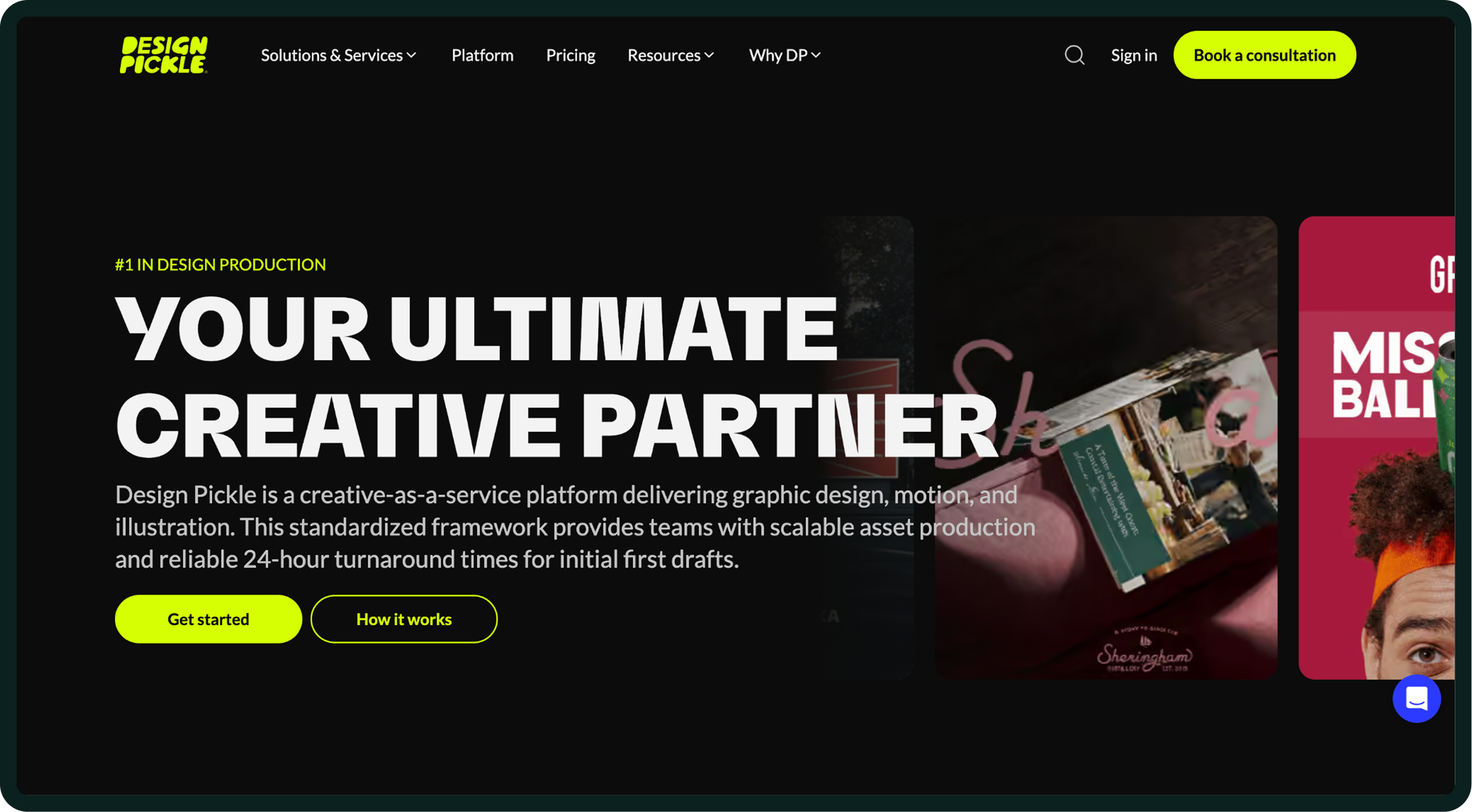
One of the original design subscriptions, built around a request queue for steady, repeatable output. You reserve a number of creative hours per day and that sets your limit.
- Services: Graphic design, illustration, presentations, motion on higher tiers
- Pricing: No longer published. Scoped on a consultation call, billed quarterly or annually, nothing refundable once a term renews.
- What reviewers say: 4.4/5 on G2 across 220+ reviews, but 3.4/5 on Trustpilot. Praise for the platform and first concepts within a working day; critical reviews describe designers changing between projects and revisions from missed details.
- Best for: Teams with steady, high-volume, straightforward design needs.
- Trade-off: Creative direction is an add-on below the higher tiers, and you trade Superside's published minimum for a quote you cannot benchmark against anything.
5. Penji: Best for Budget Graphic Design
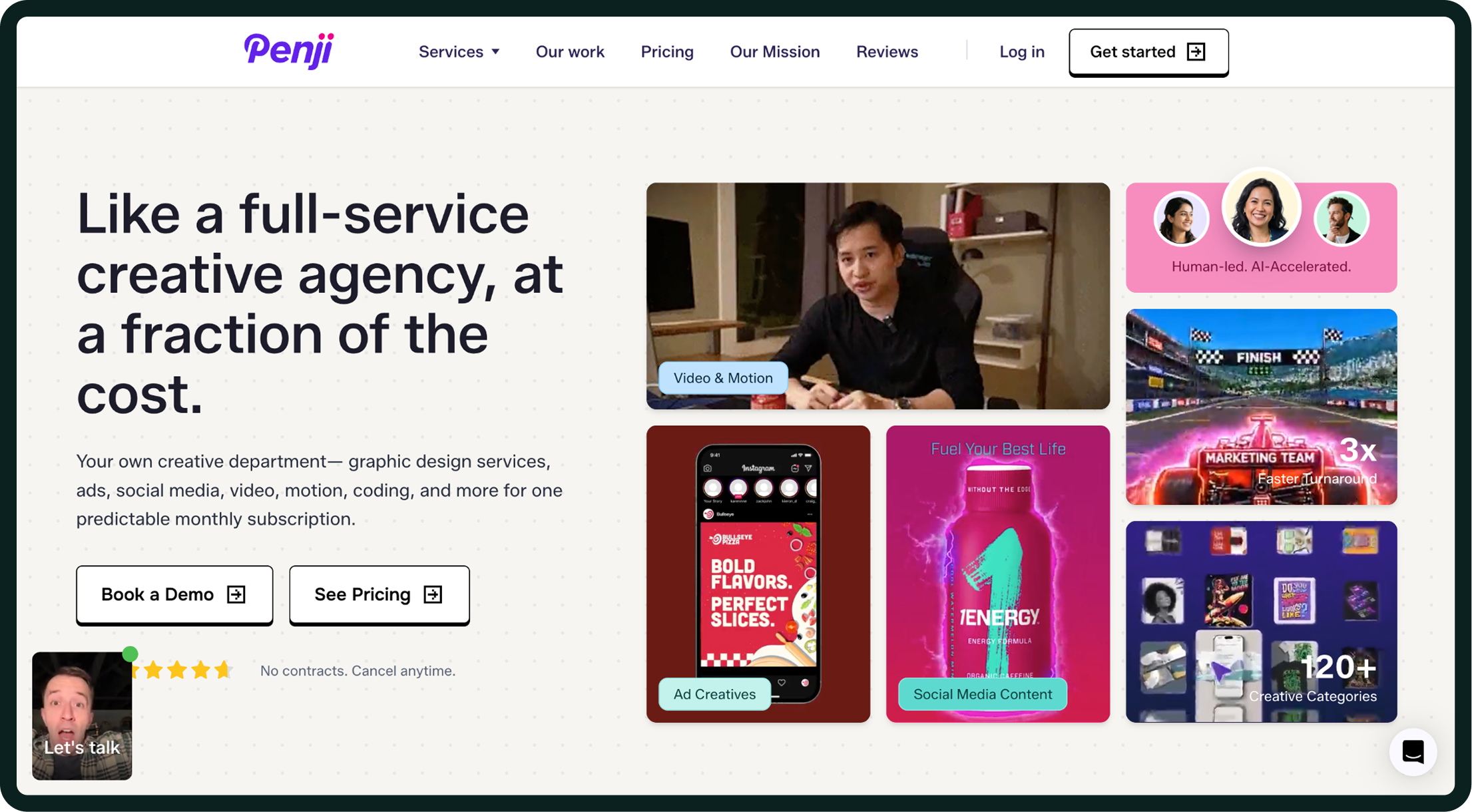
Unlimited requests and revisions through a portal, with your limit set by how many projects run at once. Penji's pricing table is unusually clear about what each tier includes.
- Services: Graphic and social design, branding, illustration, presentations; video, motion and web from the second tier
- Pricing: Essentials $995 a month, Agency Partner $1,995, Dedicated Team from $4,500. 15% off quarterly, 20% yearly. No contract, 30-day money-back guarantee.
- What reviewers say: 4.7/5 on G2 from around 179 reviews and 4.8/5 on Trustpilot. Praise for value, the portal and quality at volume; critical reviews mention revision cycles stretching on complex work and consistency varying when the designer changes.
- Best for: Teams that know exactly what they want and need it produced. If your briefs are already tight, I would not pay more than this.
- Trade-off: Penji's main pricing table lists Essentials as self-managed with best-matched creatives. Same assigned creatives and an Art Director begin at $1,995.
6. Kimp: Best for Design and Video Under One Plan
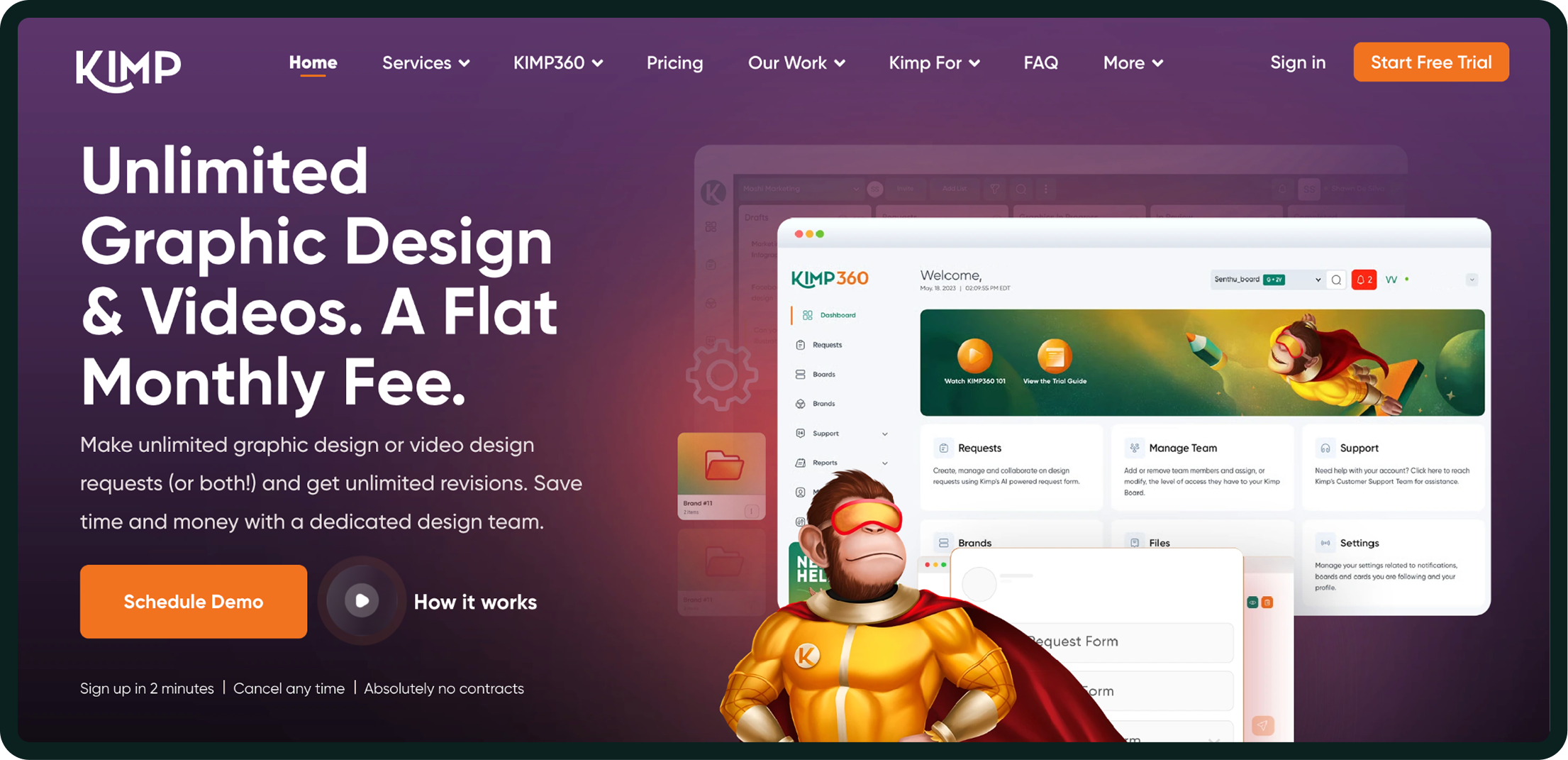
Kimp sells video as its own subscription or bundled with graphics, rather than gating it behind a higher tier. Each account gets a creative team plus project management.
- Services: Graphic design, video editing, motion graphics
- Pricing: $1,397 for Graphics or Video, $1,697 for both, half off the first four months. Seven-day trial before any charge.
- What reviewers say: 4.9/5 on Trustpilot, 4.1/5 on G2 from a much smaller sample.
- Best for: Content and social teams producing motion at the same rate as static work.
- Trade-off: No creative director and no web design, so it solves video without solving direction.
7. ManyPixels: Best Affordable Ongoing Design
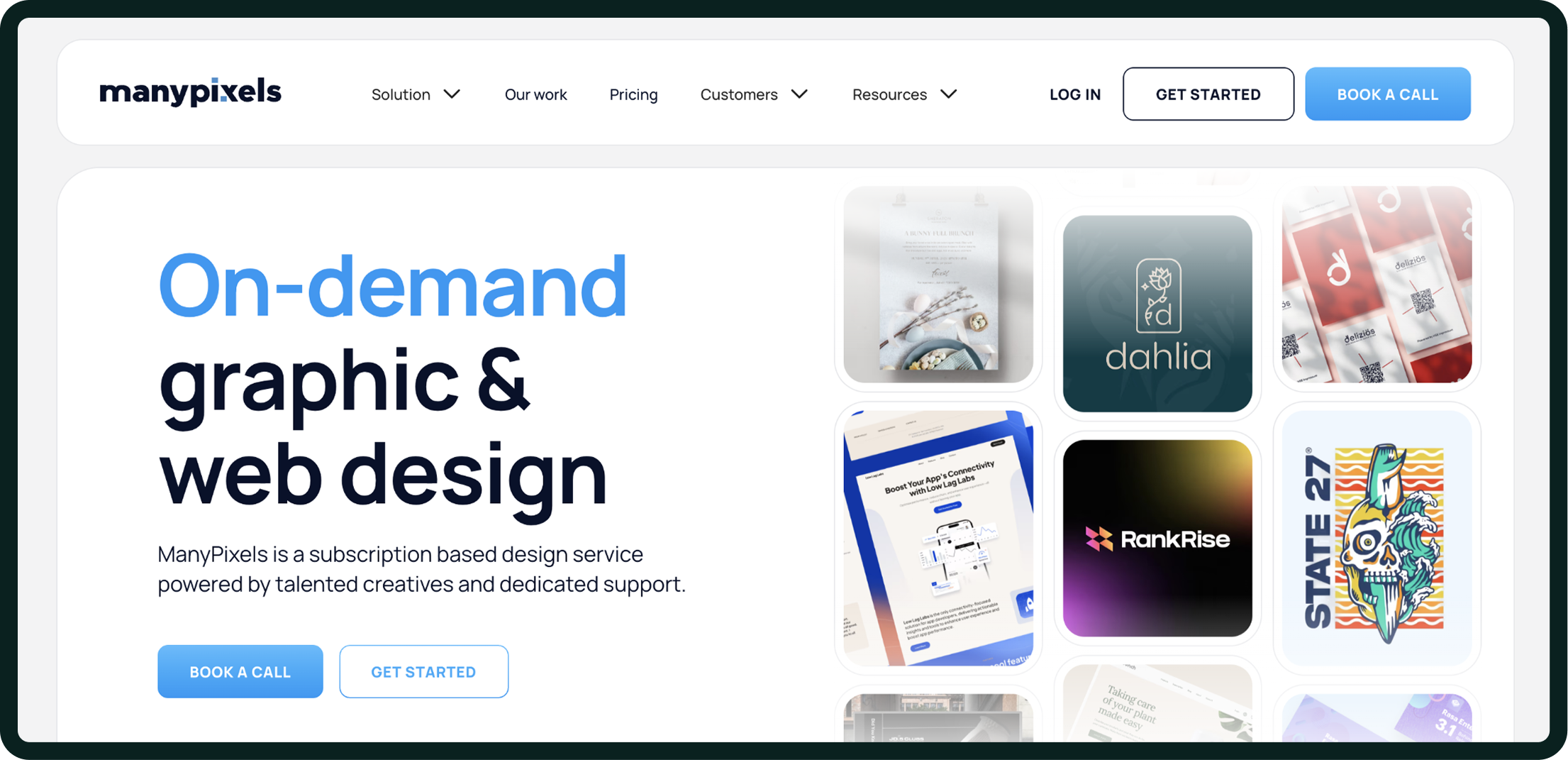
ManyPixels sells a set amount of work per day rather than a vague promise of unlimited work. Every plan includes a project manager, source files and full copyright, and quiet months can be paused for $10.
- Services: Graphic design, web page design, illustration, presentations; motion on higher tiers
- Pricing: Advanced $699 a month, Business $1,199, Assigned Designer $1,399, Design Team $2,599, about 10% off quarterly. Year one at entry is roughly $8,400.
- What reviewers say: 4.9/5 on G2 from a small sample and 4.8/5 on Trustpilot from around 149. Praise for speed to first draft, the portal and reliability for the price.
- Best for: Small teams and agencies wanting reliable, affordable output on published pricing. If price is your only complaint about Superside, start here.
- Trade-off: No creative director at any tier, and the $699 plan equates to roughly two hours of design a day.
8. Flocksy: Best for Design, Copy and Video Together
.png)
More kinds of work in one subscription than almost anything else here, with one permanent person assigned to each. Unused hours roll forward for 30 days.
- Services: Graphic design, video, motion, illustration, copywriting, web development, virtual assistant tasks
- Pricing: $1,699 a month for two daily hours, up to $5,899 for eight. Near $1,199 billed annually. 14-day money-back guarantee.
- What reviewers say: 4.9/5 on G2 from around 41 reviews. Praise for working with the same people each time and transparent workflow; no recurring criticism in the available base.
- Best for: Small to mid-sized teams tired of coordinating separate vendors.
- Trade-off: Covering six kinds of work means rarely leading in any one, and an art director only appears from six daily hours.
9. Growmodo: Best for Design and Web Development
Creative work paired with real web development behind a dedicated project manager, delivered white label. Talent is matched per project.
- Services: Graphic design, web design and development, landing pages, email assets
- Pricing: Not published. Scoped on a call, and you are not charged until onboarding completes.
- What reviewers say: 4.8/5 on Trustpilot from around 87 reviews. Praise for fast, responsive development and daily PM updates; one recurring note is an initial learning curve on how scope works.
- Best for: Agencies and teams that need pages built, not just designed. We do not code, so if that is your gap I would point you here.
- Trade-off: No published price, no trial, no guarantee of the same people.
10. Bricx: Best for B2B SaaS Product and Web UX
A design studio working only with B2B and AI SaaS companies on brand, website, product design, no-code build, 3D and motion. It has shipped with 50+ SaaS companies including Writesonic, Sybill and Camb.ai.
- Pricing: Not published. Custom retainers scoped against the project.
- Best for: SaaS teams with a defined, design-led initiative such as a rebrand, site rebuild or product redesign.
- Trade-off: A project partner, not ongoing capacity. Cost predictability depends on how the scope is negotiated.
11. Designjoy: Best for Variable Workloads
Founder Brett Williams working alone, one request at a time, roughly 48-hour turnaround. Pause whenever you have no work and carry unused days forward.
- Pricing: $4,995 a month, pause or cancel any time.
- Best for: Solo founders and lean teams with unpredictable demand.
- Trade-off: One active request, no motion or animation, and everything depends on one person's calendar.
12. Hiring In-House: The Implicit Alternative
Every subscription on this list competes with hiring, ours included. Superside's Flex floor of roughly $192,000 in year one is more than two senior designers fully loaded. You gain total control and someone in your meetings; you take on recruiting, management and the risk of one person leaving.
- Pricing: Estimate only. Salary, benefits, software and management overhead commonly lands between $80,000 and $195,000 a year per designer.
- Best for: Teams with enough steady work to keep people busy every day for a year.
- Trade-off: One person covers one skill set, so motion, web and brand work still go outside.
How to Choose Before You Commit
These are the six questions I ask when someone is weighing us against the rest of this list. They will shortlist this page to two or three.
- How much parallel work do you run? Two or three concurrent projects point to a queue. Eight or ten point to a dedicated team or Superside.
- Do you need execution or creative leadership? If briefs are specific and someone internally owns the brand, do not pay for direction. If briefs keep coming back wrong, direction is what you are missing.
- Do you need the same designers each month? If you are re-explaining your brand every month, the model is the problem.
- How much does month-to-month flexibility matter? For smaller and mid-market teams this can decide it. A twelve-month commitment at $15,000 is a different decision from $3,000 you can end in fifteen days.
- Are you creating new campaigns or resizing existing ones? Resizing at volume is a job for software. New ideas need people.
- Do you need web, video or copy as well as design? Most subscriptions gate one of these behind a higher tier. Find that line before comparing headline prices.
Switching From Superside Without Losing Momentum
If you are already on Superside, do not start the handoff the week your contract ends. Treat it the way you would treat replacing an internal creative team, because that is what it is.
1. Check your renewal and notice terms first. Your Service Agreement governs the commercial terms and overrides Superside's public terms wherever they conflict. Confirm the renewal date, notice period and remaining budget before committing elsewhere. Admins can see all of it in Superspace under Account and Plan.
2. Close or approve what is still in production. List every open project and decide which Superside should finish and which the new team picks up. Superside shares the remaining working files once an asset is approved and the project closes, so chase approvals before the handoff, not after.
3. Export the files the next team will need. Ask for source files, not just final JPGs and PDFs. Superside lets you take all working files at project close, including Figma sources, design tokens and research artefacts on product work. Get them while the account is live.
4. Hand over the brand context, not only the brand guide. Give the incoming team recent approved work, recent rejected work, templates, component libraries and examples of the requests that come up every month. That cuts the relearning period far more than a logo folder does.
5. Run both for one or two real projects. Send the incoming team ordinary work from your backlog while Superside is still active. That is when you find the missing file, the unwritten brand rule and the workflow gap, while the old team is still there to fill them.
The goal is not a clean break on one date. It is a new team that is already productive before the old workflow stops.
Which Superside Alternative Is Right for You?
- You want a dedicated team without an annual commitment: Teamtown
- You adapt one master creative across hundreds of placements: Rocketium AI Studio
- You need a Creative Director owning the brand: Designity
- You want routine production volume on a queue: Design Pickle or Penji
- You want the lowest cost for steady output: ManyPixels
- You need design, copy and video from one vendor: Flocksy
- Video is the main thing you are short of: Kimp
- You need pages built, not just designed: Growmodo
- You have one defined SaaS product or web project: Bricx
- Your demand swings and you want to pause: Designjoy
- Your budget is enterprise-sized and the work never stops: Superside
Ready to Switch From Superside?
If Superside's model fits you, I doubt this article has changed your mind, and it should not have. If it does not, you are not choosing between twelve services. You are deciding whether you need enterprise-size output across many kinds of work, or a smaller team that knows your brand and stays on it.
We built Teamtown for the second case. A Creative Lead who owns how the work looks, a Project Manager who owns when it lands, and designers who do not rotate off, from $3,000 a month with fifteen days' notice to leave. A full year on our Essentials plan costs about the same as 2.25 months at Superside's current subscription floor.
Book a demo with Teamtown. All plans include a 15-day money-back guarantee.
Frequently Asked Questions About Superside Alternatives
How much does Superside cost in 2026?
Subscriptions start at a $15,000 monthly minimum on an annual term, plus a $1,000 monthly software fee, so year one commits roughly $192,000. A Dedicated AI-Native Team starts at $30,000 a month. Unused Flex budget rolls over for three months, and Project Boosters add short-term budget from $15,000. That $192,000 is the subscription commitment, not the cost of one project; Superside also sells one-off projects outside it.
What are the best Superside alternatives for high-volume design?
"High volume" can mean three different things, and the answer depends on which one you mean.
- Lots of versions of one design (a finished ad in fifty sizes for ten platforms): Rocketium AI Studio, which charges per finished file and checks each against your brand rules and platform requirements
- Lots of new designs that all need to stay on-brand: Teamtown, with a Creative Lead holding the brand and the same designers every month, or Designity with a Creative Director at a higher price
- Lots of simple, repeatable requests: Design Pickle and Penji are built for it, and ManyPixels does the same for less
What is the best Superside alternative for web design and SaaS teams?
It depends whether you need pages designed or software built.
- A marketing website designed (landing pages, a redesign, ongoing updates): Teamtown, inside the same subscription as your ads and social, with Webflow and Framer builds included. We do not build web apps, code your product, or run user research.
- Something coded (a web app, dashboard or customer portal): Growmodo, which pairs design with development under one subscription
- One big project (a product redesign or new site from scratch): Bricx, a studio that prices the whole job rather than selling monthly hours
- Enterprise product design at volume (UX, prototyping, design systems across many teams): Superside still covers more of this under one contract
What is the best Superside alternative for video production?
It depends on how much video you need and what else sits around it.
- Kimp for affordable recurring video alongside static work, sold as its own $1,397 subscription or bundled with graphics at $1,697
- Flocksy when video editing is one part of a broader design, copy and web subscription
- Teamtown where motion graphics and video editing are part of an ongoing marketing-design relationship, with the heavier video work on our Pro and Studio tiers
- Superside for enterprise-size video, motion and 3D production under one contract
What is the best Superside alternative for mid-market teams?
I would say Teamtown, though it is my company so weigh that accordingly. It suits teams wanting a dedicated recurring creative team without an annual enterprise commitment. Year one is roughly $36,000 against Superside's $192,000 floor, with 15 days' notice to leave.