Quick Answer
Of the 99designs competitors worth considering, Teamtown is the strongest if you regularly need design work. You get the same team every month, a Project Manager, a Creative Lead and designers, from $3,000 a month. ManyPixels is the budget subscription pick at $699 a month, and Superside covers enterprise volume. If you only need one logo, DesignCrowd and Crowdspring run the same contest format at a lower entry price. For reference, 99designs charges $249 to $1,050 for a logo contest and up to $2,499 for web design.
Key Takeaways
- 99designs runs on contests, priced per project. You post a brief and a prize, dozens of designers submit concepts, and you pay whoever you pick. A logo contest runs $249 (Bronze) to $1,050 (Platinum), and web design runs $599 to $2,499.
- Contests don’t work for all jobs. Dozens of designers enter, so you see a wide spread of concepts. But most go unpaid, and some entries are rushed. That works for a one-off logo, where choosing between 30 takes is worth paying for. It is a bad deal for the design you need every week, or for app and product work that needs several rounds or revisions.
- Alternatives to 99designs fall into four camps: design subscriptions (Teamtown, Design Pickle, ManyPixels, Penji, Kimp, Flocksy, Designity, Superside), contest platforms (DesignCrowd, Crowdspring, Designhill), freelance marketplaces (Toptal, Fiverr Pro, Upwork), and DIY tools (Looka).
- For work that never stops, Teamtown is the strongest option. One subscription covers ad creative, social, presentations, brand identity, web design, motion and video, handled by the same Project Manager, Creative Lead and designers every month. From $3,000, with nothing annual to sign and 15 days to change your mind. Book a demo and see it in action.
Plenty of people arrive here having already run a contest. You got your logo, then the next thing came up, and the next, and you realized you were relaunching a contest every time you needed a social graphic.
Others are still deciding whether to run one at all. Both questions have the same answer underneath, which is that a contest has a start and an end. That is fine when the job does too. But marketing design never ends.
What follows are the 15 strongest 99design alternatives, split by the job you actually need doing, with current pricing for each. Teamtown is first, and it is my company, so weigh that entry accordingly.
99designs Competitors at a Glance (2026)
All figures checked in September 2026.
What Sends Buyers Looking Beyond 99designs
99designs still does one thing better than almost anyone: put a lot of different options in front of you for a fixed price.
That said, these four things push teams to look elsewhere:
- Per-project pricing does not scale. A $249 logo is good value once. Running a contest for every ad set, deck and email costs more than a subscription within a couple of months, and each one restarts the briefing from zero.
- Continuity is optional. The contest ends once the work is delivered. You can rehire the winner through a one-to-one project, but that is a separate decision and a separate cost, and if they are unavailable, the next brief starts with someone who has never seen your guidelines.
- Quality varies by tier and by entry. The cheaper packages attract more junior designers, and since nobody gets paid unless they win, some entries are rushed or reused from other contests.
- Contests do not fit iterative or technical work. UI, product and complex web design need back-and-forth with one designer. 99designs has a direct-hire track for this, but the platform’s strength is branding contests.
My Evaluation Criteria
I have sat across from a lot of buyers leaving contest platforms, and they arrive with the same question in different words: how do I stop starting over?
Here is how I weigh the options.
The first question is not what something costs, it is how often you need design. If it is one brand project, a contest is the cheapest answer. If you need weekly design work, then paying per project will eat your budget.
After that I look at four things:
- What it really costs once you add upgrades, platform fees and the hours spent briefing someone new, rather than the price on the pricing page.
- Whether the same people stay on your brand or you get whoever is free that week.
- Whether the promised turnaround holds up once you are a paying client.
- What the service actually covers, because a logo platform won't make your motion graphics.
Star ratings tell you very little on their own, so I read the written reviews and look for recurring complaints.
What 99designs Users Have Said
99designs holds a 4.2/5 star rating on Trustpilot from more than 1,560 reviews. Users like getting multiple options for a price they knew upfront. For a logo or a book cover, that is a good deal.
The negative reviews cover a range of things, from deliverables and support to platform rules and account problems. One recurring criticism is originality, including concerns about AI-generated and reused work.
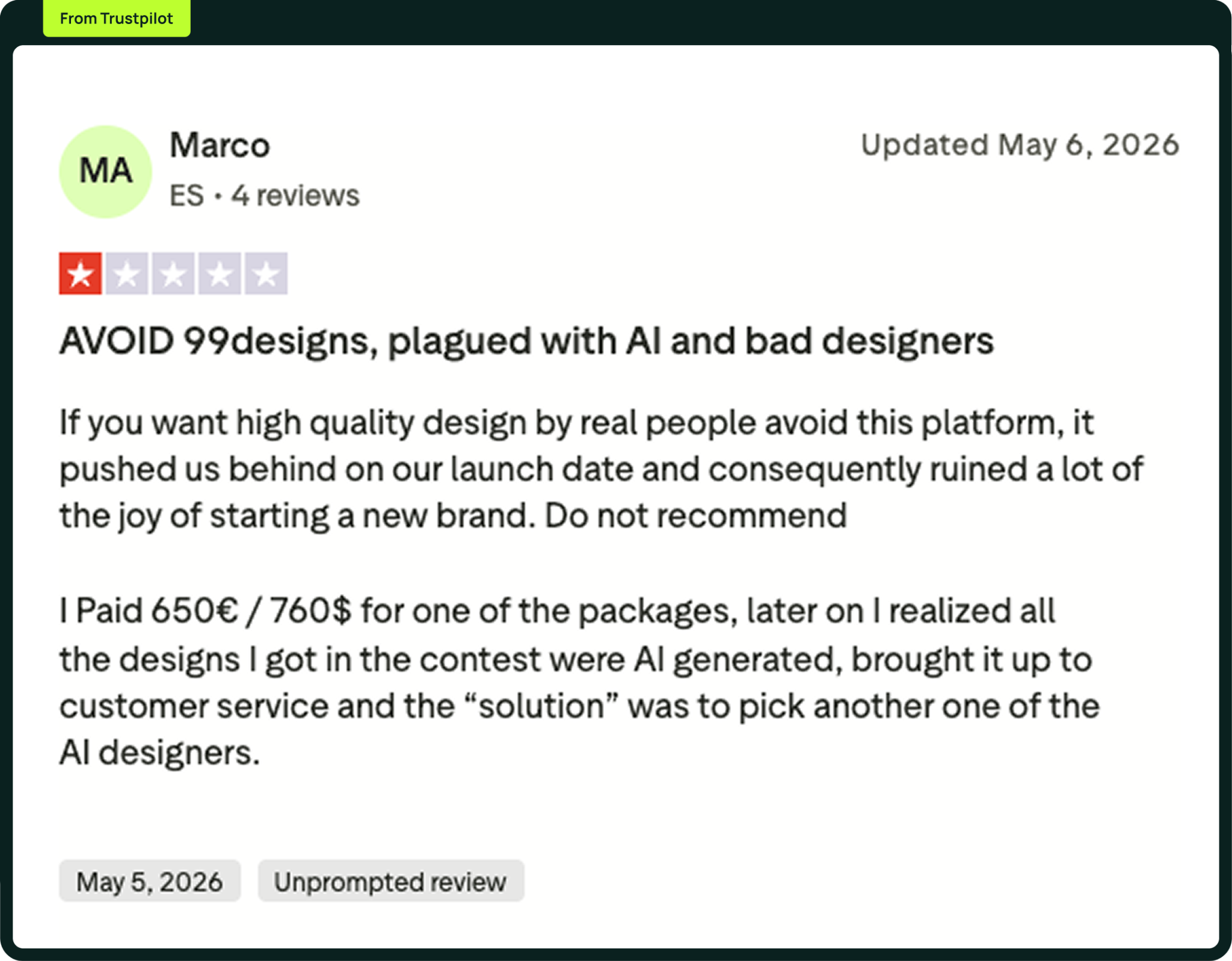
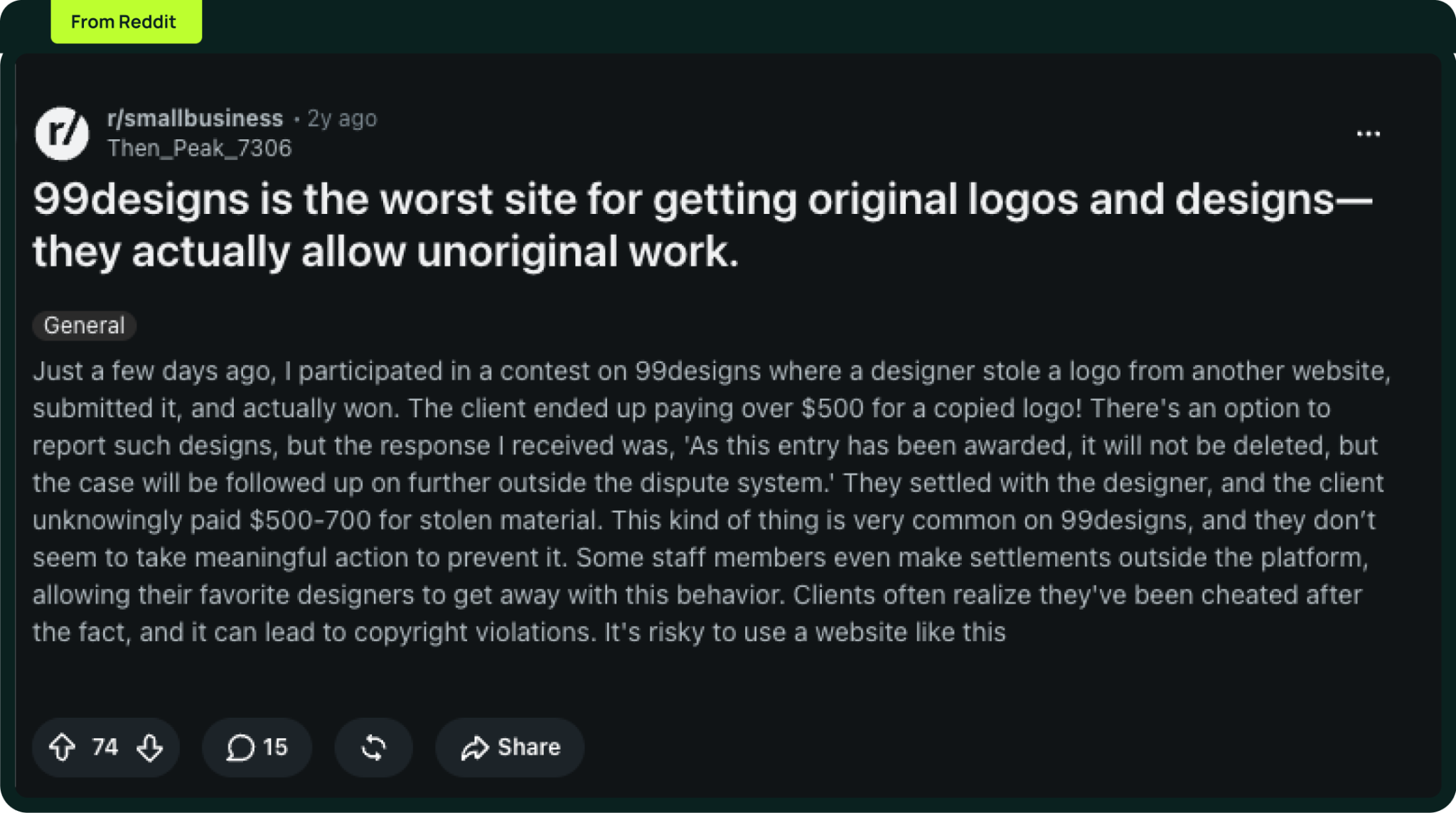
I wouldn't consider these reviews evidence of how all contests generally run. But it does show one thing: when dozens of people race to submit concepts quickly with no guaranteed pay, they might end up cutting corners.
The 15 Best 99designs Competitors & Alternatives
1. Teamtown: Best Overall for Ongoing Design
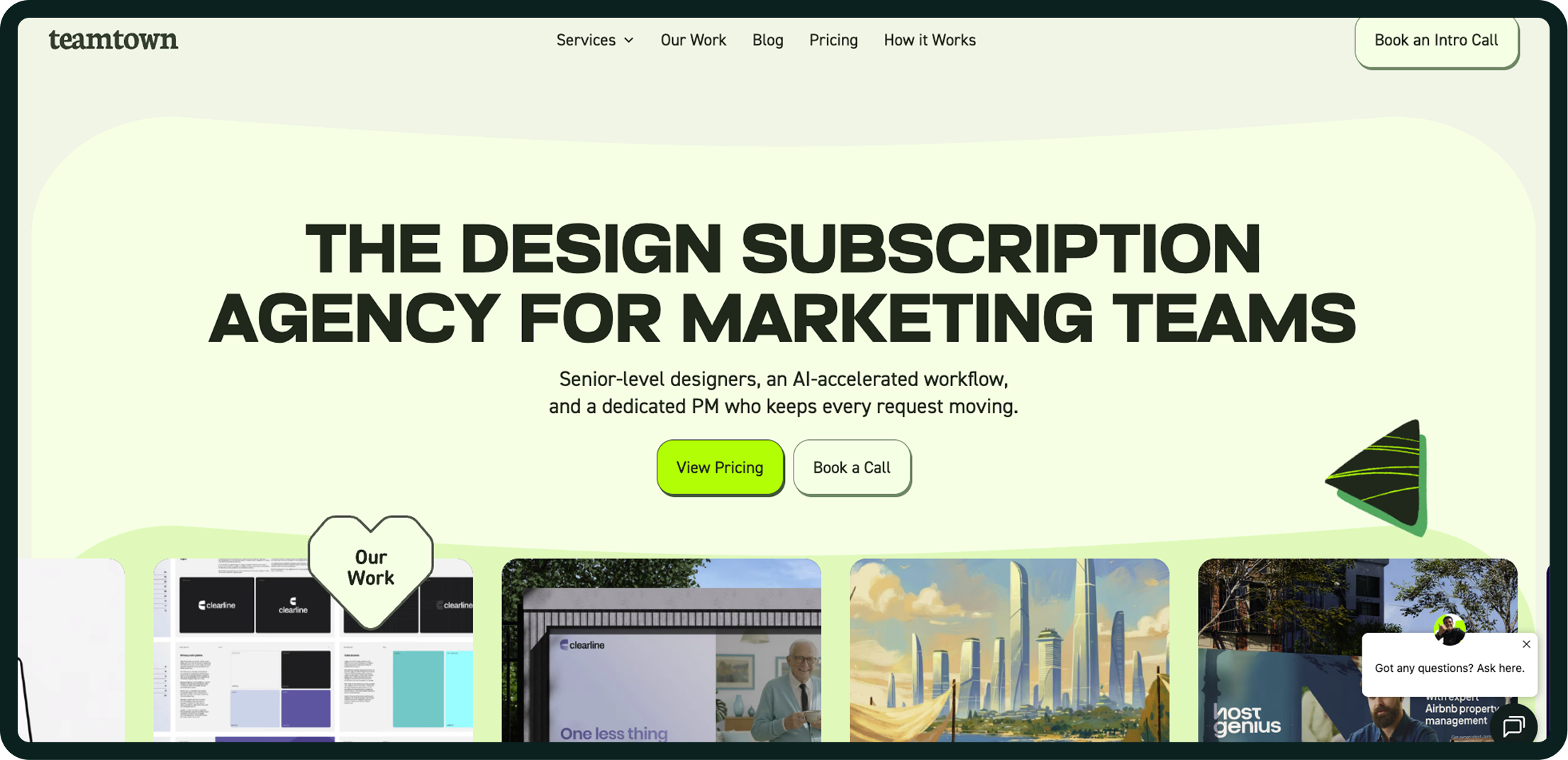
Disclaimer: You are reading this on the Teamtown blog, and I run the company, so use your judgment. The reasoning still stands.
A contest gives you one deliverable from a stranger. Teamtown gives you people who stay. A Creative Lead owning how the work looks, a Project Manager owning when it lands, and designers who are still on your account next quarter.
That is the whole difference. No re-briefing, no starting over, no hoping the winning designer is still available in March. Pricing is transparent and month-to-month from $3,000, so you pay for monthly capacity rather than individual projects.
Ad creative, social, web design, branding, motion and video all run through the same subscription, along with brand identity and web design when you need them. Not all of it sits in the entry tier, though: Essentials handles core design work, while heavier motion, video and web builds live on Pro and Studio.
We have delivered 5,000+ projects across 200+ customers with a 90% first-draft approval rate.
- Best for: Marketing teams that have outgrown running a contest for every request.
- Pricing: Three tiers: Essentials at $3,000, Pro at $4,500 and Studio at $9,900 per month. Nothing is annual, and you can cancel with 15 days’ notice.
- Turnaround: 24 to 48 hours on most requests, longer for anything more complex.
- Rating: 4.6/5 on Trustpilot. What comes up most is having the same faces each month and being able to dial capacity up or down.
- Trade-off: If you need one logo and nothing else, a contest platform will cost you less.
Most teams come to us after the third or fourth contest, once it is clear the work is not going to stop. If that sounds like you, we will look at what you are producing now and show you what the same workload costs with one team handling it.
2. Superside: Best When the Budget Is Enterprise-Sized
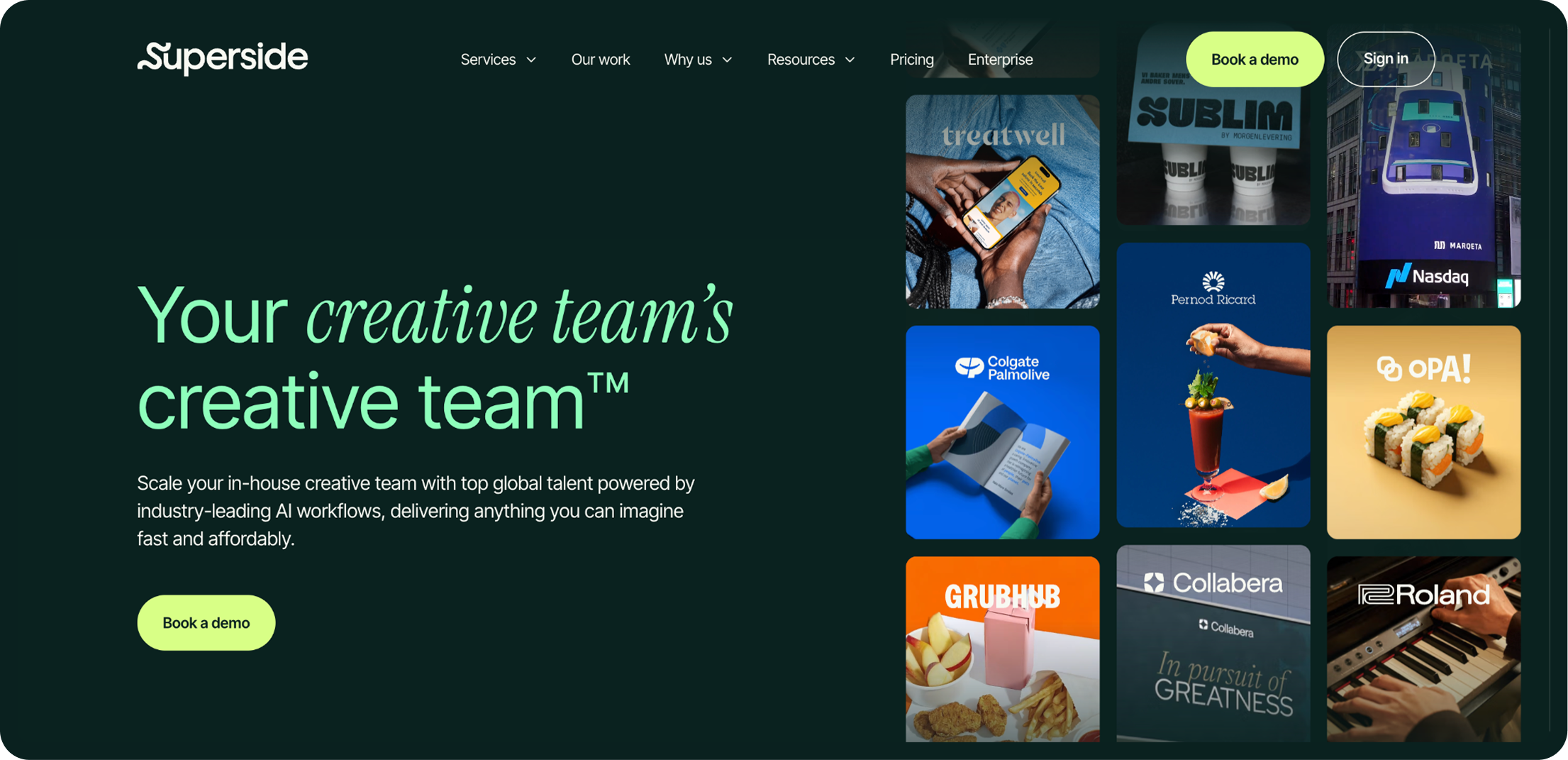
Superside is for companies buying more than just a logo. You get designers, project managers and creative directors working together on full campaigns, and the price reflects that.
- Best for: Big marketing teams running campaigns across many channels all year round.
- Pricing: A $15,000 monthly floor on an annual term, with a further $1,000 a month for platform access.
- Rating: 4.5/5 on G2, with the strongest marks going to execution quality.
- Trade-off: The minimum annual commitment works out to roughly $192,000, which rules it out for most companies leaving a contest platform.
3. Designity: Best When You Need a Creative Director, Not Just Output
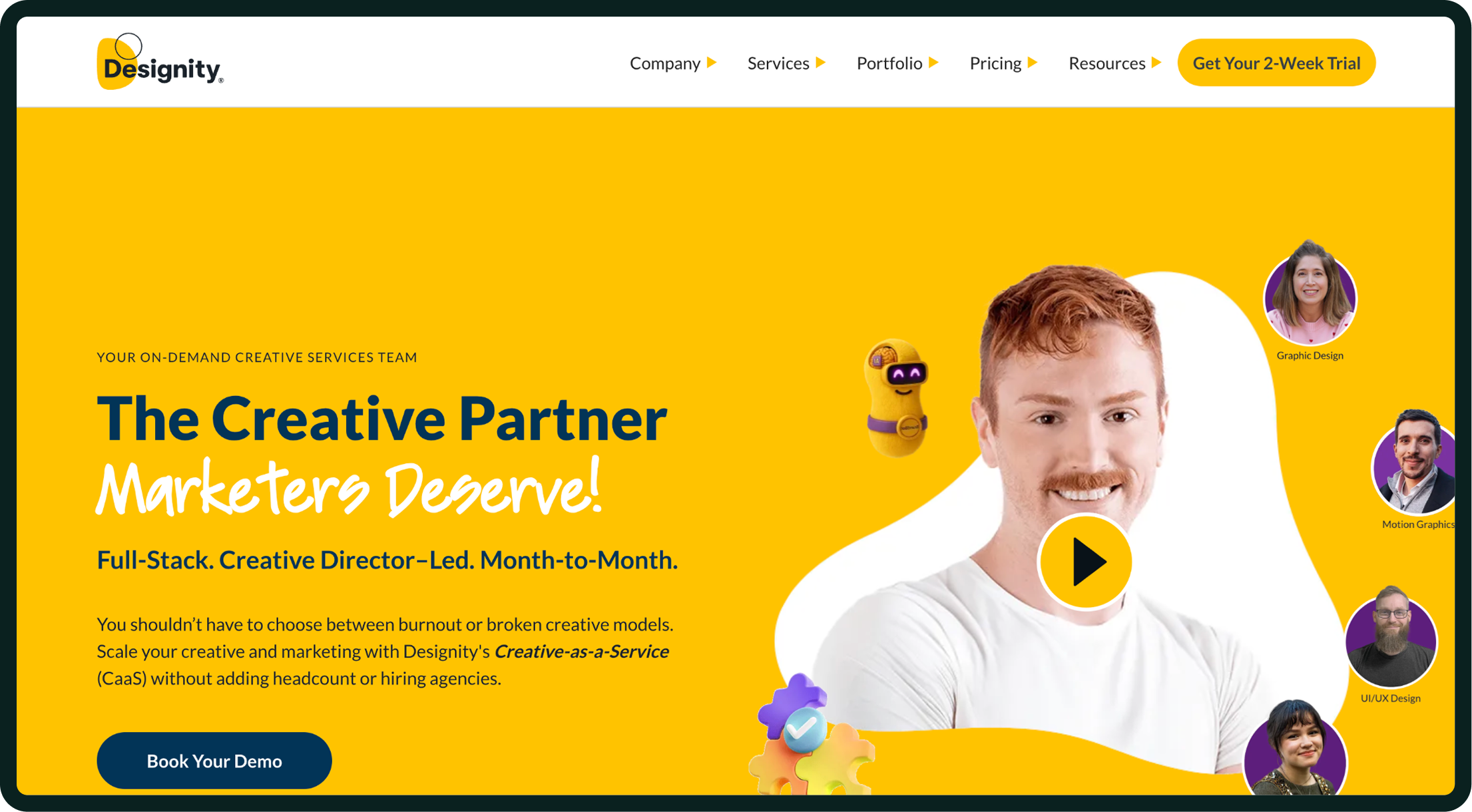
Designity answers the complaint that a contest gives you pixels but no direction. A named Creative Director stays on the account, sets the direction, and assigns the right specialist to each brief. There is a two-week window to try it before you commit.
- Best for: Companies rebuilding a brand who want someone accountable for how it hangs together.
- Pricing: The Plus tier opens at roughly $5,995 a month and carries 120 dedicated hours, with no annual tie-in.
- Rating: 4.7/5 on G2, where the director relationship is what most reviewers highlight.
- Trade-off: You are paying for judgment. If you only need assets produced, cheaper options do that job.
4. Design Pickle: Best for High-Volume Production
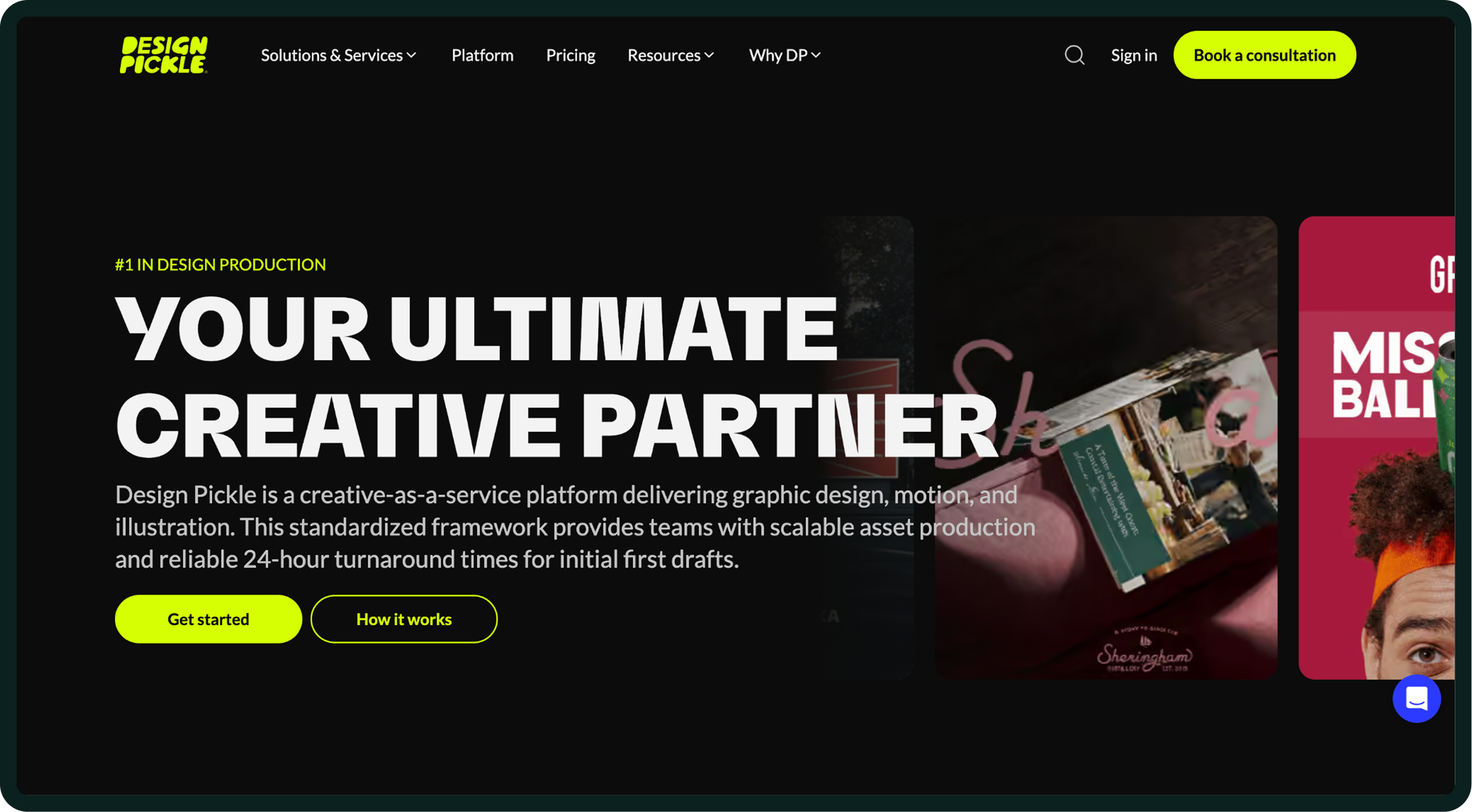
Design Pickle was among the first services to sell design as a monthly product, and the queue format still works for teams pushing out routine assets at volume. One caveat before you shortlist it: the published price list is gone, so the number now comes up on a sales call.
- Best for: Predictable weekly output such as ad variants, social sets and deck updates.
- Pricing: Scoped on a call and billed quarterly or annually. For context, the rates it last published in February 2025 ranged from $1,349 to $2,049 a month.
- Rating: 4.4/5 on G2, though its Trustpilot score sits a good deal lower at 3.4/5.
- Trade-off: Creative direction is not included by default at lower tiers. Art Director support is an add-on until you reach the higher daily-hour plans.
5. ManyPixels: Best Budget Subscription
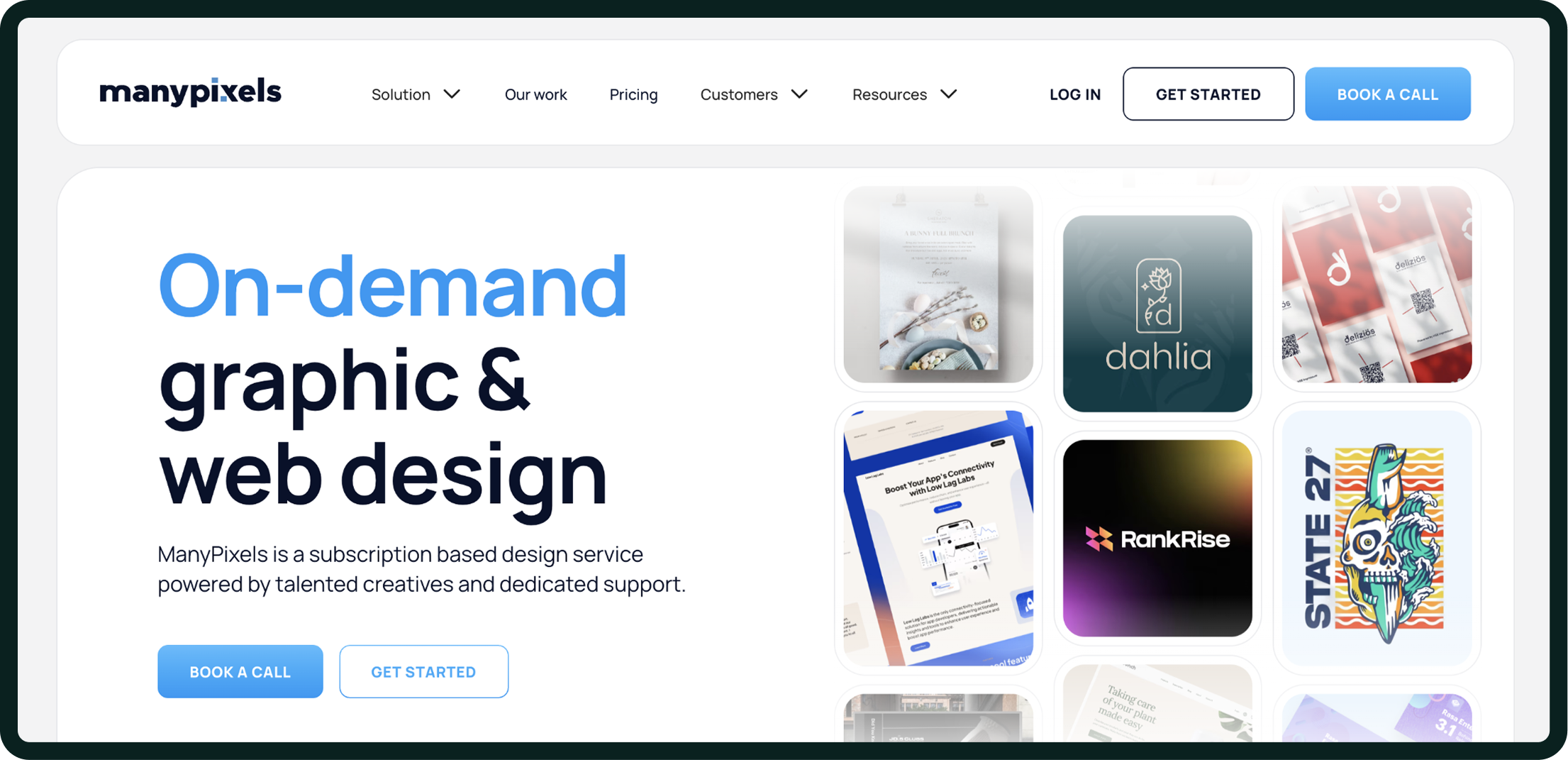
ManyPixels is one of the lower-cost subscriptions on this list. What stands out is how much is in the entry tier: web design, illustration and presentation work are all included rather than reserved for upgrades, and a project manager plus a quality reviewer are attached to every plan.
- Best for: Lean marketing teams and agencies making the jump from one-off briefs to a monthly rhythm.
- Pricing: Starts at $699 a month, and a $10 pause option means you keep the account without paying full freight in quiet months.
- Rating: 4.9/5 on G2. Steadiness of output is the most recurring theme.
- Trade-off: The entry plan works on one project at a time, so two urgent jobs on the same day will wait their turn.
6. Penji: Best Art-Director-Managed Graphics
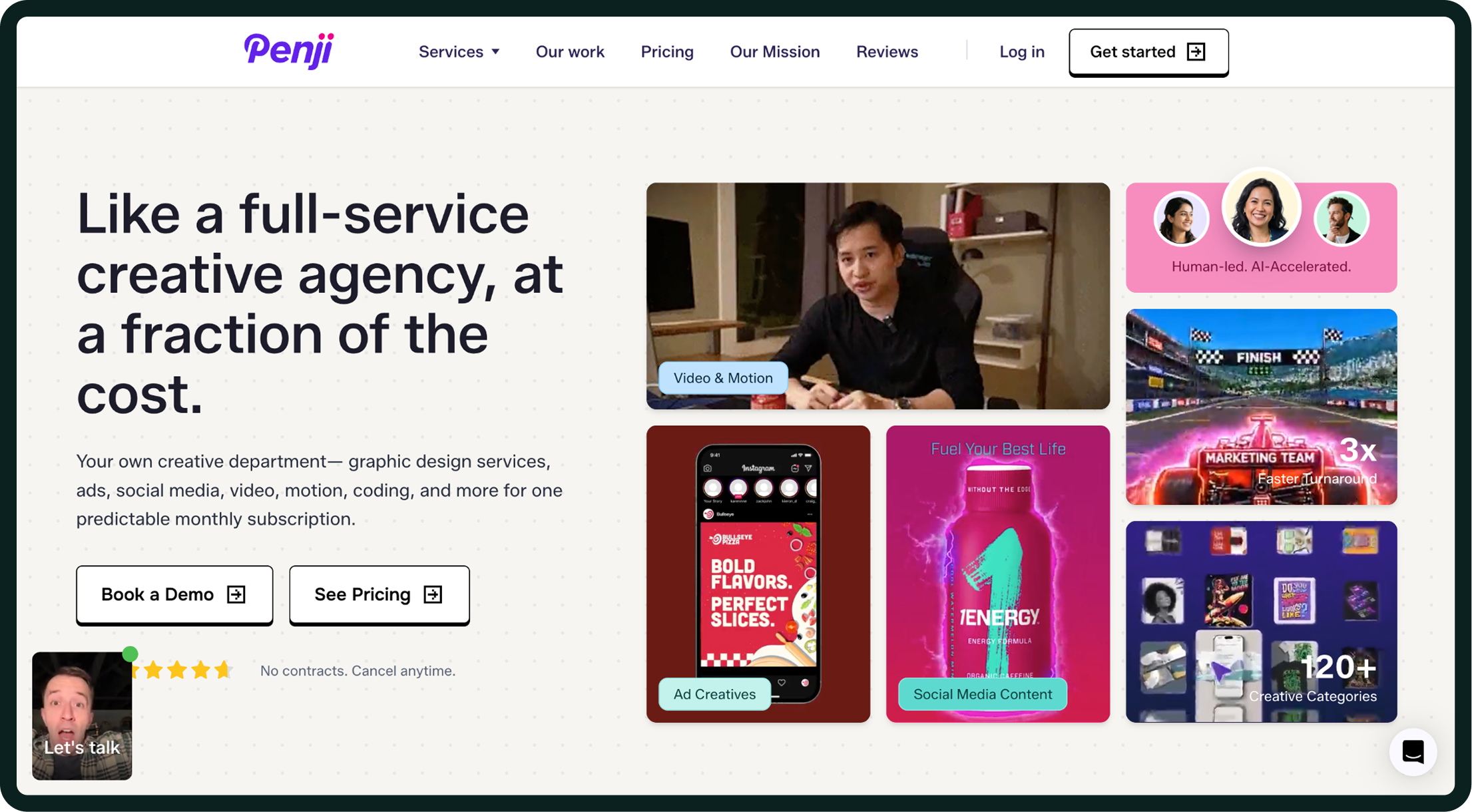
Penji rebuilt its plans in 2026, and the low entry point didn't survive. Entry is now Essentials at $995 a month, covering branding, email, print and packaging, presentations, illustrations and infographics, with two jobs moving at once.
- Best for: Steady ad, brand and print output at a fixed monthly cost.
- Pricing: Essentials runs $995 a month. Agency Partner at $1,995 adds web, motion and video.
- Rating: 4.7/5 on G2, and it has the deepest review pool of any subscription here.
- Trade-off: Web, motion and video are not available on Essentials, so those needs push you to the $1,995 tier.
7. Kimp: Best for Design Plus Video
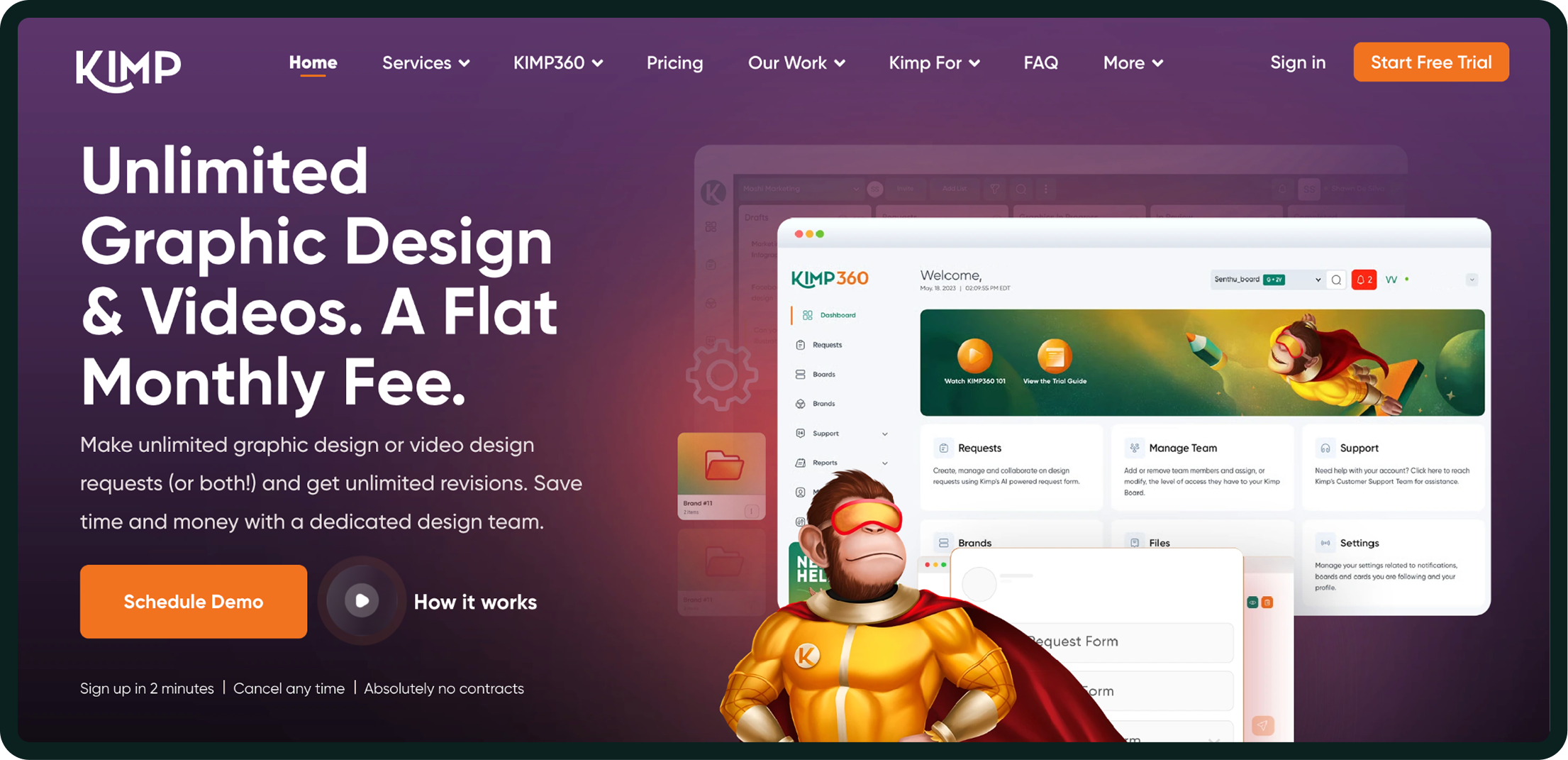
Kimp is worth a look if you are currently buying stills in one place and motion somewhere else. It puts graphic design and video editing on the same subscription, with three jobs running at once on the graphics plan. A 7-day trial means you can judge the output before paying.
- Best for: Social calendars that need stills and short-form video produced on the same brief.
- Pricing: Standard rates are $1,397 for Graphics, $1,397 for Video and $1,697 for Graphics plus Video, with 50% off the first four months. The widely advertised $699 is the introductory Graphics price, not the combined plan.
- Rating: 4.9/5 on Trustpilot. G2 puts it lower at 4.1/5, though from a much thinner sample.
- Trade-off: Budget against the standard rate rather than the introductory one, and note that design plus video is the $1,697 plan.
8. Flocksy: Best Multi-Discipline Subscription
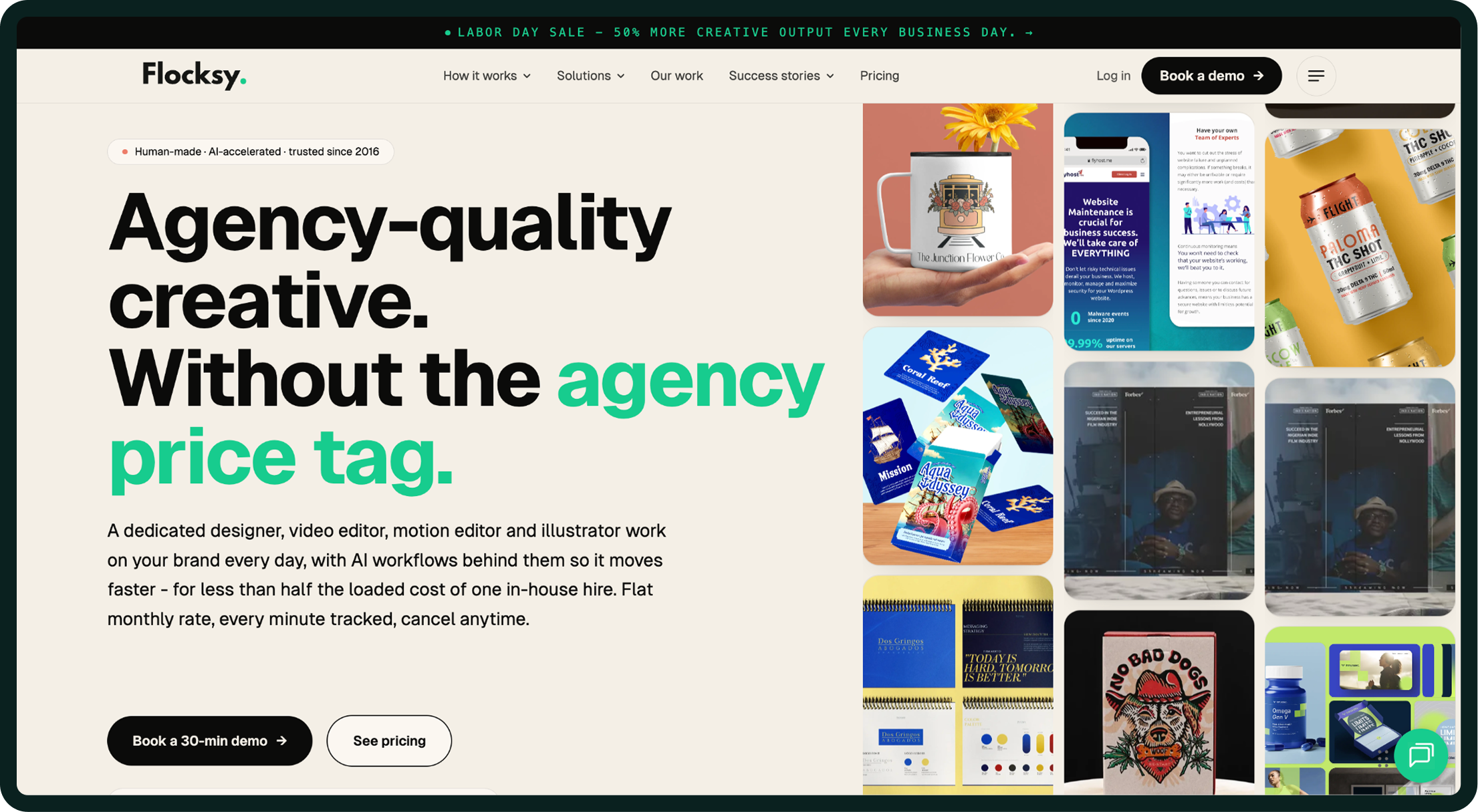
Flocksy covers the most ground. One plan gets you design, video, motion, illustration, copy and light web work, and you buy a set number of hours per day to spend across all of it. If it disappoints, there is a 14-day refund.
- Best for: Founders and small teams who would otherwise juggle three separate suppliers.
- Pricing: Paying monthly costs $1,699. Committing quarterly brings it near $1,399, and annually near $1,199.
- Rating: 4.9/5 on G2, where working with the same faces each time is the common praise.
- Trade-off: Covering six disciplines means rarely leading in any one, and your daily hours set a hard ceiling.
9. DesignCrowd: The Closest Swap if You Like Contests
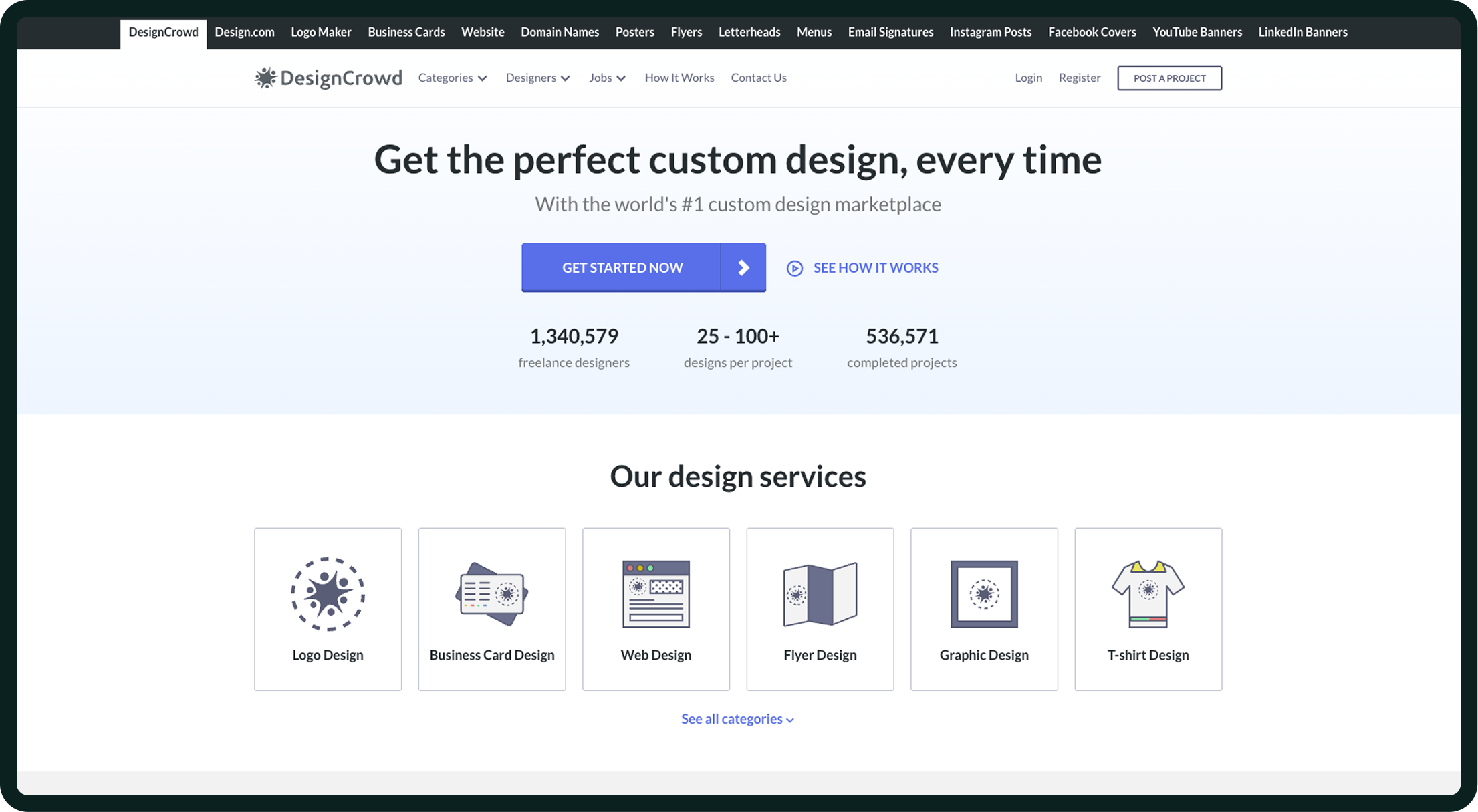
DesignCrowd is the platform most similar to 99designs, running the same contest model since 2007. It has a large pool of designers, gives you more time to run a contest, and will refund you if nothing works out.
- Best for: Buyers who want the contest format at a lower entry price.
- Pricing: Advertised from around $99, but read the total carefully: a posting fee of up to $129, a 4% transaction fee, and a 20% project-management fee on packages of $200 or more.
- Rating: 4.5/5 on Trustpilot. Reviewers highlight the easy process, fast support, and designers who get the brief right the first time.
- Trade-off: Add-on fees can push the real total well past the advertised price, and it carries the same drawbacks of contest platforms: most entrants work unpaid, and you have to arrange continuity after delivery.
10. Crowdspring: Contests With a Guarantee
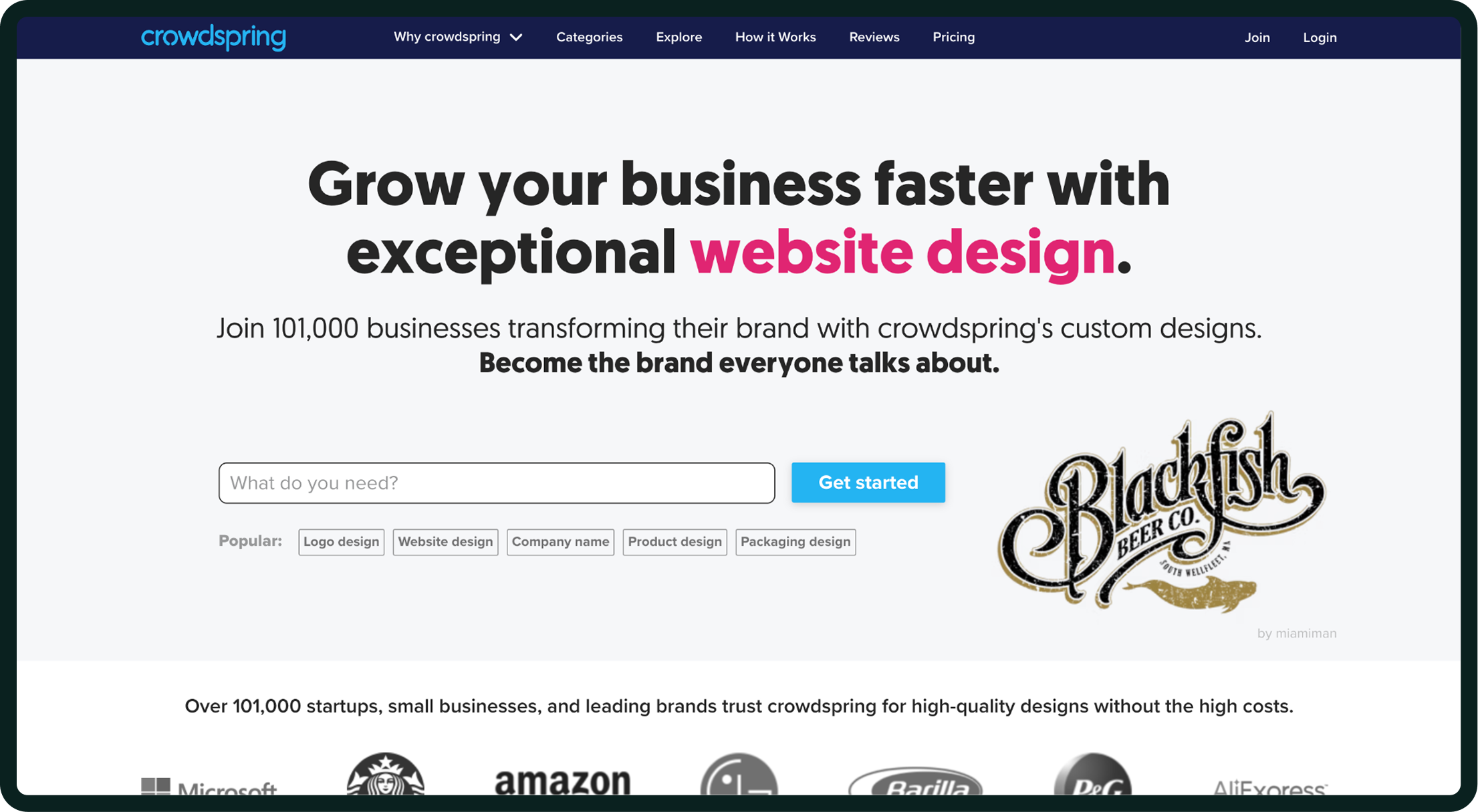
Crowdspring is a long-running contest marketplace covering logos, web design, product design and business naming. Projects include a custom copyright agreement, and its design guarantee covers Silver, Gold and Platinum projects. Naming projects carry separate conditions, and you waive the right to a refund if you assure a project.
- Best for: One-off brand projects where you want contest variety with a safety net.
- Pricing: From around $299 per project, with premium projects starting near $1,249.
- Rating: 1.5/5 on Trustpilot, the lowest here. Most recent criticism comes from designers reporting unpaid earnings.
- Trade-off: Entry pricing is close to 99designs, so the savings are smaller than with DesignCrowd. Recent reviews are also a concern.
11. Designhill: Contests Across a Wider Set of Categories
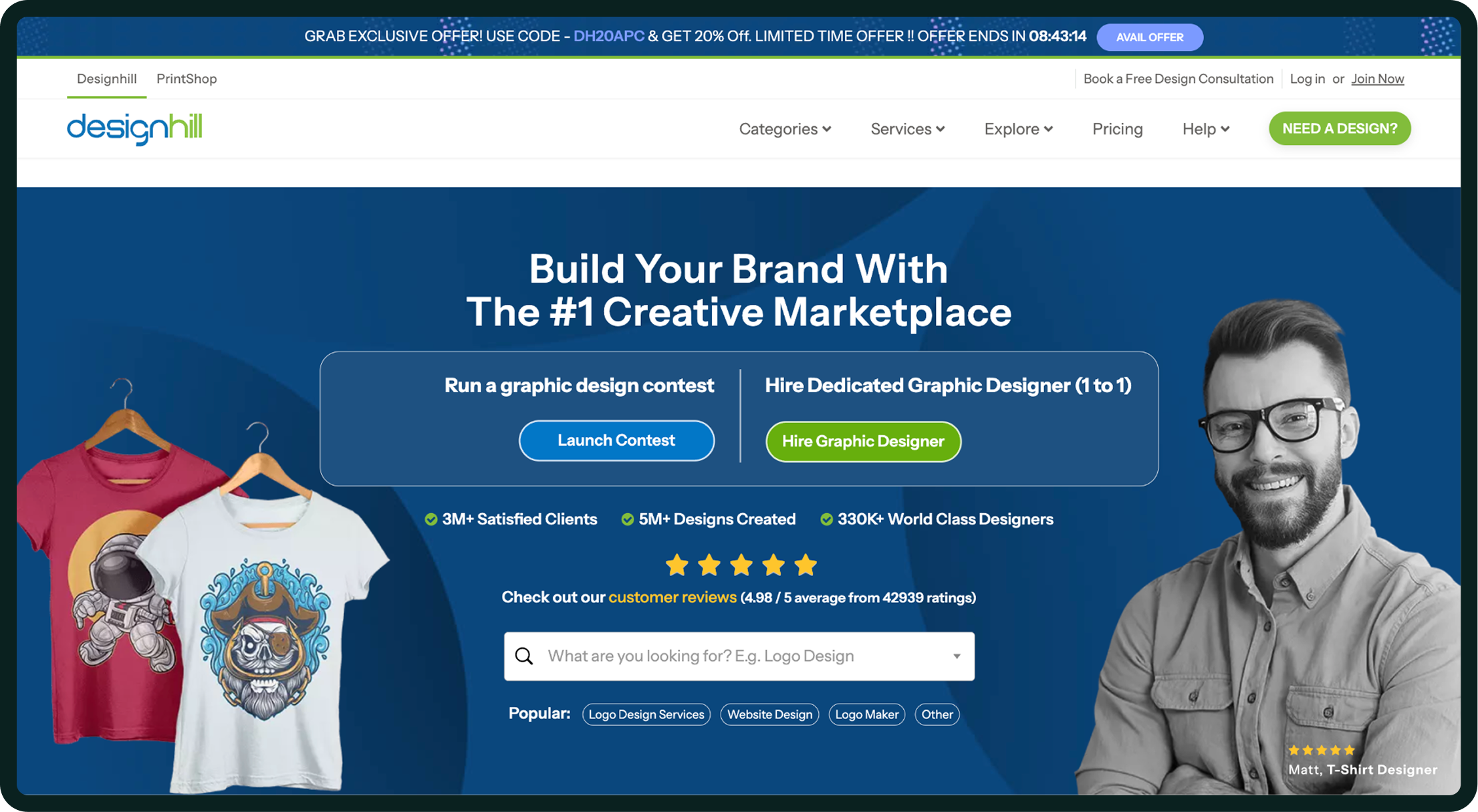
Designhill runs contests across logos, brand identity, websites and apps, packaging, advertising, social and illustration. Packages are tiered by how many concepts you receive and how experienced the entrants are. Higher tiers include promotion to attract stronger designers.
- Best for: Buyers who want contest variety across more categories than logos alone.
- Pricing: Logo contests roughly $249 to $999 depending on concepts and designer level.
- Rating: 4.5/5 on Trustpilot. Buyers like the range of concepts and the value per tier. The common complaint is slow responses when something goes wrong.
- Trade-off: It is still a contest platform, so the same limits apply: most entrants are unpaid, quality varies between entries, and nothing carries over to your next brief.
12. Toptal: Best for Elite Vetted Freelancers
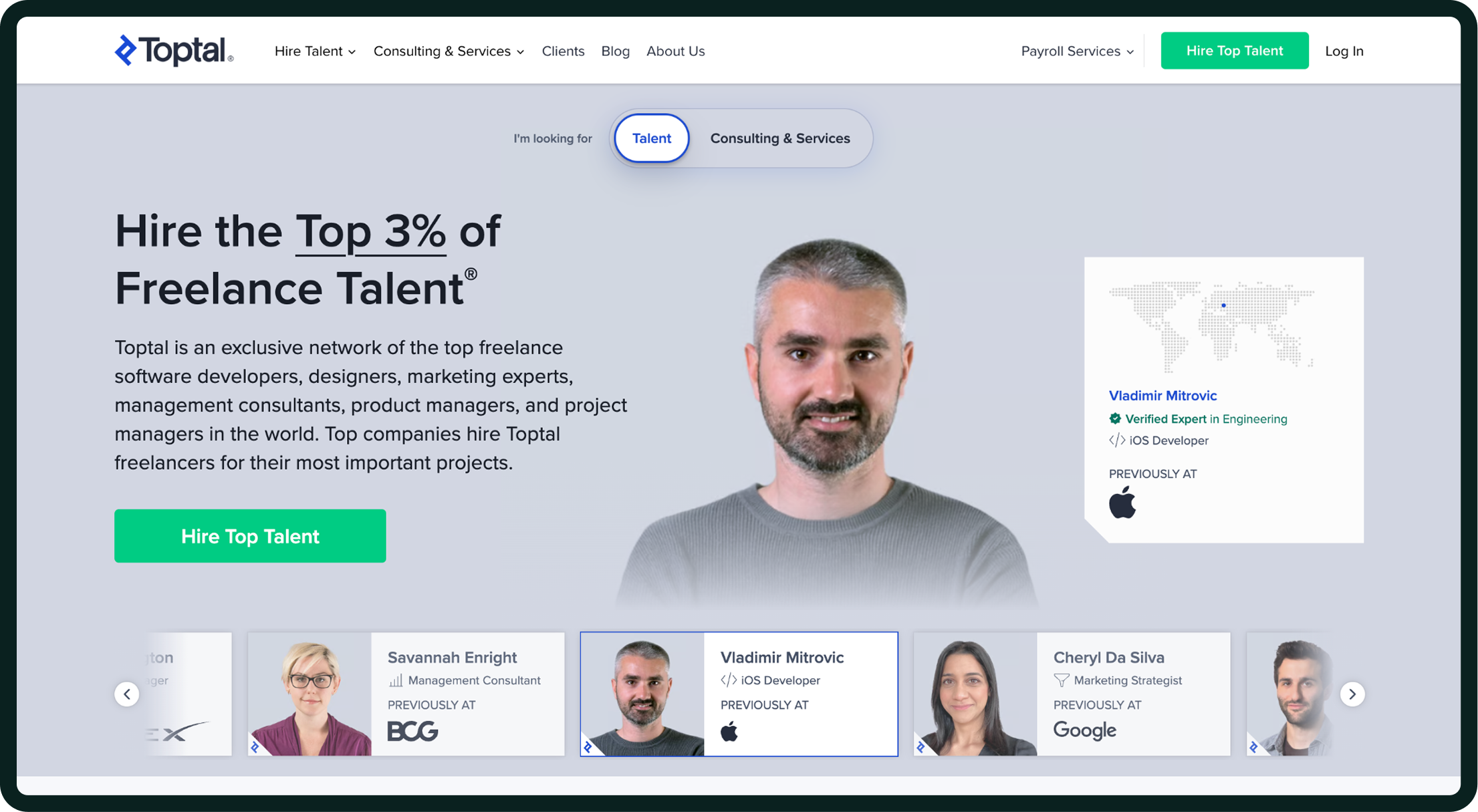
Toptal is the opposite of a contest. It turns away most applicants, and you work with one senior designer from start to finish, with nobody working unpaid on the side. That suits the work contests handle worst: apps, interfaces and anything that needs several rounds to get right.
- Best for: Difficult, high-stakes work where you need someone senior.
- Pricing: Custom and quoted per engagement. Toptal does not publish a standard rate, so get a quote rather than assuming a figure.
- Rating: 4.8/5 on Trustpilot at platform level, but the designer you are matched with matters just as much, so review their profile too.
- Trade-off: Cost, and you are still managing an individual contractor rather than buying a process.
13. Fiverr Pro: Best for Ad-Hoc Projects
.png)
Fiverr Pro is the closest thing here to how 99designs direct hire already works, minus the contest. You browse pre-screened designers and engage one for a defined job. Screening is tighter than the open marketplace, but the outcome still rests on choosing well.
- Best for: Sporadic jobs where a recurring bill would sit unused half the year.
- Pricing: Set by each seller and by the scope you agree, so there is no platform-wide figure to quote.
- Rating: Rated per seller rather than as a service; check each profile's rating and review count.
- Trade-off: Every new job restarts the search, the brief and the chasing, and that time is a real cost.
14. Upwork: Best for Longer Freelance Engagements
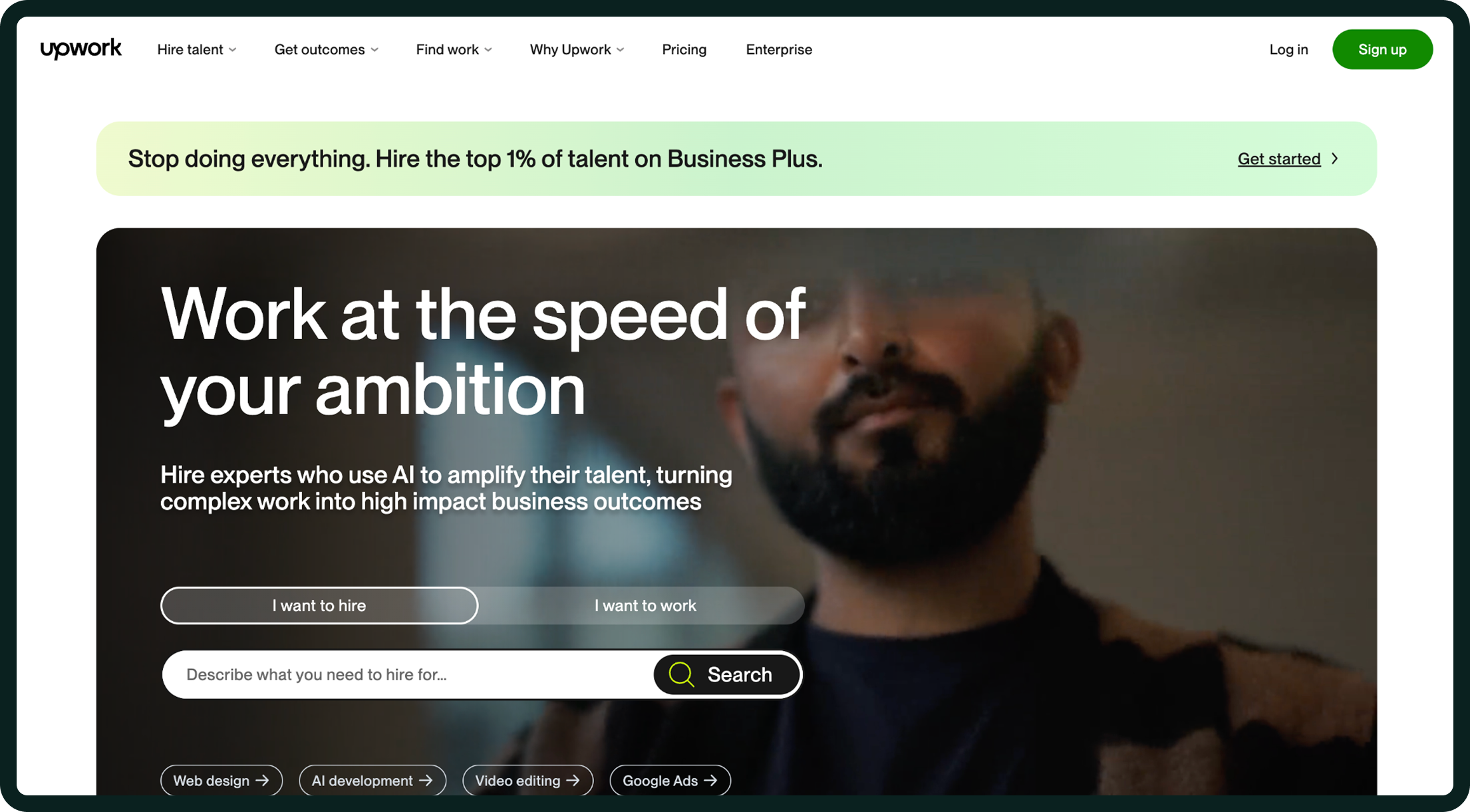
Upwork is better when you want to keep the same freelancer around rather than hire for one job. You can pay by the hour or by the project, check what they have done before, and work with the same person for months, so at least somebody remembers your brand between briefs.
- Best for: Teams that want one recurring freelancer rather than a subscription.
- Pricing: Varies by freelancer, hourly or fixed price, plus platform fees.
- Rating: Rated per freelancer rather than as a service; check individual work history.
- Trade-off: You do the vetting, quality swings a lot, and one person can only get through so much work.
15. Looka: Best Fast, Cheap Starter Logo
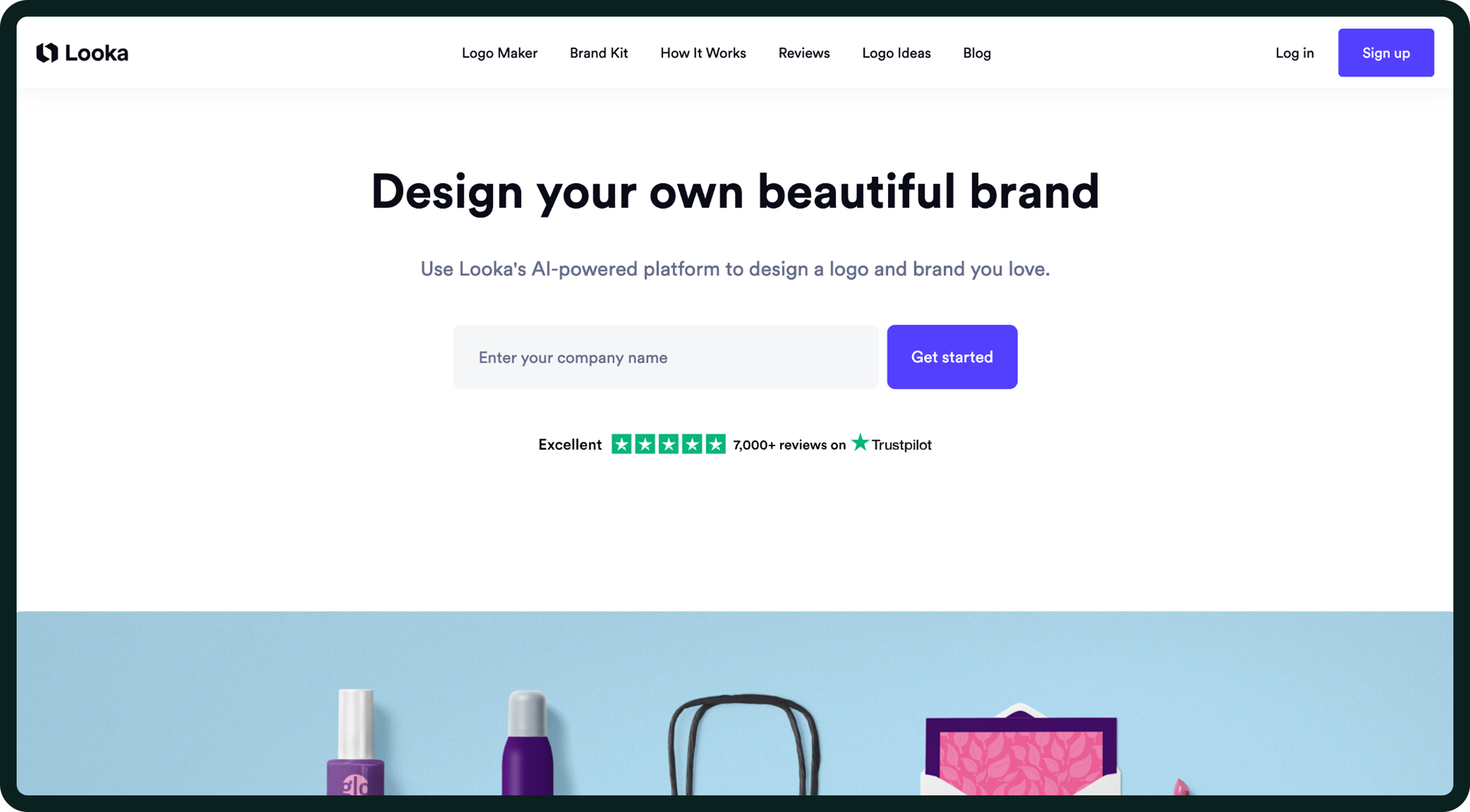
Looka is an AI logo maker, not a design service. It combines type and stock icons to generate options in minutes. For a pre-revenue business that needs a mark on a pitch deck this week, it is a reasonable placeholder.
- Best for: Very early-stage founders needing something serviceable immediately.
- Pricing: Around $20 for a low-resolution file and $65 for a high-resolution package; brand kit subscriptions cost more.
- Rating: Reviewed as a piece of software, so its score does not compare with the design services above.
- Trade-off: Output is built from stock elements, so results tend to look generic.
Which 99designs Alternative Is Right for You?
- You need design most weeks and want the same team each time: Teamtown
- You want ongoing design at the lowest sensible price: ManyPixels
- You want steady ad, brand and print output at a fixed cost: Penji
- You need graphics and video from the same team: Kimp
- You need copywriting and motion as well as design: Flocksy
- You want a Creative Director who owns your brand: Designity
- You run campaigns all year and have the budget for it: Superside
- You need a high volume of straightforward production work: Design Pickle
- You need one logo or brand identity and nothing more: DesignCrowd, Crowdspring or Designhill
- You need app, interface or product design: Toptal
- You only need design occasionally: Fiverr Pro or Upwork
- You need a basic logo today for under $100: Looka
When Contests Stop Working
A contest is a good way to buy a logo. It is a terrible way to buy a marketing function, and the difference only becomes obvious around the third or fourth time you write a brief for something you will need again next month.
That is the gap Teamtown fills.
Nobody starts from scratch on your brand, because nobody rotates off it. One subscription covers ad creative, social, presentations, web, motion and video, so the next thing does not need a new process. We publish our prices so you can compare us against anything on this list before you talk to us.
If you need one logo this year, run the contest. DesignCrowd will do it cheaper than we ever could. But if you are here because the requests keep coming, no contest platform solves that, however good the concepts are.
Book a demo to see how our subscription model compares to your current workflow.
Frequently Asked Questions
Who are 99designs’ main competitors?
99designs’ main competitors are Teamtown, Superside, Designity, Design Pickle, ManyPixels, Penji, Kimp, Flocksy, DesignCrowd, Crowdspring, Designhill, Toptal, Fiverr Pro, Upwork and Looka. They fall into four camps: design subscriptions for ongoing work, contest platforms that work the same way 99designs does, freelance marketplaces for individual hires, and DIY logo tools.
How does a design contest work?
You write a brief, set a fixed prize, and designers send in concepts. You pick one, and that designer gets paid. Some might get a small fraction of the money, but usually everyone else gets nothing. You end up with plenty of options for a price you knew upfront, which works well for a one-off job like a logo. The catch is that you are choosing from finished ideas rather than shaping one with a designer, and the contest ends at delivery. You can rehire the winner for one-to-one work, but that is a separate arrangement.
How much does 99designs cost in 2026?
99designs prices per project rather than per month. Logo contests run $249 for Bronze, $399 for Silver, $799 for Gold and $1,050 for Platinum. Web design contests run from about $599 to $2,499. Brand identity, packaging and other categories vary. Optional upgrades, taxes, and a client platform fee on one-to-one projects add to the total.
What is a design subscription and how does it work?
You pay one monthly fee and get a design team on tap instead of paying job by job. You submit requests, and the team works through them, revising until you are happy. There is always a limit somewhere, usually on how many jobs run at once or how many hours a day you have bought. It makes sense when design comes up constantly, not just once in a while.
Is a design subscription worth it compared to running contests?
It depends on volume. For one or two brand projects a year, contests are cheaper. Once you need design most weeks, per-project pricing quickly overtakes a subscription, and you also stop paying the hidden cost of re-briefing a new designer every time. Work out your own break-even: add up what you spent on design over the last 90 days and compare it against a monthly subscription. Six $249 logo contests and six $2,499 web projects give very different answers, so use your real numbers rather than a rule of thumb.
What is the best 99designs alternative for ongoing design work?
If you need design most weeks, Teamtown is the strongest option on this list. You get the same team every month, a Project Manager, a Creative Lead and designers, from $3,000 with nothing annual to sign and 15 days to walk away. Nobody rotates off the account, so what they learn about your brand stays put instead of starting from scratch on the next job.
What is the cheapest 99designs alternative?
That depends on what you need. A one-off mark can cost as little as $20 to $65 through Looka, and DesignCrowd packages open near $109. If the need is continuous, ManyPixels at roughly $699 a month is the lowest sensible starting point. Several providers advertise introductory rates, so always confirm the ongoing figure before signing.
Can I switch from 99designs without losing my brand assets?
Yes. Contest winners on 99designs transfer full copyright of the winning design, so you own the files. Before switching, gather your source files, brand guidelines and any style references so your new partner can pick up where the contest left off. Ramp-up varies a lot between providers, so ask directly how soon a new team can take on live briefs.