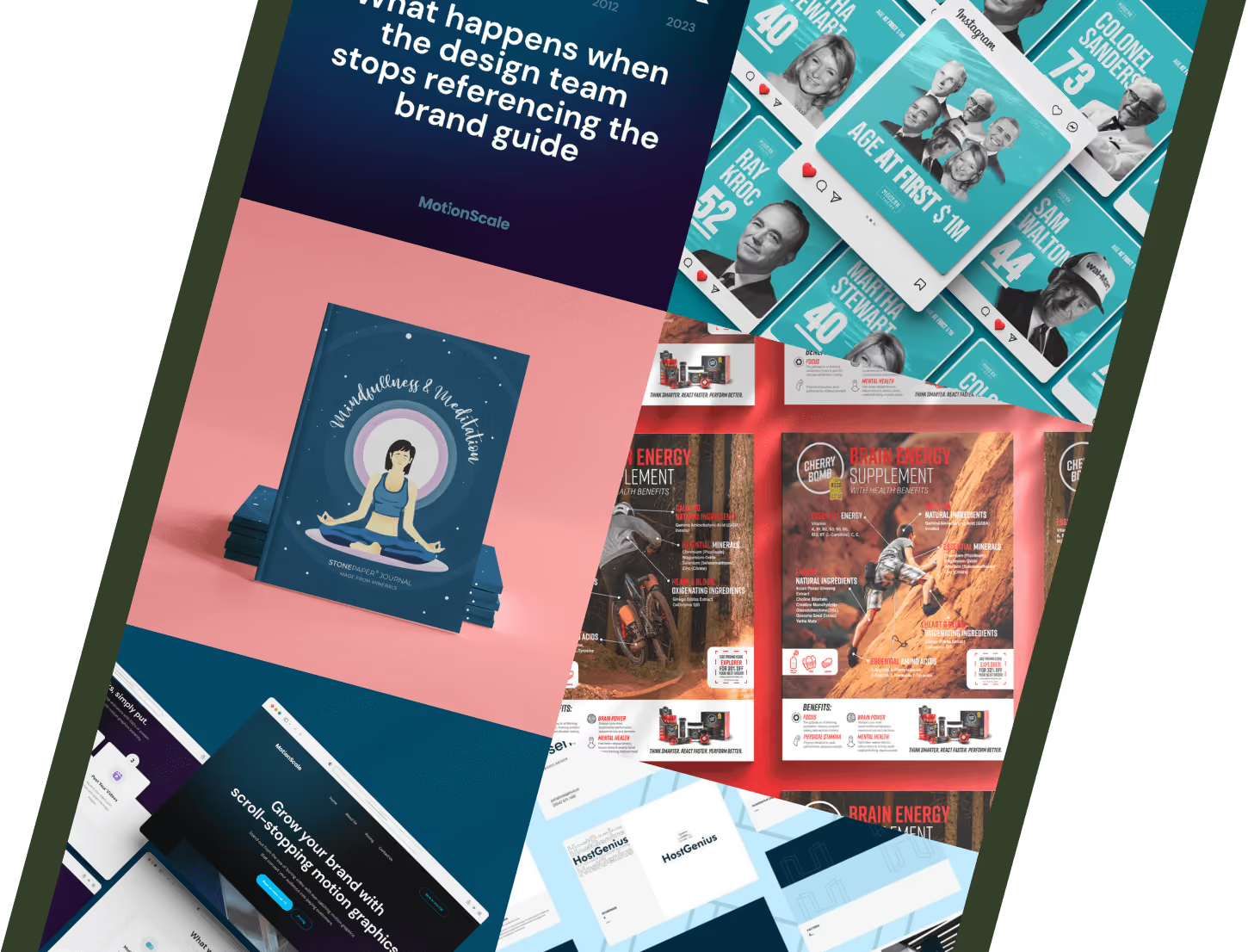
Quick Answer: The best design subscription agency for B2B marketing teams with recurring, multi-format work is Teamtown. You get a dedicated team led by a Project Manager and Creative Lead, covering decks, ads, email, web, brand and motion. Plans start at $3,000 a month on rolling monthly terms, with a full refund available in your first 15 days. For other budgets, Superside fits enterprise teams from $16,000 a month on an annual term, and ManyPixels and Penji are lower-priced options for general-purpose production.
If you're comparing design subscription agencies, your design requests have probably outgrown the people available to handle them. Campaigns are waiting on creative, and hiring another senior designer would take months you don't have.
A subscription can add that capacity without a new hire, as long as the plan matches how your team actually works.
From the outside, they all look alike, and the differences surface after you've paid, when "unlimited" means one request at a time or unused hours vanish at renewal.
So I compared 15 of them side by side, with verified 2026 pricing, how each one measures capacity, what customers say in their reviews and the questions worth asking before you sign.
Key Takeaways
- Teamtown comes out on top for marketing teams with recurring, multi-format work, after comparing 15 agencies on price, capacity, scope, team continuity, creative direction, flexibility and verified reviews. Superside leads at enterprise scale, while ManyPixels and Penji cover lower-priced general production.
- "Unlimited requests" never means unlimited output. Every agency caps throughput with one of four capacity models (active project limits, daily hours, daily outputs or a monthly allowance), so compare the model before the price.
- Cost per approved asset is a better yardstick than the monthly fee. Divide what you paid by what you approved in a real month, and watch for annual-billing headline rates, software fees, pause fees and hours that expire at renewal.
- Want to see what a dedicated team would do with your queue? Book a demo with Teamtown, bring last month's requests and we'll map them to the plan that fits.
Design Subscription Agencies at a Glance
Prices are the lowest published monthly rate for each provider as of October 2026, and billing terms differ.
Superside requires an annual term, Flocksy's rate assumes annual billing and Designjoy's is a limited-time discount. The rest are month-to-month rates unless noted.
How I Compared These Design Subscription Agencies
Disclaimer: Teamtown is ranked first, and I'm its founder. I'd rather say that up front than have you find out in the final paragraph. Where another agency is the better fit for a specific situation, I say so.
I looked at the same seven things for every agency:
- Published price and billing terms
- How capacity is measured
- The scope of services
- Whether you keep the same designers over time
- Who provides creative direction
- How easy it is to pause or leave
- What verified customers say
The order reflects my overall judgment of how well each agency serves a marketing team with recurring design work, based on how it held up against those seven criteria. I didn't reduce that to a numeric score, because a one-request plan and an enterprise retainer can't be weighed fairly on the same scale.
Every one of these 15 agencies is the right pick for someone, so each profile's "Best for" line matters more than its rank.
I pulled every price straight from each provider in October 2026. The one exception is No Limit Creatives, which prices through a slot calculator, so its figure is the advertised starting point.
Where a provider publishes no price, I say "quoted on a call" rather than repeating a third-party number I couldn't verify.
Review evidence comes from G2 and Trustpilot, with ratings and review counts as of October 2026. I've included low scores and critical reviews where they exist, because a comparison that only quotes praise isn't a comparison.
Where an individual review URL is available, I've linked directly to it. Otherwise, I've linked to the review platform and identified the reviewer and date.
The 15 Best Design Subscription Agencies in 2026
1. Teamtown: Best for Marketing Teams That Need a Dedicated Creative Team
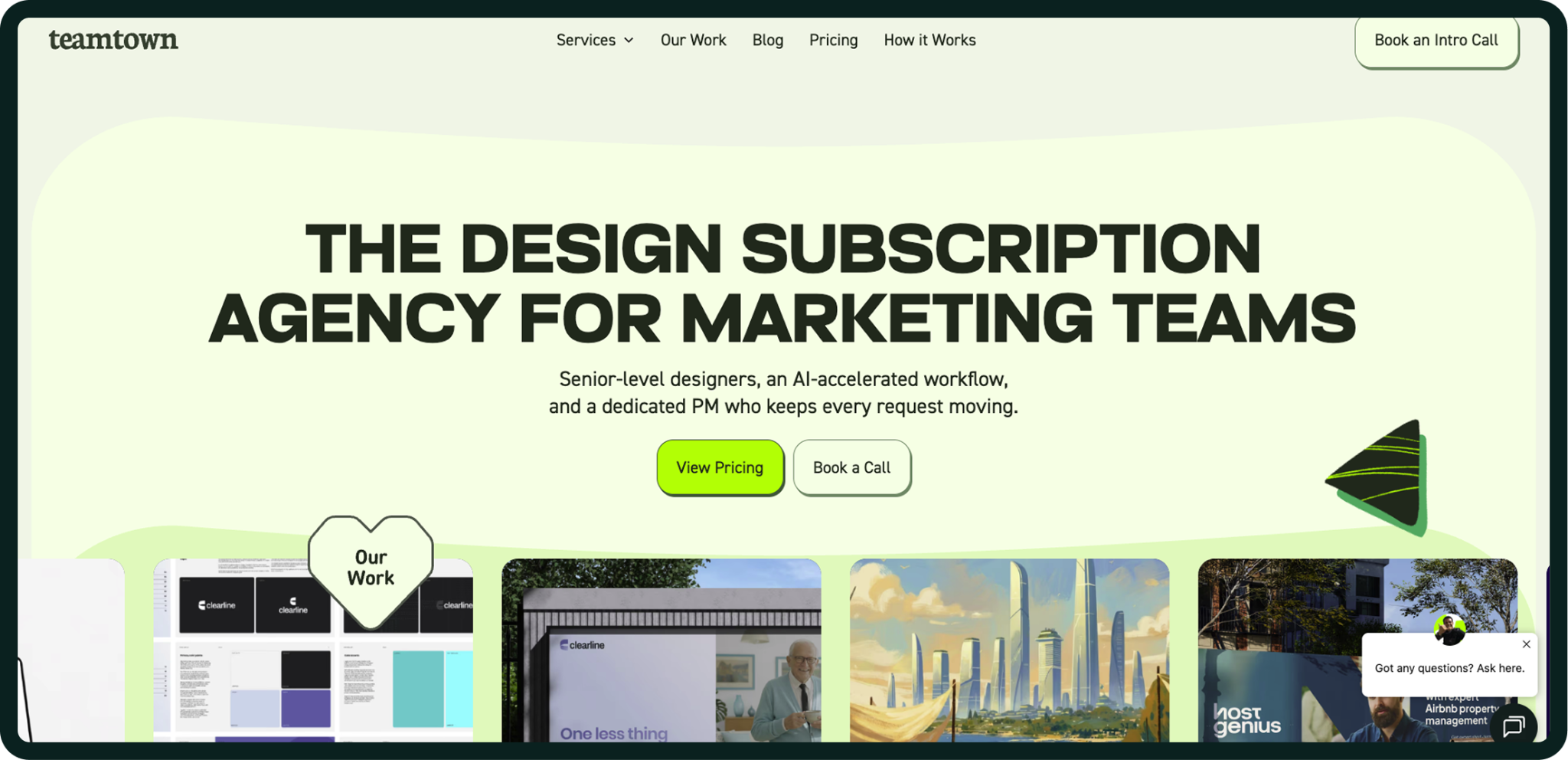
Best for: Mid-market B2B marketing teams with recurring design work across several formats, who want the same team every week and a Creative Lead who holds the brand together.
Price:
- Essentials: from $3,000/month with 2 active projects
- Pro: from $4,500/month with 5 active projects, 1.5x capacity, 2 rush projects a month and complex video, motion and 3D
- Studio: from $9,900/month with 8 active projects, a Creative Director, quarterly creative roadmap and copywriting
There's no annual lock-in. You can pause or cancel on 15 days' notice and request a full refund in your first 15 days. See our pricing for the full breakdown.
How it works: You get a fixed team: a Project Manager who runs your queue, a Creative Lead who owns quality and consistency, and designers who learn your brand.
Capacity is a monthly hours allowance alongside the active project limit, and unused capacity rolls over one month. Work runs on US hours through Slack Connect or our portal, and most requests get a response within two hours.
Why it ranks first:
- Your campaigns stop waiting on design. Up to five projects move at once on Pro, so a launch deck doesn't hold up this week's ad set.
- You add a full creative team without adding headcount. You skip the recruiting and the salary commitment, and scaling up or pausing only takes 15 days' notice.
- Your brand stays consistent as volume grows. The same people work on your account every week and a Creative Lead reviews everything before you see it, which is why our own tracking puts first-draft approval at 90%.
- You spend less time managing design. A Project Manager runs the timelines and revisions, and anyone on your team can submit requests, so no one person becomes the bottleneck.
Limitations: We're not the cheapest way to get a social graphic. If you need a handful of simple assets a month, Penji or ManyPixels will cost you roughly a third of what our entry plan does.
We also deliver design assets, not brand strategy, social posting or user research. Essentials works on two projects in parallel, so high-volume teams usually belong on Pro.
What reviews say: Rated 4.6/5 across 18 Trustpilot reviews, a small enough sample that I'd read it as an early signal.
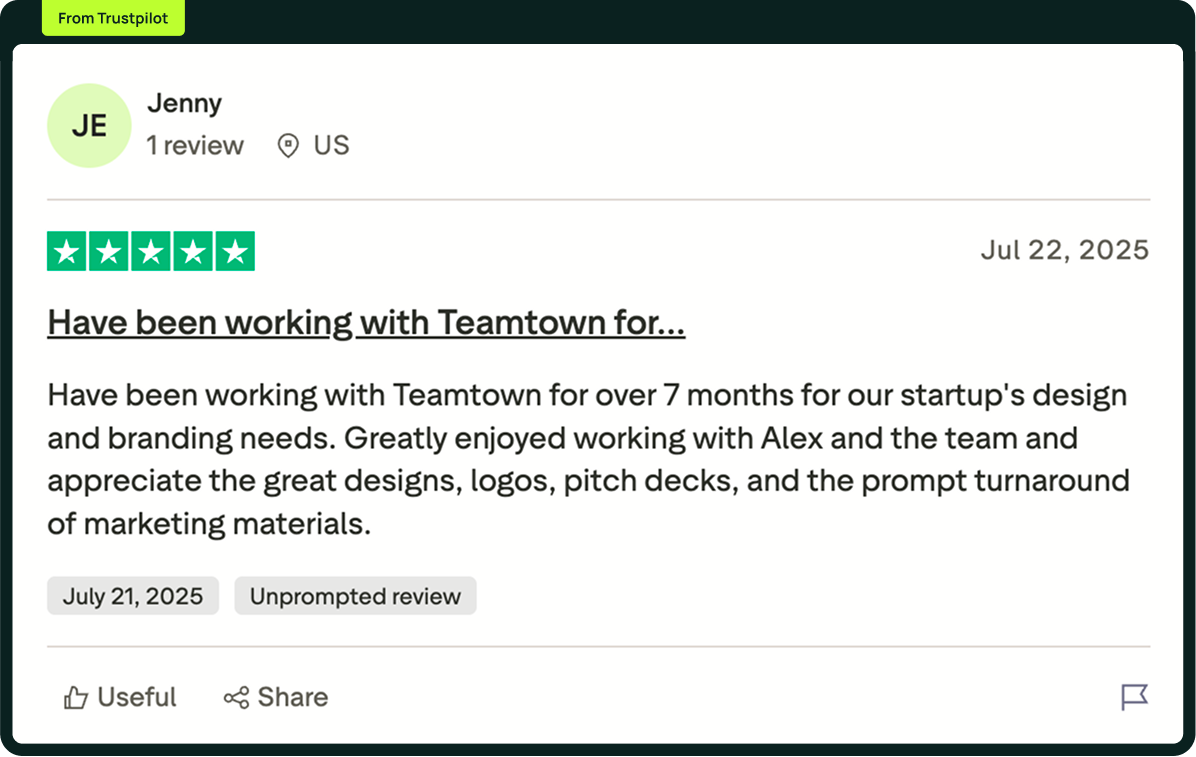
Praise centers on turnaround speed and Slack-based collaboration, often from long-term clients. A July 2025 review from a client seven months in credits the design quality and the fast turnaround.
Verdict: Shortlist us if you're replacing an agency retainer, a stretched in-house designer or a bench of contractors with one team that scales. Look elsewhere if you need one-off work or the lowest possible price per asset.
Ready to see it on your own workload? Book a demo and we'll show you which plan fits the work you already have lined up.
2. Superside: Best for Enterprise Creative Operations
Best for: Large marketing organizations with distributed teams, a six-figure annual creative budget and a need for video, motion, 3D and localization under one roof.
Price:
- Flex: from $15,000/month on an annual commitment
- Dedicated: from $30,000/month on a 12-month term
A $1,000 software charge lands on top of either plan each month, which puts the first year of Flex at $192,000 or more.
How it works: Work is spread across a global bench of creatives, and a Creative Project Manager coordinates it for you. Strategy and concept work sit inside the monthly budget, and unused budget carries for three months.
Strengths: Breadth none of the other 14 match, from campaign concepts to 3D and product design, with enterprise-grade process and security. For a team spending at this level, the coordination overhead it removes is real.
Limitations: The minimum rose from the $5,000 that circulated in earlier guides to $15,000 on an annual term.
Mid-market teams that liked the model but not the lock-in make up a large share of the people searching for Superside alternatives.
What reviews say: Rated 4.5/5 across 115 G2 reviews and 4.3/5 across 389 on Trustpilot.
Recent praise covers communication and fast turnaround on campaign work, while the critical reviews cluster around contract rigidity and budget disputes.
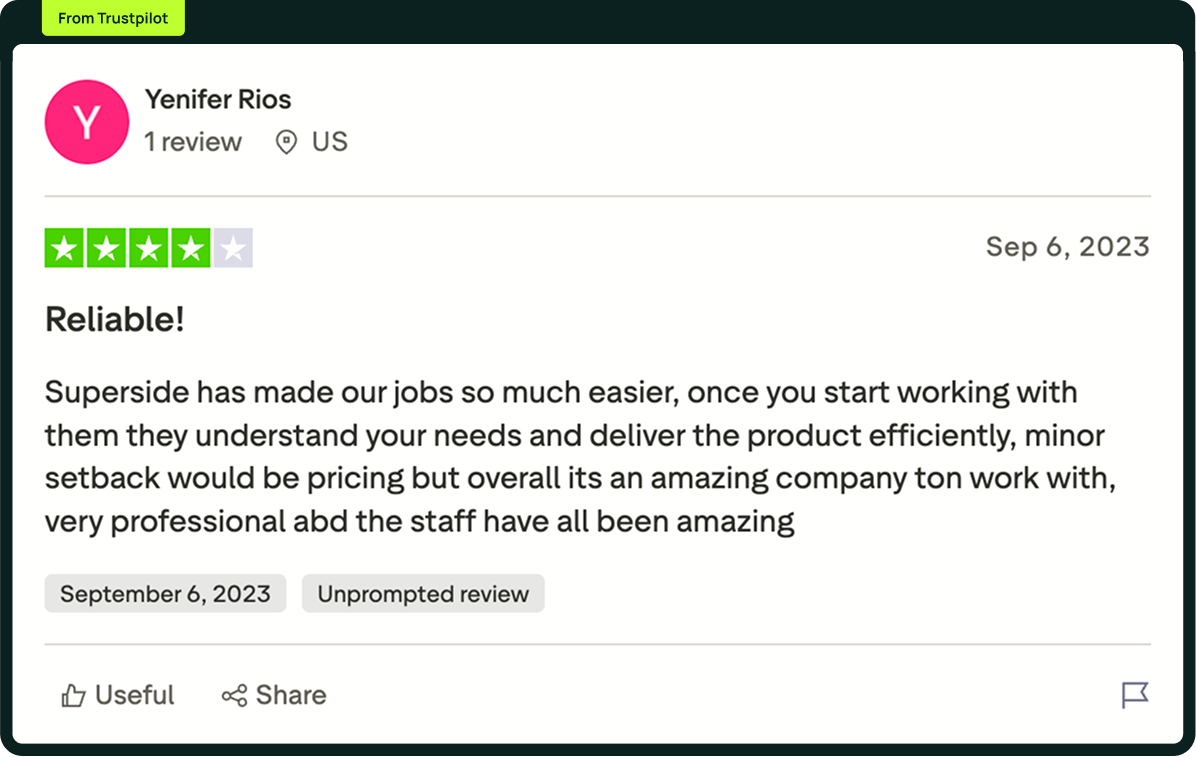
A September 2023 review covers both sides in a few lines. Once work started, the team understood what the company needed and delivered efficiently, and pricing was the one setback the reviewer named.
Verdict: The right choice when the budget is already there and the brief includes things most subscriptions can't do. The wrong one if month-to-month flexibility matters.
3. Design Pickle: Best for Teams That Want a Managed Production Platform
Best for: Marketing teams that want a brand-trained production team, a mature request platform and reserved daily hours, and can live with quarterly or annual billing.
Price:
- Base: quoted on a call
- Pro: quoted on a call
Neither tier has a public price. Billing runs quarterly or annually, and unused time is lost once a cycle renews.
How it works: Design Pickle assigns a team to your account and trains it on your brand, with backup coverage when someone is out. Capacity is reserved daily hours overlapping your time zone, and Art Director support depends on how much capacity you buy.
Strengths: One of the most developed platforms in the category, with Slack integration, a light asset library and quick first concepts, according to its reviewers.
Limitations: The move away from public pricing makes it hard to compare without a sales call, and the billing cycle locks you in for at least a quarter.
Some customers report designer rotation and details slipping between handoffs. That's the gap most of the Design Pickle alternatives try to close.
What reviews say: Rated 4.4/5 across 228 G2 reviews, but only 3.5/5 across 367 on Trustpilot.
Positive reviews credit the platform and overnight turnaround, while critical ones mention inconsistent designers and daily hours that don't carry over.
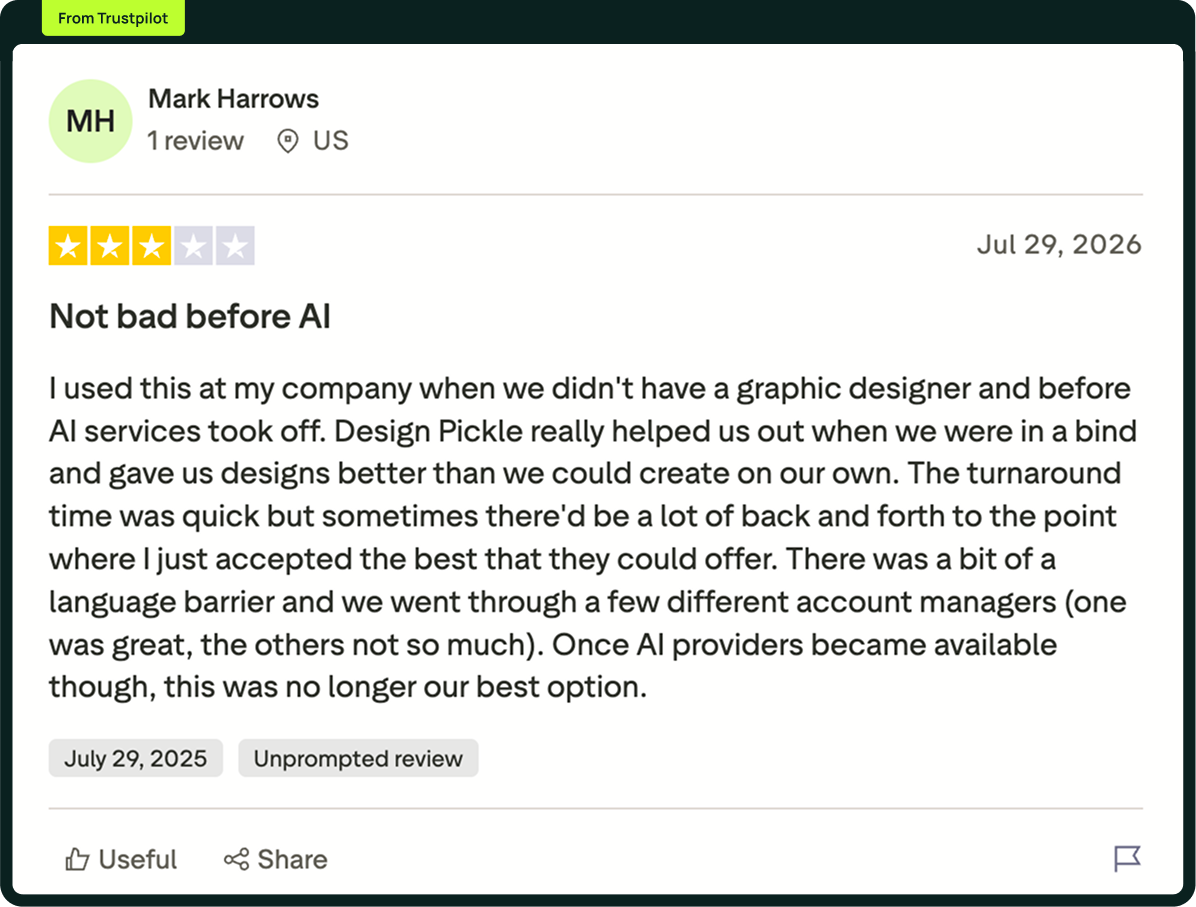
A July 2026 review finds the designs better than what the reviewer's own team could make, then lists slow revisions and changing account managers as the reasons it fell short.
Verdict: Worth a call if platform and process matter more than price transparency. Skip it if you want to know the number before you talk to sales.
4. Penji: Best for Small Teams Testing the Model
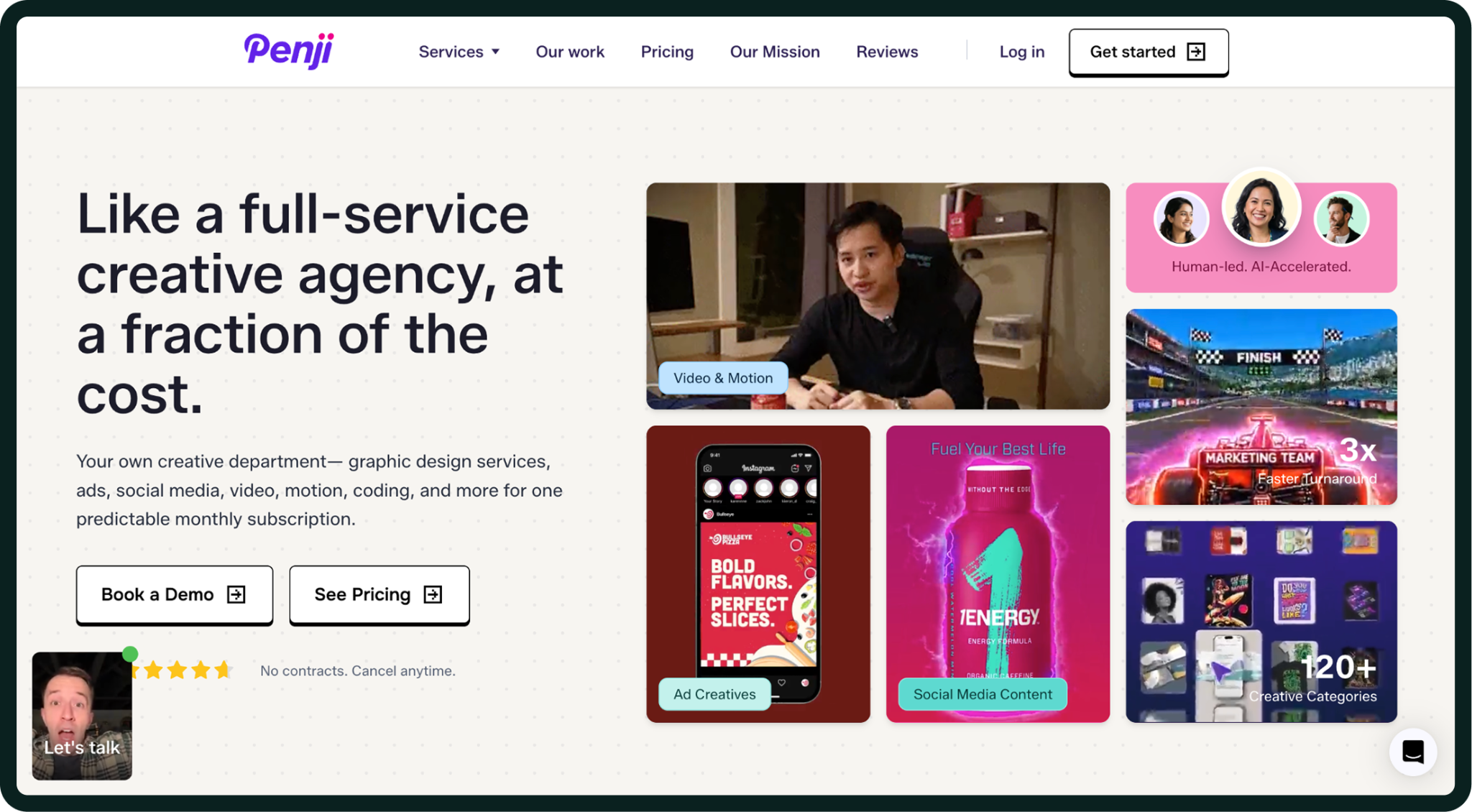
Best for: Small marketing teams or founders who want a low entry price with a project manager overseeing quality.
Price:
- Essentials: $995/month with 2 active workstreams
- Agency Partner: $1,995/month with 3 workstreams and an Art Director
- Dedicated Team: from $4,500/month with 4 workstreams
Paying quarterly takes 15% off and paying yearly takes 20%. You can leave whenever you like, and the first month is refundable for 30 days.
How it works: Unlimited queued requests, with each plan capping how many are worked on at once. On Essentials you manage requests yourself while a Project Manager checks quality; Agency Partner brings a consistent group of creatives plus video.
Strengths: Value for money and a clean portal are the recurring praise. The 30-day refund window is the longest of the 15.
Limitations: The entry tier doubled from $499 to $995 this year, which narrows its gap with hours-based services.
On Essentials, the designer can change between requests, and reviews mention revisions dragging and quality shifting when that happens. I've written about Penji alternatives for teams hitting those limits.
What reviews say: Rated 4.7/5 across 195 G2 reviews and 4.8/5 across 393 on Trustpilot.
Long-term customers praise the turnaround and editable working files, while a few G2 reviews from 2026 mention uneven skill between designers.
An April 2026 review values the on-demand model for a lean team but says first passes sometimes miss the brief and revisions can turn into a loop.
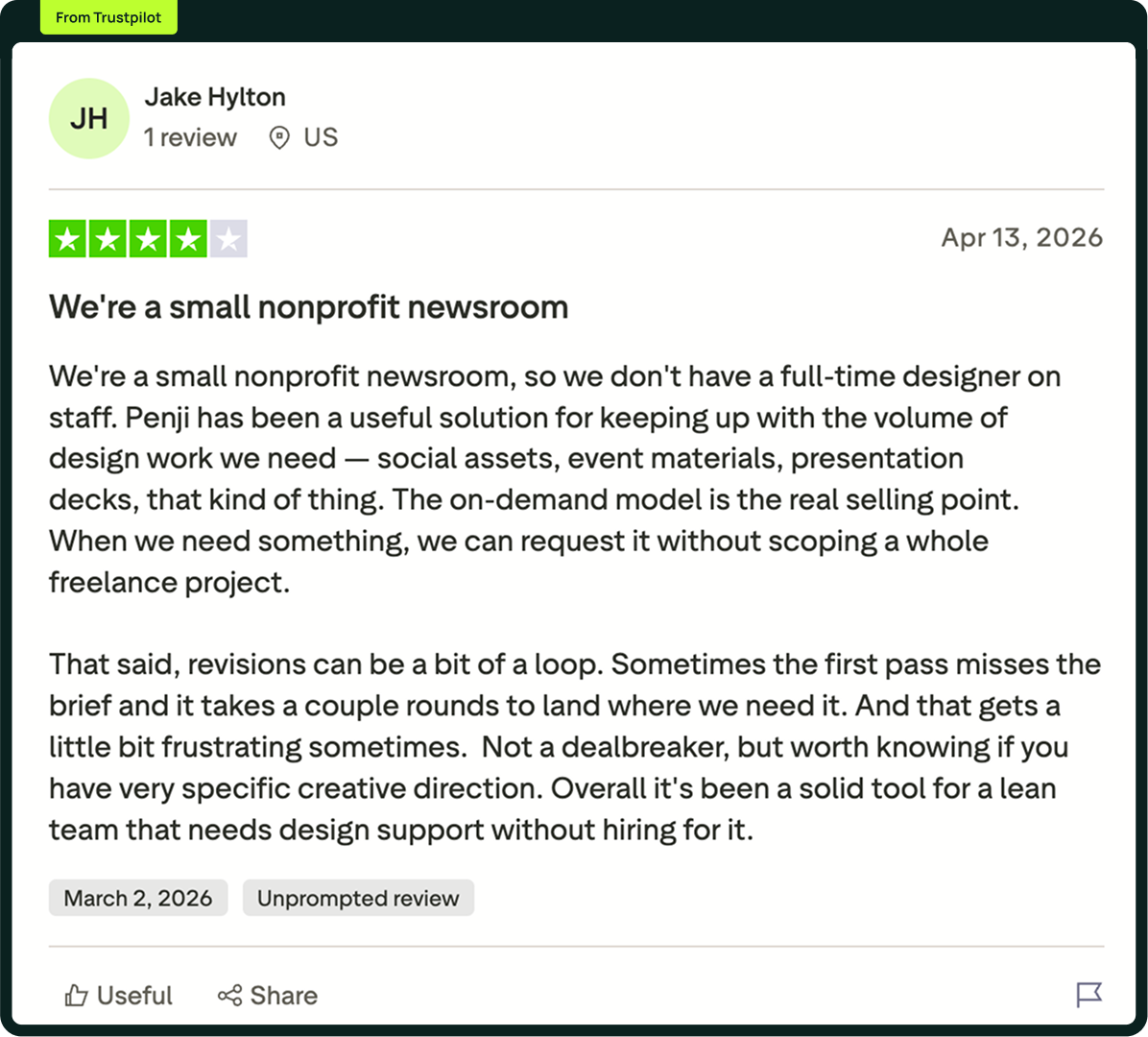
Verdict: A sensible first subscription for a team that has never used one. Expect to outgrow Essentials once consistency across requests starts to matter.
5. Designjoy: Best for Solo Founders Who Need One Senior Designer
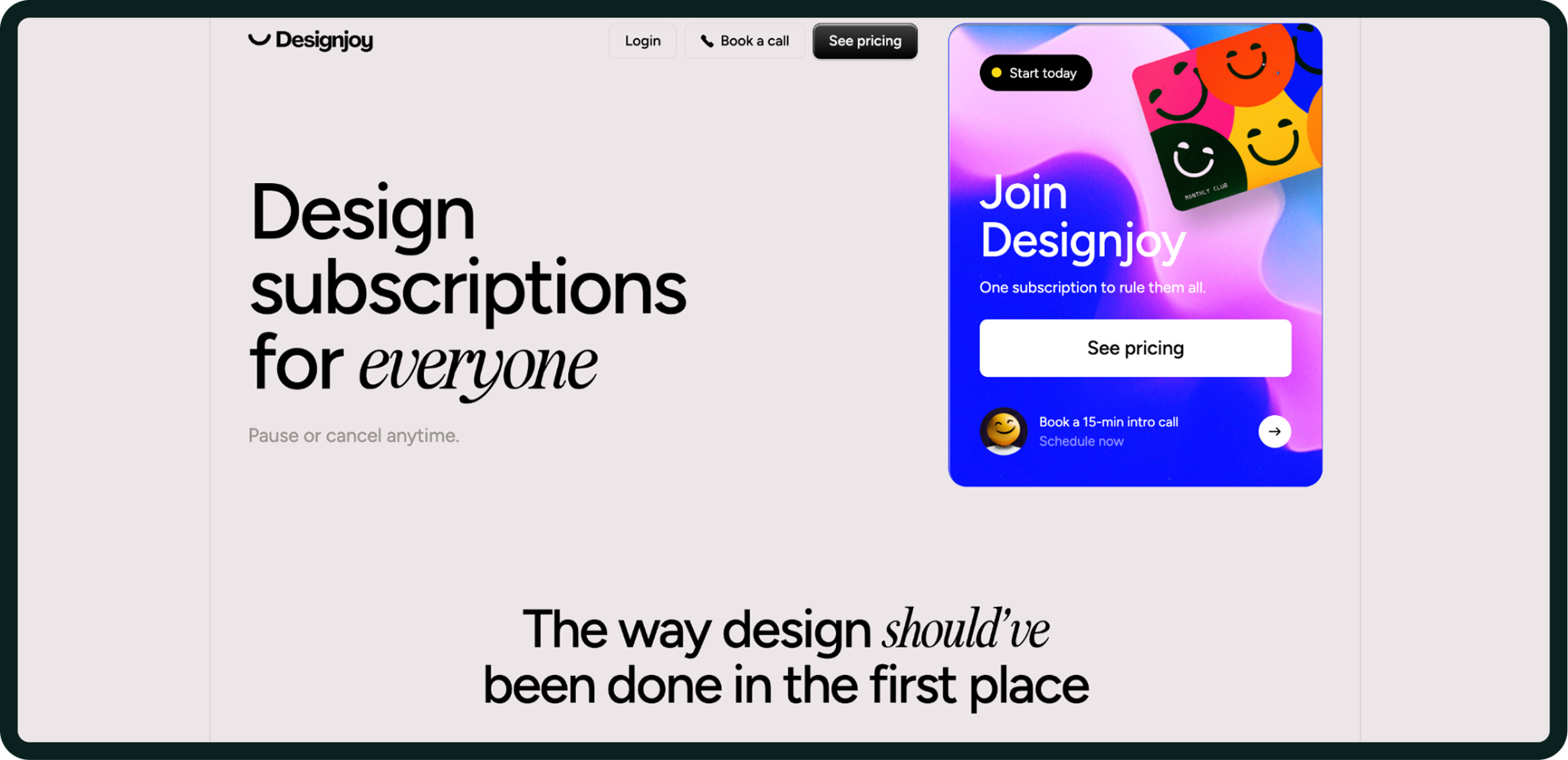
Best for: Founders and small startups who want a single senior designer, Webflow builds included, and don't need parallel work or video.
Price:
- Monthly Club: $4,995/month under a limited-time "lifetime discount," shown against a $5,995 regular rate
One request at a time, pause or cancel anytime, and a 75% refund if you cancel within the first week.
How it works: Designjoy is a one-person agency run by its founder, who doesn't hire or outsource. Requests queue and are delivered one by one, with an average 48-hour delivery on standard work. Billing runs in 31-day cycles, and pausing banks unused days.
Strengths: You know exactly who's doing the work, the portfolio is consistent, and Webflow development is included at no extra charge.
Limitations: One request at a time means a campaign with five deliverables waits in line. The scope excludes video, animation, 3D, document design and heavy print.
A single-person operation also means no backup if that person is unavailable. If the format appeals but the constraints don't, see the Designjoy alternatives I've compared.
What reviews say: No third-party score with enough volume to be meaningful. Judge the portfolio instead.
Verdict: A good fit for a founder who wants one person's taste on everything. Not a fit for a marketing team running several workstreams at once.
6. Designity: Best for Teams That Want Strategy Alongside Execution
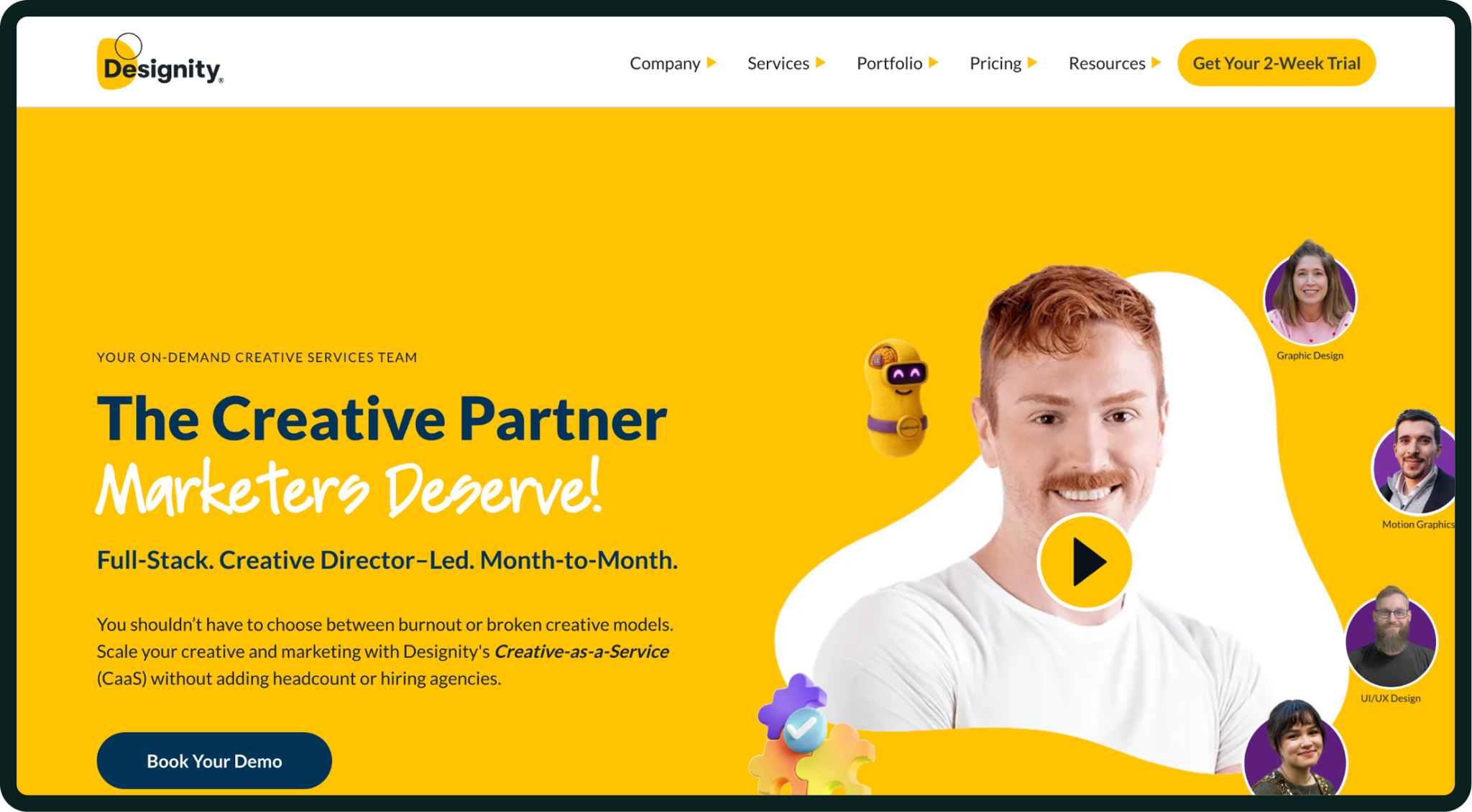
Best for: Marketing teams that want a named Creative Director leading the engagement and marketing strategy input included in the hours.
Price:
- Plus: $5,995/month for 120 dedicated hours and 2 simultaneous projects
- Premium: $8,995/month for 180 hours and 3 projects
- Custom: from $6,000/month
Plans run month to month with 7 days' notice. There's a free two-week trial, and a two-week pause costs $995, once per quarter.
How it works: A Creative Director pulls specialists from a pool working US hours across more than 100 services, alongside a Project Manager and a Marketing Strategist. Capacity is measured in dedicated hours, and unused hours don't roll over.
Strengths: Reviewers praise the creative work and describe the team as an extension of their own. Minor requests turn in 24 hours on Plus and 12 on Premium.
Limitations: Expiring hours mean a quiet month costs the same as a busy one, and cancellation requires an exit interview with a Customer Success Manager.
Subscriptions also can't be paused for longer than two weeks, which may be restrictive for teams with seasonal workloads. Teams that want the director model with rollover tend to look at Designity alternatives.
What reviews say: Rated 4.5/5 across 111 Trustpilot reviews and 4.7/5 across 33 on G2. A June 2026 review describes the team as a real extension of in-house marketing rather than an outside vendor.
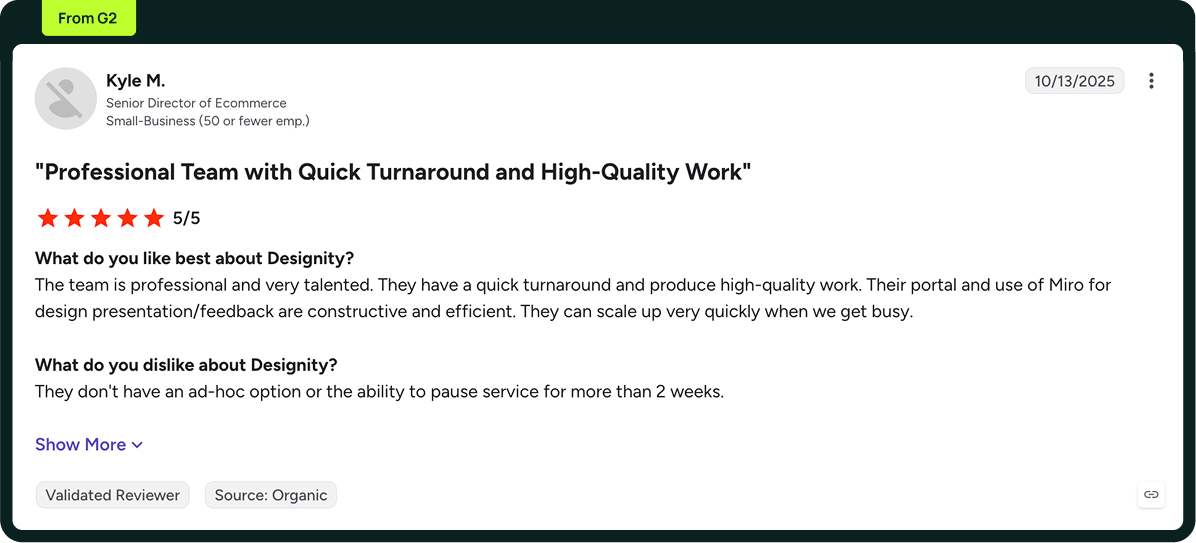
An October 2025 review sums up the trade-off. The reviewer praises the team's talent, quick turnaround and ability to scale up in busy periods, and the one complaint is flexibility: there's no ad-hoc option, and pauses top out at two weeks.
Verdict: Shortlist it if a Creative Director in your weekly meetings is the main thing you're buying. Weigh the expiring hours carefully if your workload is uneven.
7. Growmodo: Best for Design and Development in One Subscription
Best for: Teams that need a designer and a developer, or want to switch between skills, with a Project Manager coordinating both.
Price:
- All-Inclusive: $3,000/month per talent, billed monthly
- Partner add-on: $1,000/month for creative, UX and technical direction
Committing for six months cuts 5% and a full year cuts 10%, with no placement fees.
How it works: You pick one to five talents across UI/UX, graphic design, web development, motion, Shopify, video and 3D. Every talent handles a single live project, coordinated by your Project Manager, with structured QA and daily progress updates.
Strengths: The talent-swap model is flexible, and reviewers highlight fast builds and daily updates from the Project Manager. White-label delivery is included.
Limitations: Capacity scales only by adding $3,000 talents, so three parallel projects cost $9,000 before the Partner add-on.
There's no trial or money-back guarantee listed, and reviewers note that scoping takes some learning early on. I've laid out the differences in our Growmodo comparison.
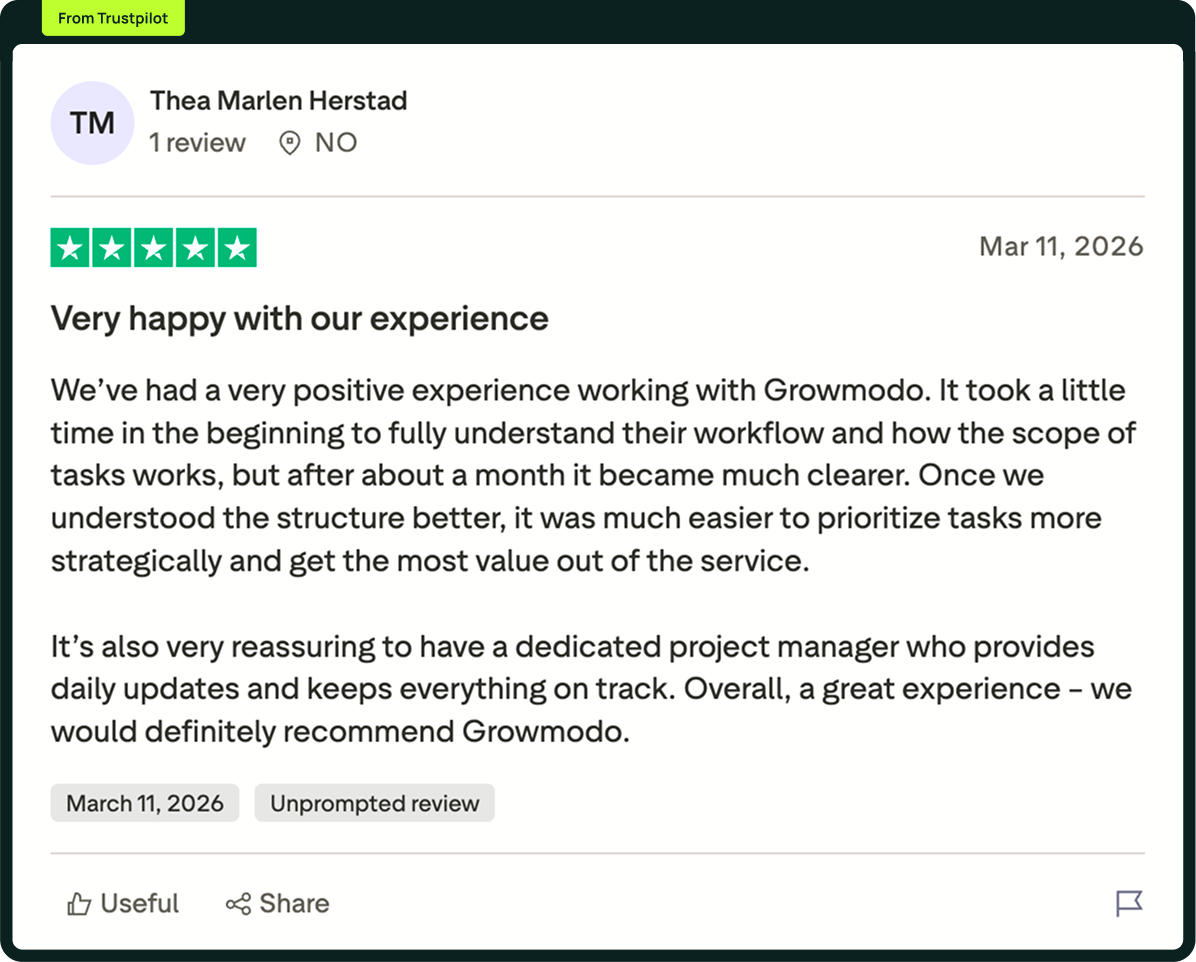
What reviews say: Rated 4.8/5 across 86 Trustpilot reviews. Most praise the dedicated Project Manager and the speed of delivery, and a couple mention needing a month or a team reassignment before the fit was right.
A March 2026 review describes that learning curve well. The reviewer recommends Growmodo and values the daily updates from a dedicated Project Manager, but says it took about a month to understand the workflow and how task scope works.
Verdict: The strongest option here if development is a standing part of your design queue. Less compelling if you only need design and want several projects moving at once.
8. Flocksy: Best for Hours-Based Pricing With Named Specialists
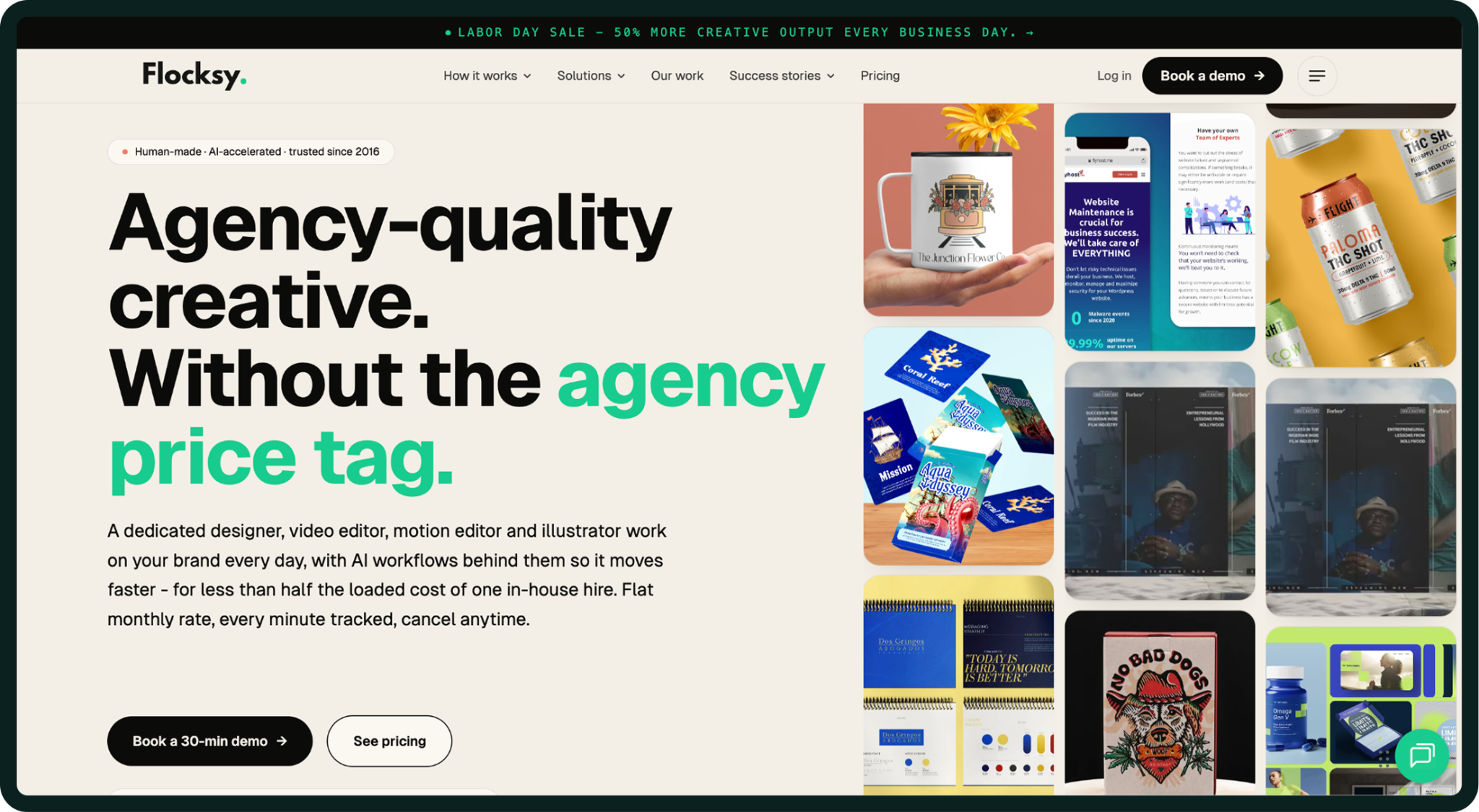
Best for: Teams that want named specialists for design, video, motion and illustration from the start, paid for by the hour.
Price:
- 2 to 8 daily hours: $1,199 to $3,799/month (42 to 168 hours a month), shown against list prices of $1,699 to $5,899
- 9 or 10 daily hours: $4,199 and $4,599/month, arranged through a demo
- Custom: teams beyond 10 daily hours
Every displayed rate requires annual billing, and quarterly billing saves "17%+." Hours you don't use carry over for 30 days, and refunds are available in the first 14 days.
How it works: Every plan includes named people per role, copywriting support and parallel projects with no cap. A Production Coordinator joins at 4 daily hours, an Art Director at 6 and a Creative Director at 8.
Strengths: Transparent hours, rollover and source files on every project. Reviewers like working with the same creatives each time and banking unused hours.
Limitations: The headline price assumes annual billing; the monthly-equivalent list price is about 40% higher.
Art direction doesn't appear until $2,999/month, so the entry tiers are pure production. That's the main reason teams look at Flocksy alternatives.
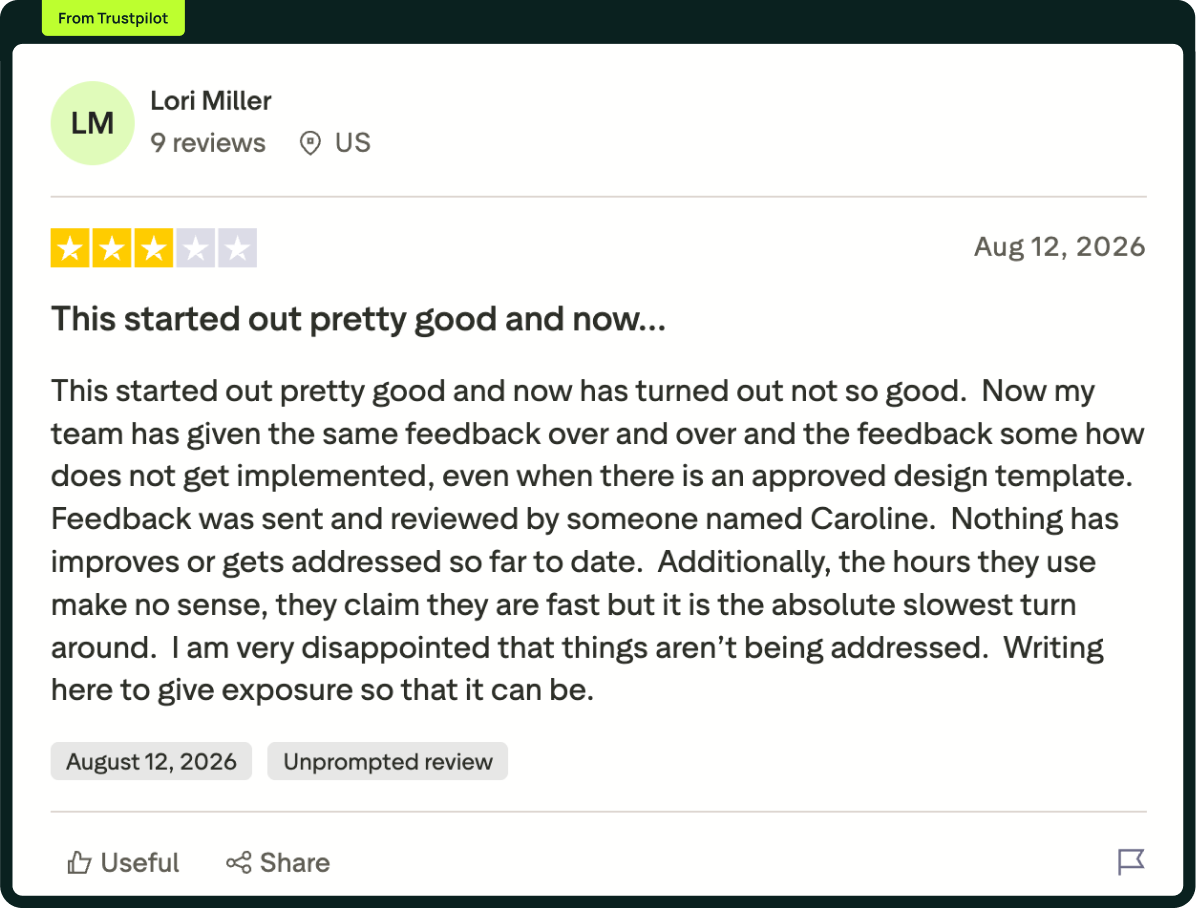
One customer also reported repeating the same feedback without it being applied, and said the hours logged didn't make sense given the slow turnaround. That's a single account, but it's worth asking how hours are tracked before you commit.
What reviews say: Rated 4.9/5 across 51 G2 reviews and 4.6/5 across 138 on Trustpilot.
Praise centers on creatives who learn your brand, and some G2 reviewers mention slower job pickup and quality dips when a new designer joins.
An August 2026 review is the source of that concern, including feedback that wasn't applied even with an approved template. Flocksy replied that it had passed the comments to its team.
Verdict: A good fit if you want to buy hours and manage the creative direction yourself. Budget for the 6-hour tier if you want an Art Director in the loop.
9. Kimp: Best for High-Volume Social and Video Graphics
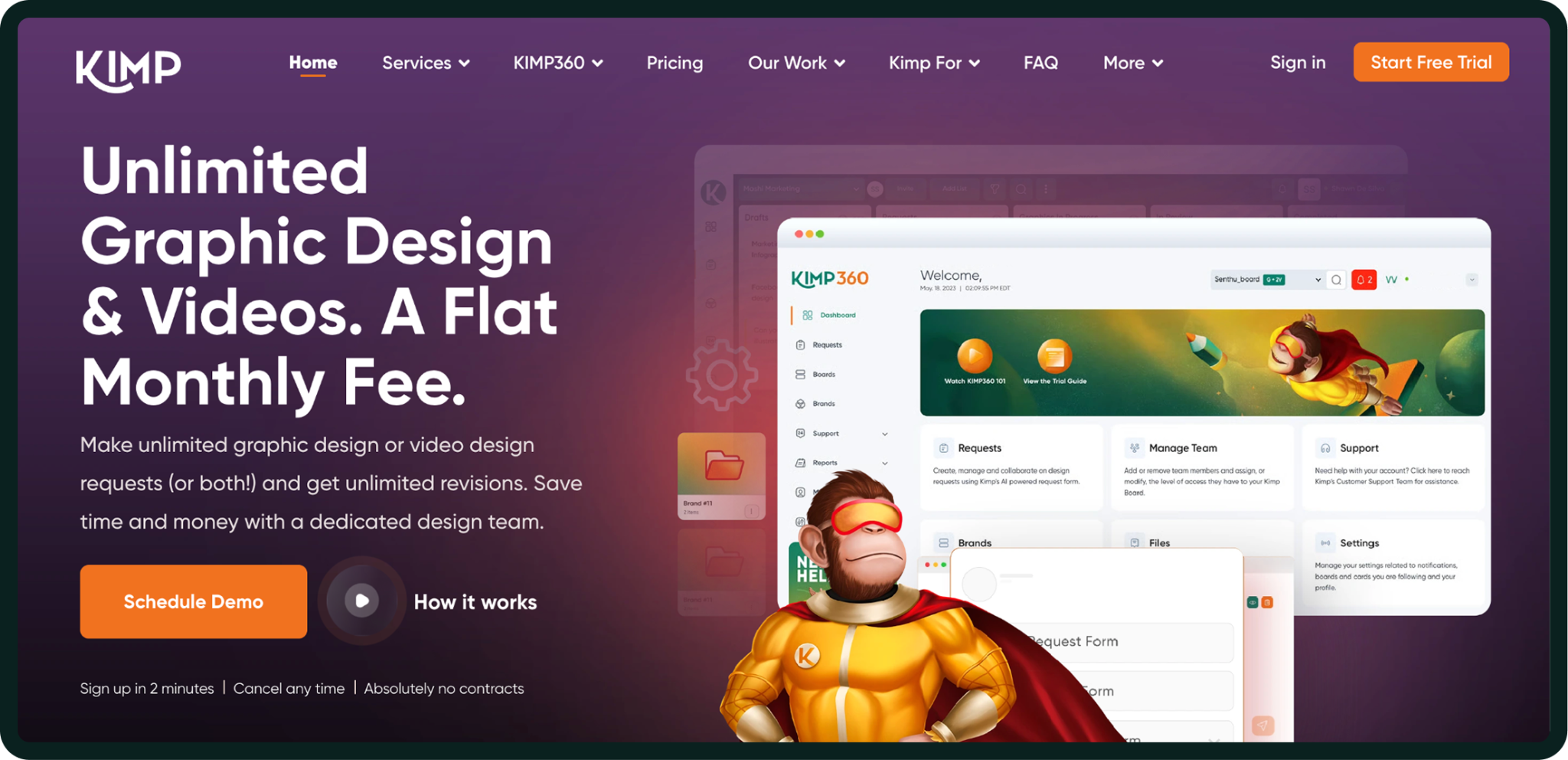
Best for: Teams pushing a large volume of social graphics, ads and short videos that need a fast daily cadence more than creative leadership.
Price:
- Kimp Graphics: $1,397/month with 3 active requests ($698.50/month for the first four months)
- Kimp Video: $1,397/month with 2 active requests ($698.50/month for the first four months)
- Graphics + Video: $1,697/month with 5 active requests ($848.50/month for the first four months)
Every plan starts with a free trial and has no contract, and pausing costs $19.95/month.
How it works: Every account is assigned its own design or video team, with a regional Project Manager. Simple tasks turn in around 24 hours; complex ones take 2 to 4 days.
Strengths: The combined graphics-and-video plan is one of the cheapest ways to get both formats under one subscription, and the trial lets you test before billing starts.
Limitations: Kimp's plan table and FAQ list different active-request counts, so confirm what you're getting. There's no published Art Director or Creative Director role.
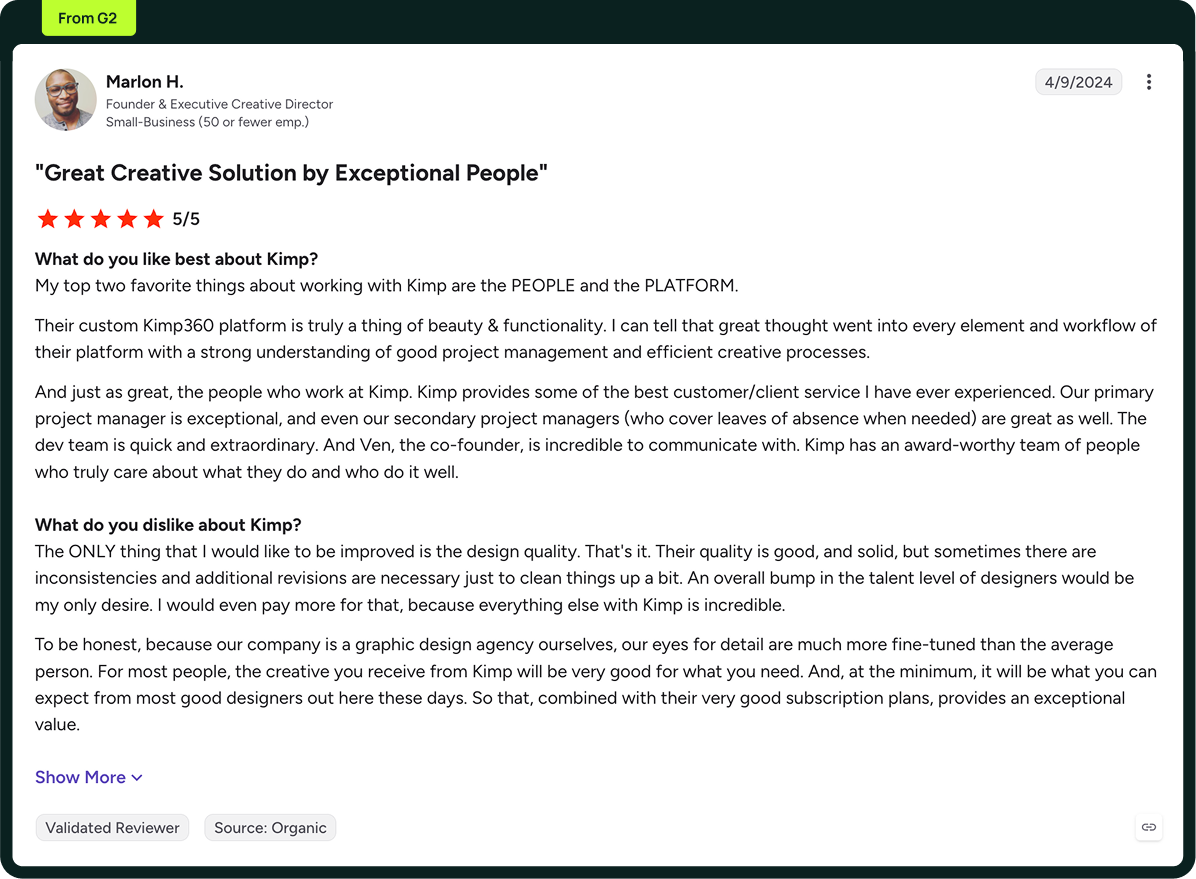
Separately, one reviewer with agency-level standards for detail notes occasional inconsistencies that call for an extra revision round, while adding that most buyers will find the quality very good for the price.
Teams that need direction over volume usually end up on my Kimp alternatives list.
What reviews say: Rated 4.9/5 across 353 Trustpilot reviews, against 4.1/5 across 16 on G2.
Recent Trustpilot reviews, many from agencies, praise consistent quality and quick turnaround.
G2's smaller review sample includes some older criticism of the feedback process. An April 2024 review gives a more balanced picture, praising the Kimp360 platform and the project managers alongside its request for steadier design quality.
Verdict: Shortlist it for volume. Look elsewhere if your work needs a senior eye before it ships.
10. ManyPixels: Best for Fast Daily Production at a Low Price
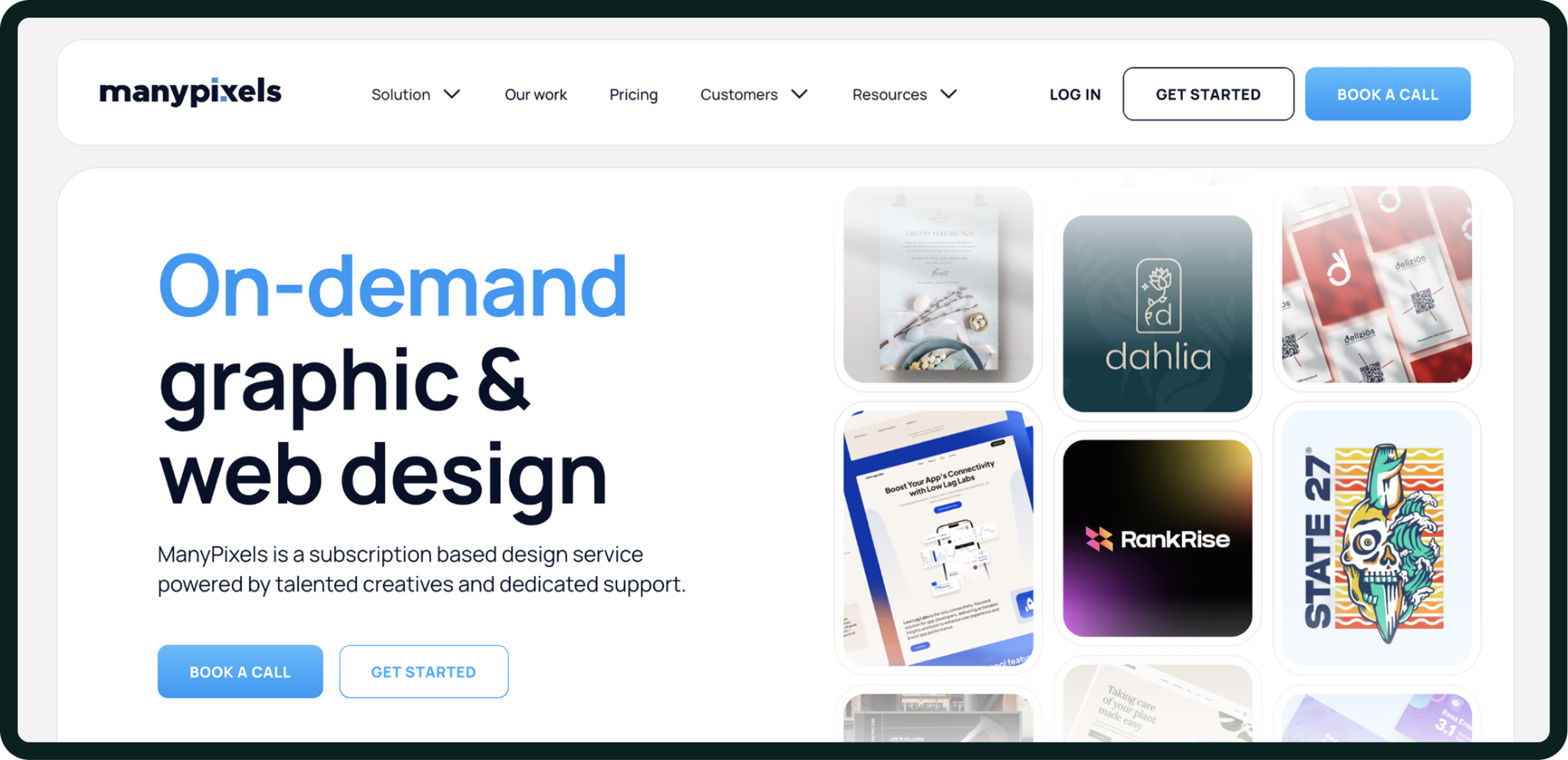
Best for: Teams that want next-day production, a simple portal and the option to upgrade to an assigned designer later.
Price:
- Advanced: $699/month for 1 daily output
- Business: $1,199/month for 2 daily outputs
- Assigned Designer: $1,399/month for a part-time designer of your choice, with same-day delivery
- Design Team: $2,599/month for two part-time designers of your choice, with same-day delivery
Quarterly and yearly billing bring each price down by roughly 10% and 20%. There are no contracts, and pausing costs $10/month.
How it works: Every plan runs through a managed queue, and work is checked for quality before a Project Manager sends it over. Capacity is quoted as daily outputs on the lower tiers, and designers on the assigned plans work set hours in US Eastern, EU or Indochina time.
Strengths: Fast first drafts, dependable output for the price and native source files with full IP transfer on every plan.
Limitations: There's no Creative Director on any tier, and the FAQ is clear that complex work like full brand identities or websites spans multiple days regardless of plan. No trial or money-back guarantee is listed.
Even when the daily cadence works well, budget for a few revision rounds on detailed briefs.
What reviews say: Rated 4.8/5 across 149 Trustpilot reviews and 4.9/5 across 30 on G2.
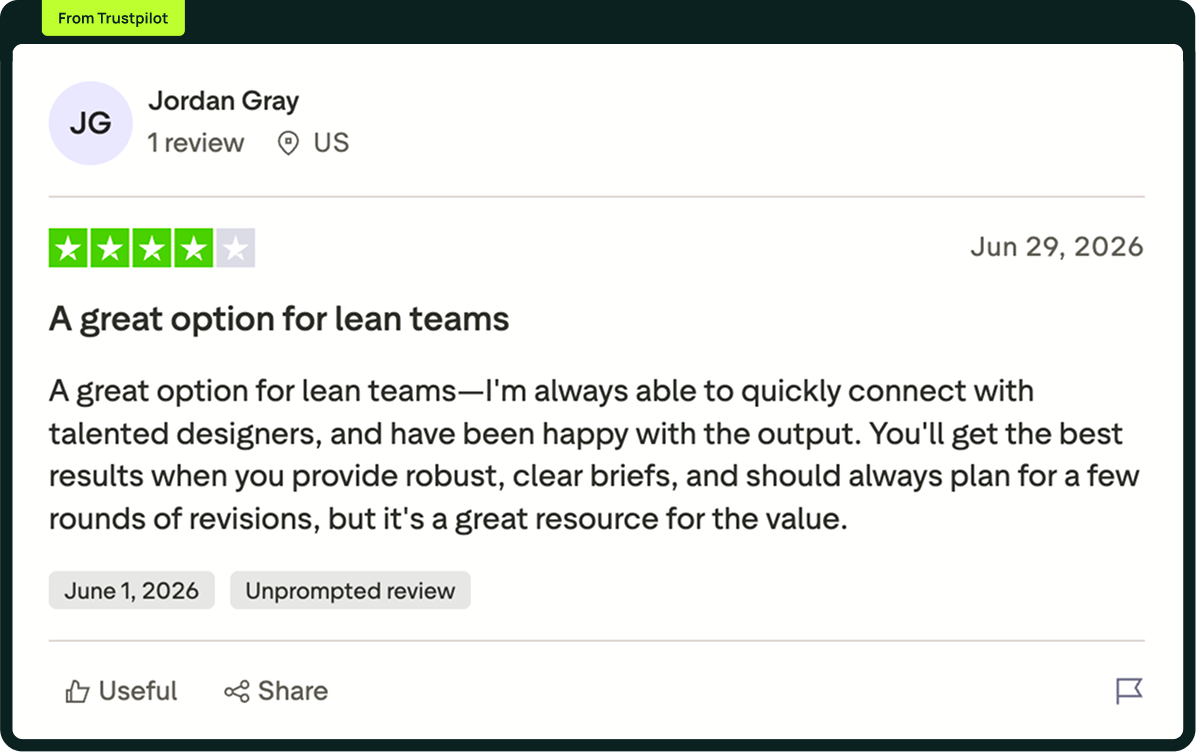
Praise centers on responsiveness and daily updates on overflow work. A June 2026 review calls it a great option for lean teams, with the caveat that you should plan for a few rounds of revisions.
Verdict: A strong production engine for the price. Pair it with your own creative direction or move up the list when you need someone to provide it.
11. Awesomic: Best for Startups That Want a Designer Matched Fast
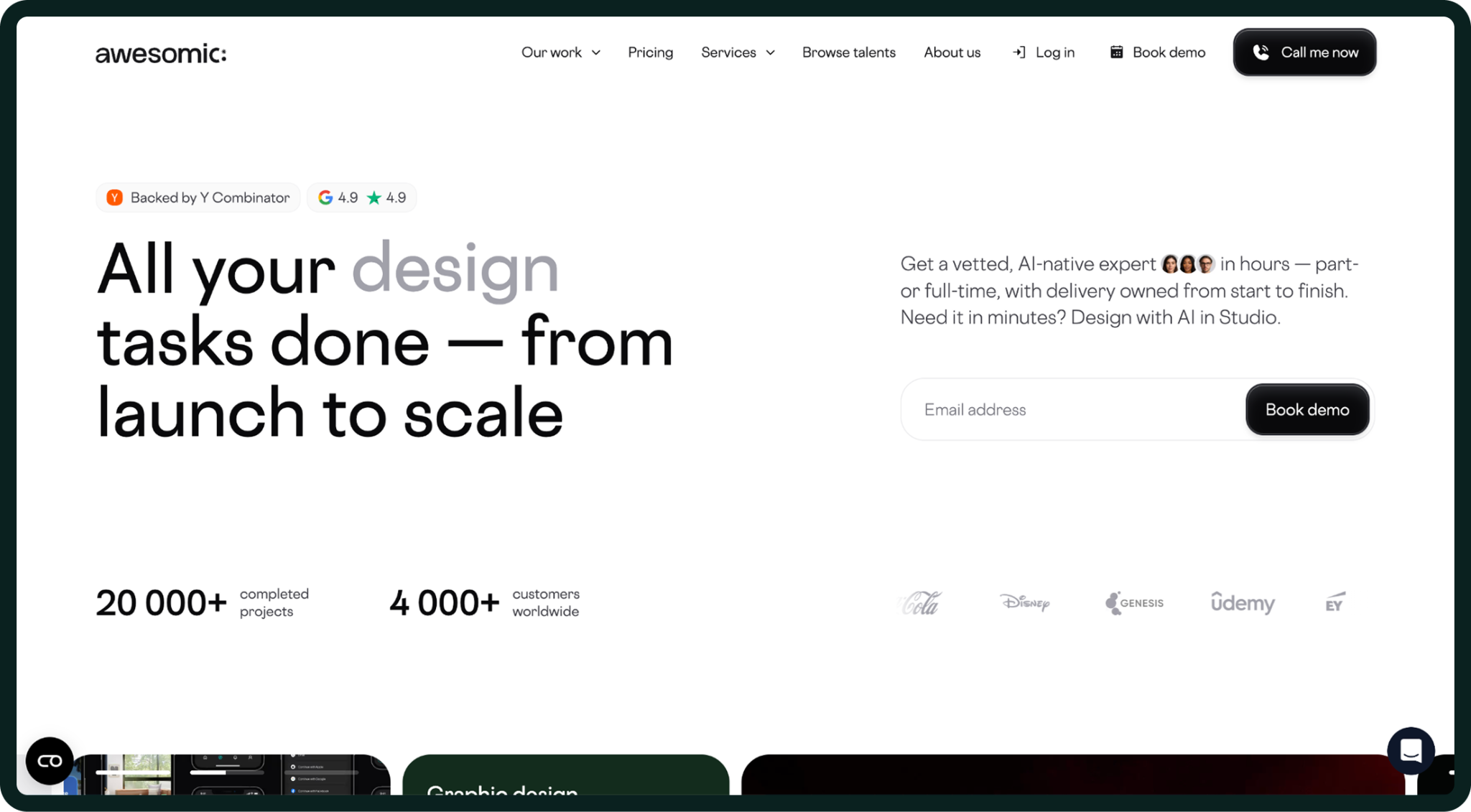
Best for: Startups that want a designer matched within 24 hours, with a free rematch if the fit is wrong, and the option to add copy and Webflow later.
Price:
- Graphic Pack: $1,490/month, or $1,190/month on a quarterly commitment
- All-in-One: $2,995/month ($2,396 quarterly), covering design, no-code, copywriting and QA
- Dedicated Talent: quoted
- AI Designer: $200/month for AI-generated pages
The quarterly plan can only be canceled after three months.
How it works: A talent-matching model rather than a fixed studio. Standard tiers give you part-time talent and a single task in progress, while Dedicated Talent adds its own Project Manager.
Strengths: Speed to start and the rematch guarantee remove the usual onboarding risk, and reviewers rate the experience highly.
Limitations: Hours of work per day aren't published, and its site shows the same plan at different prices in different places, so confirm the number in writing. Standard tiers also cap you at a single task in progress.
What reviews say: Rated 4.9/5 across 66 Trustpilot reviews, with no recurring complaint; the one mild criticism, from 2023, is cost.
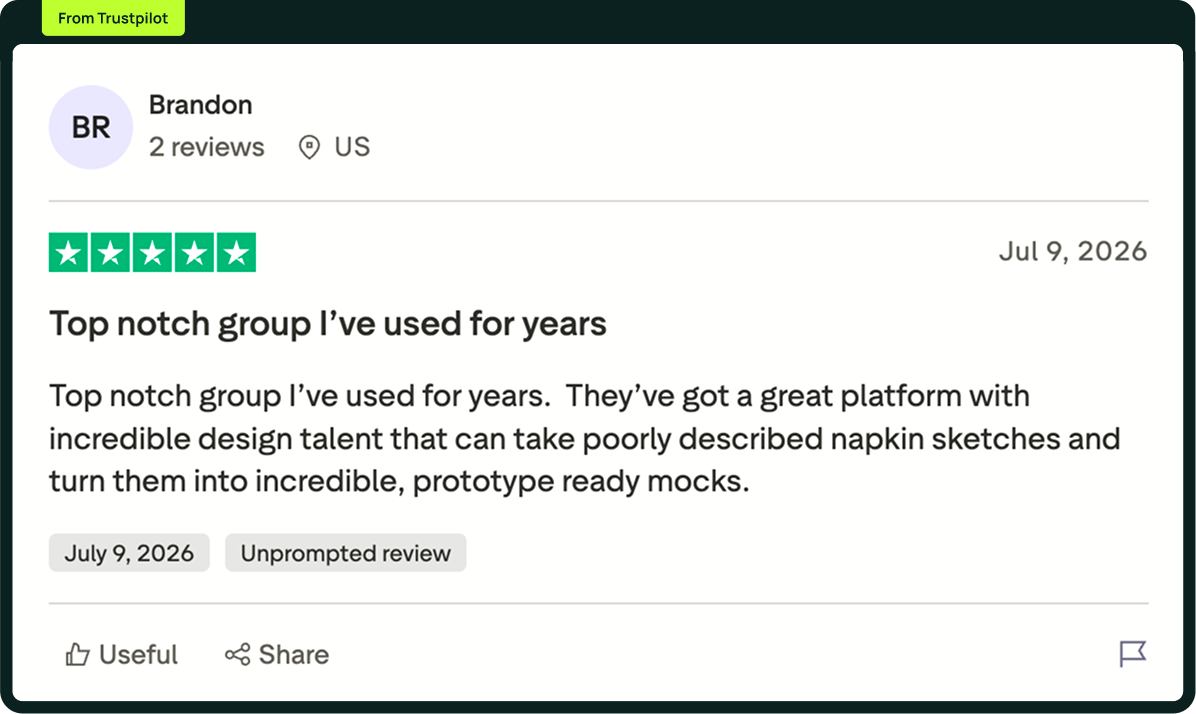
A July 2026 review from a long-time customer credits the designers with turning rough sketches into prototype-ready mockups.
Verdict: A good fit for an early-stage team that wants a designer this week. Clarify hours and active tasks before you commit to a quarter.
12. No Limit Creatives: Best for a Steady Stream of Ad Creative
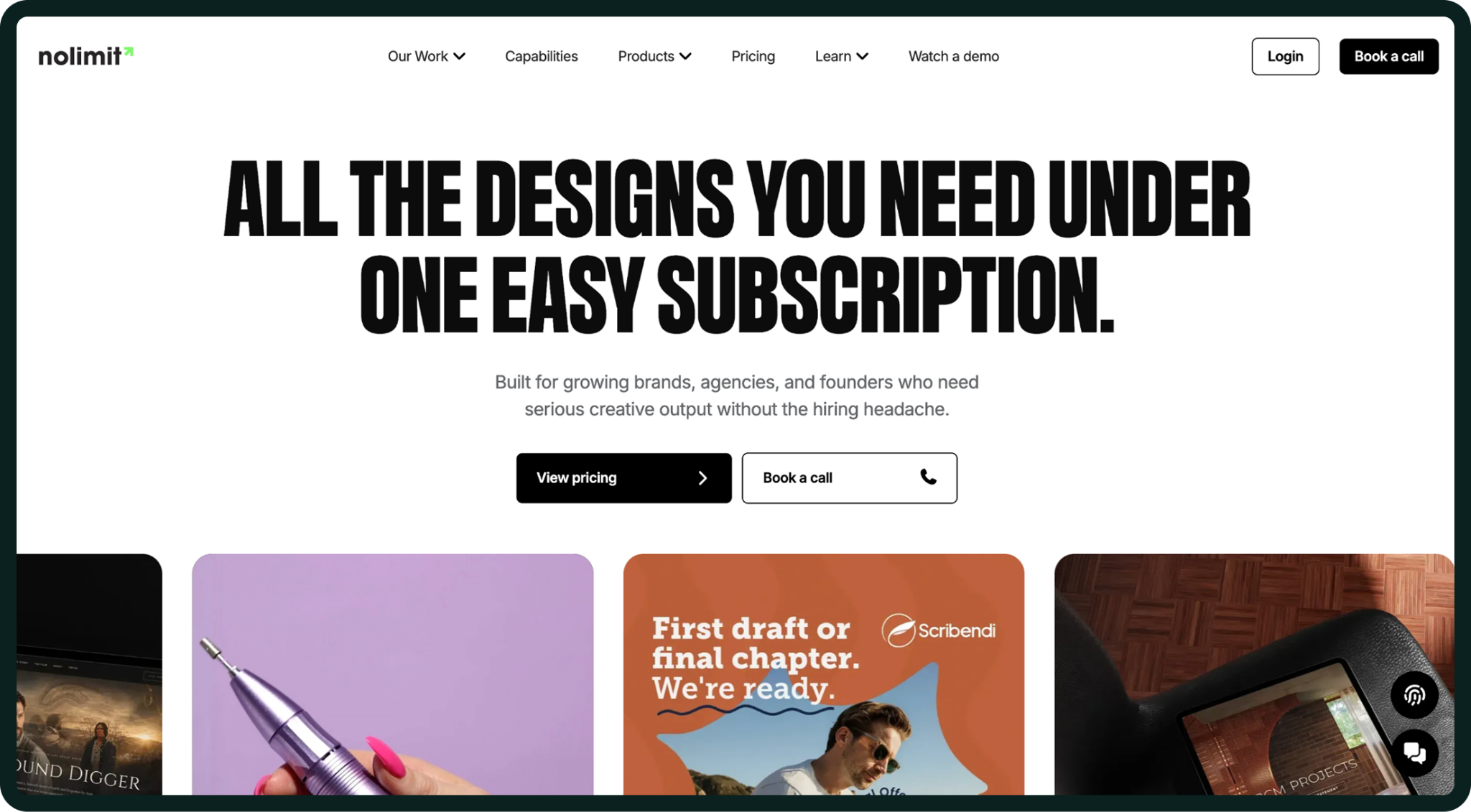
Best for: Performance marketing and ecommerce teams that need social ads, product visuals and short video on a continuous cycle.
Price:
- Digital Ads Starter: $250/month, credit-based rather than unlimited requests
- Unlimited-request plans (Digital Ads, Ecom, Marketing or Full Stack): advertised from $500/month, with the exact price set by the plan and the number of design slots
You pick the slots on a slider, and per-plan prices only appear once you set it. More than six slots requires a sales conversation, and there are no contracts.
How it works: Each slot is a request worked on in parallel. On managed plans, a Creative Director and a Project Manager take care of briefs, check-in calls and copywriting.
Strengths: Built for the ad-creative loop specifically, with motion and short-form video in the base plans and a Creative Director on managed tiers at a lower price than most of its competitors.
Limitations: The slider pricing makes it hard to compare without working through the configurator, and sales are final. The scope leans performance; brand and long-form design live in the higher plans.
Design slots also cap how many requests move at once, since each slot holds one request in progress.
What reviews say: Rated 4.9/5 across 262 Trustpilot reviews. Recent reviews praise quick turnaround on video and responsive account support.
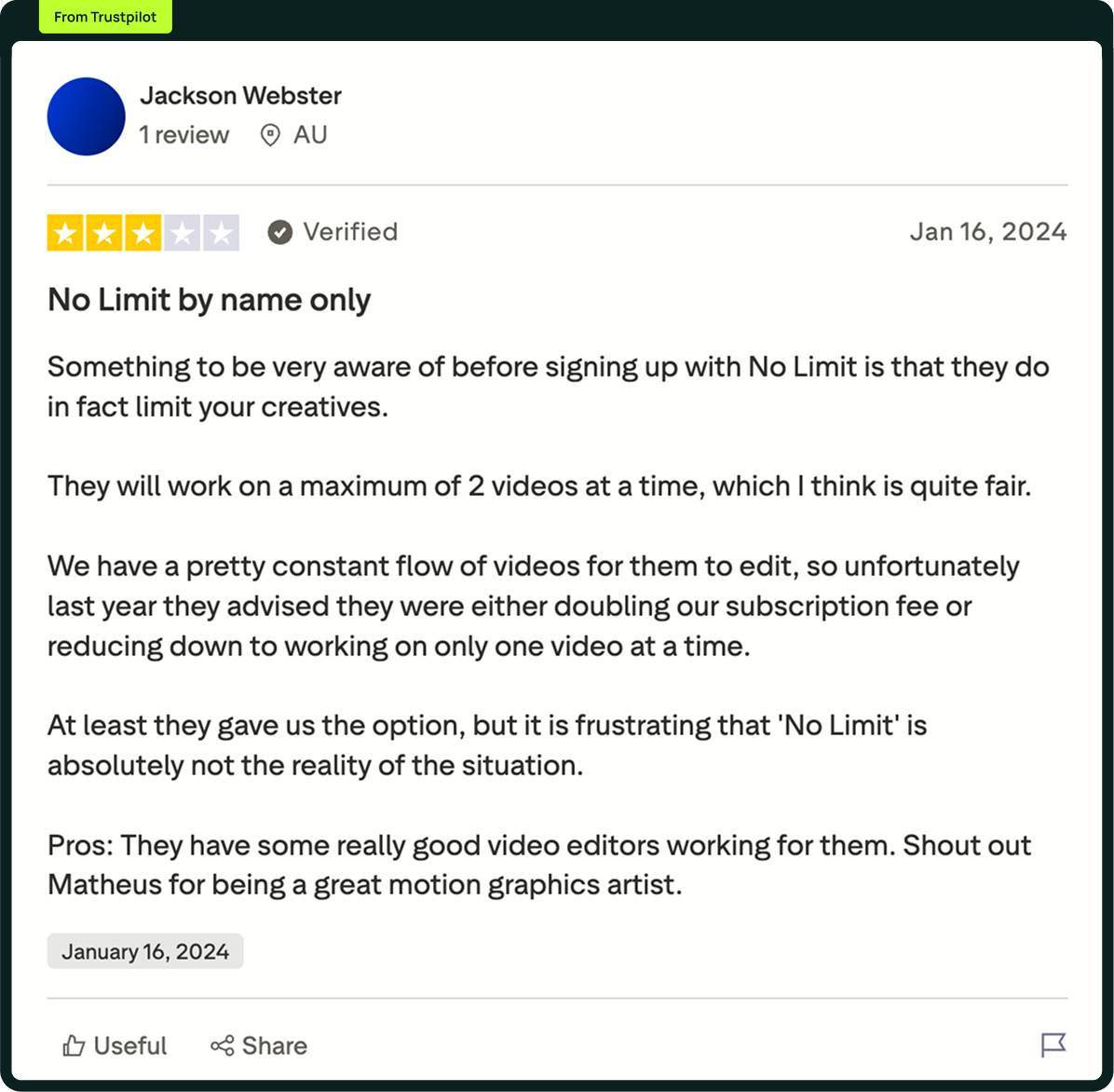
The most useful critical one, from January 2024, comes from a video customer who was offered a price increase or a limit of one video at a time. Those 2024 terms may have changed, but the slot model behind them still sets the pace.
Verdict: Shortlist it if your queue is mostly ads. Less relevant if you need decks, brand work and web in the same subscription.
13. Delesign: Best for One Dedicated Designer on a Fixed Daily Schedule
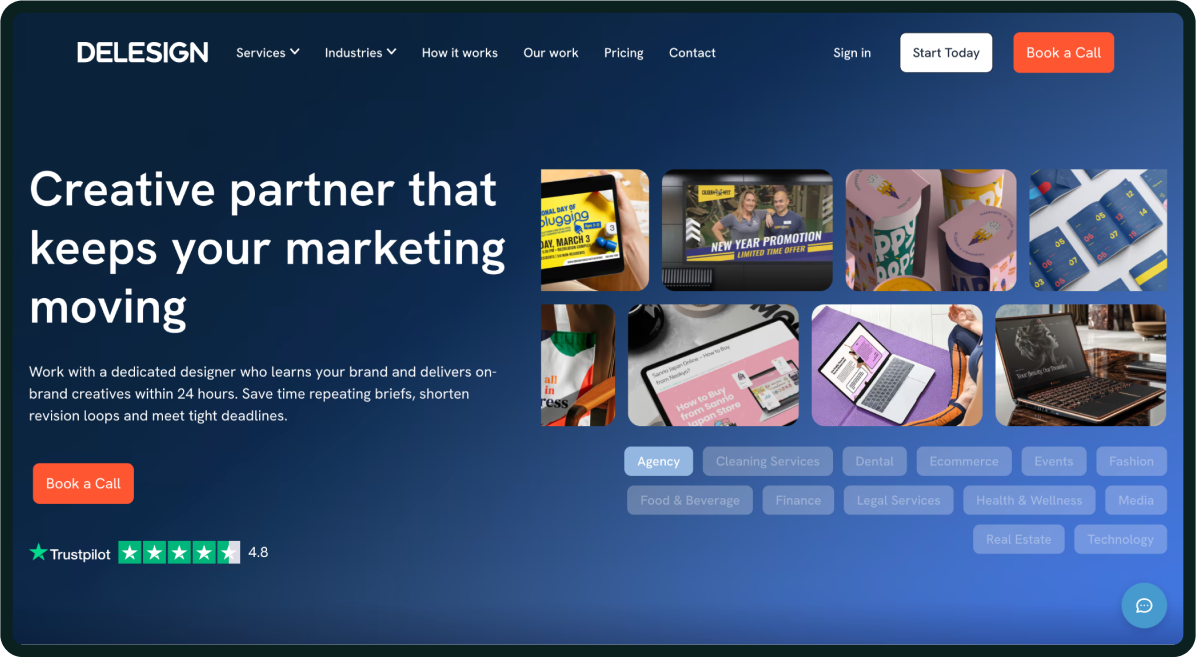
Best for: Small teams that want the same designer every day for a predictable two hours, in their time zone.
Price:
- Marketer Growth: $899/month for a dedicated graphic designer at 2 hours per business day
- Agency Booster: $1,199/month, adding a senior designer, an art director, web design, video and motion
- Enterprise: quoted
- Add-ons: a web developer ($649/month) or an SEO writer ($899/month)
Any plan can be refunded if you cancel in the first 15 days.
How it works: An unlimited queue you prioritize, first drafts in one business day, a design manager overseeing quality. To get more capacity, you buy another subscription and get another designer with it.
Strengths: Predictability. You know who's working and when, and Agency Booster adds art direction at a price most competitors reserve for higher tiers.
Limitations: Prices are up from the $649 and $849 quoted in earlier comparisons.
Two hours a day can slow larger projects. That cap is built into the plan, so it applies however good your designer is, and it's the gap I looked at when I compared Delesign alternatives.
What reviews say: Rated 4.8/5 across 48 Trustpilot reviews, with recent ones praising reliability and quick revisions.
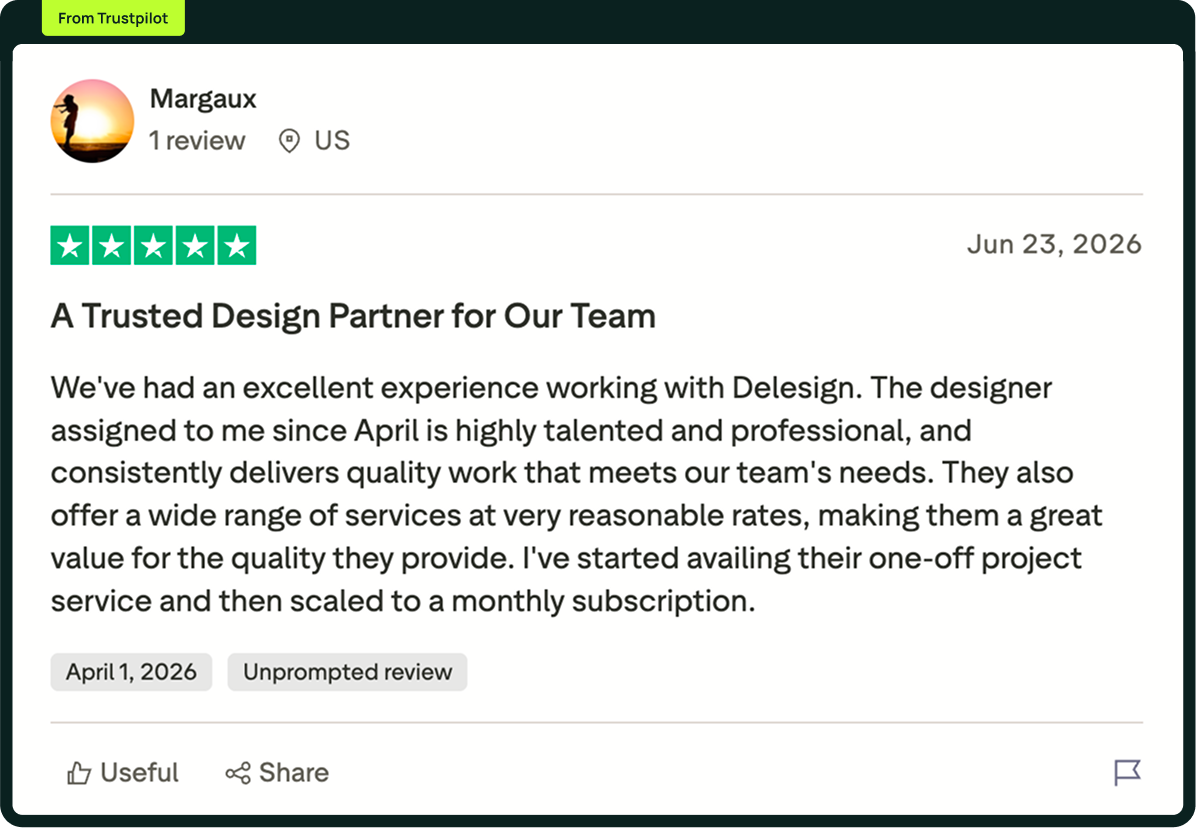
A June 2026 review fits the customer Delesign serves best: a team that started with one-off projects and moved to a monthly subscription after finding a talented, professional designer at reasonable rates.
An older critical review from May 2022 reflects one customer's experience: the work was good, but communication was thin and two hours a day felt too little for bigger jobs.
Verdict: A fair deal for a small, steady queue. Outgrown quickly once a campaign needs more than two hours of attention a day.
14. Renlar (Formerly Reel Unlimited): Best for Agencies Reselling Graphics, Video and Web
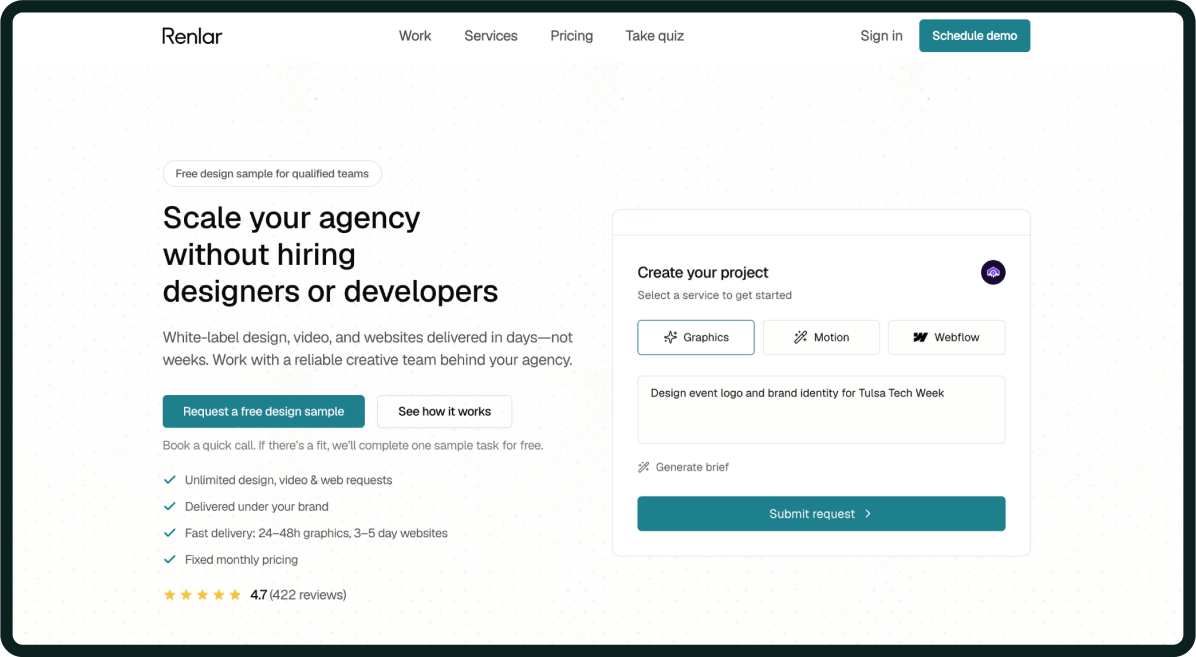
Best for: Agencies and consultants who want a white-label portal and a mix of graphics, video and website builds to resell.
Price:
- Graphics & Video: $895/month with 2 active requests
- Websites & Development: $1,395/month with 1 active request
- Bundle: $1,995/month with 3 active requests
Quarterly billing saves 10% and annual billing 20%, and every plan has a 7-day money-back guarantee.
How it works: Reel Unlimited rebranded as Renlar in late 2025. Graphics and video turn in 24 to 48 hours, websites in 3 to 5 days, with priority turnaround on the Bundle.
The white-label portal is included on every plan.
Strengths: Webflow, Framer and WordPress builds inside a subscription at this price are rare, and the portal is designed for reselling.
Limitations: The rebrand left Renlar without an independent review track record, so the 7-day money-back guarantee and client references carry more weight than usual. Web work also moves one active request at a time.
What reviews say: Renlar has no reviews under its current name on G2, Trustpilot or Clutch yet. It advertises a 4.7 rating across 422 reviews without saying which platform they come from, so ask for two or three agency references on the discovery call.
Verdict: Worth a look for agency white-label work. Marketing teams buying for their own brand will find more depth with a managed team.
15. NUMI: Best for Startups That Need Product and UI Design
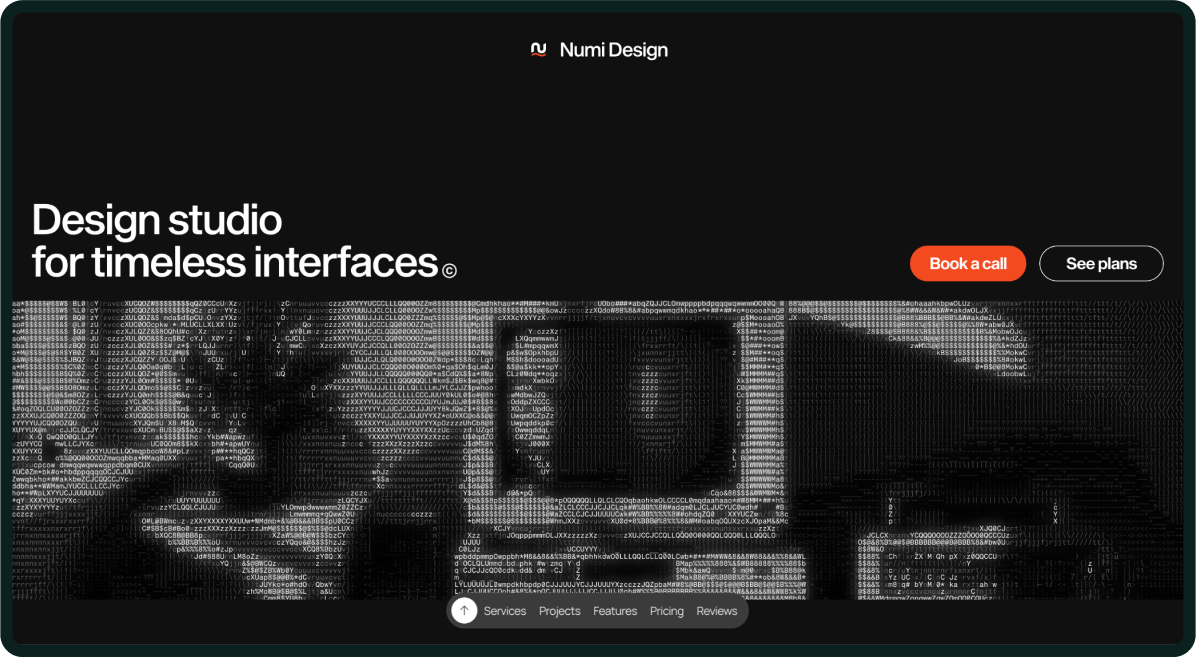
Best for: Early to growth-stage startups that need mobile app, SaaS and dashboard design, plus marketing collateral, from product designers rather than production designers.
Price:
- Design: mid-level product designers, with a one-week free trial
- Design+: senior designers and user research assistance, with a one-week trial
- Embedded tier: ongoing design for growth-stage companies
None of the tiers has a public price, so pricing comes from a demo call.
How it works: One request at a time, with up to two to four design syncs a week depending on tier and monthly office hours on the lower plans. Designers are mentored in-house, and the company is backed by Y Combinator.
Strengths: The only one of the 15 built around product design first, with user research support on Design+.
Limitations: No public pricing, one request at a time, and the lower tiers use mid-level designers. Marketing design is secondary to product work.
What reviews say: No meaningful third-party review base. Judge the portfolio and the trial.
Verdict: The right call if the work is product UI. Not the right call if the queue is marketing campaigns.
How Design Subscription Agency Services Actually Work
Every design subscription agency sells the same promise: a flat monthly fee for ongoing design work, without hiring or agency retainers.
Even the best subscription design services cap output somewhere, and the differences live in how that capacity is measured.
There are four models, and your effective price depends on which one you're buying:
Active Project Limits
You can queue as many requests as you like, but only a set number are worked on at once. Teamtown, Penji, Designjoy, Kimp and Growmodo all work this way. One active project means a five-asset campaign waits in a line.
Daily Hours
You buy a fixed number of hours of a designer's day. Flocksy, Delesign and Design Pickle use this model. It's transparent, and it's also finite: two daily hours is 42 hours a month, whatever your queue looks like.
Daily Outputs
ManyPixels quotes capacity as one or two deliverables a day. Simple to understand, as long as your definition of "one deliverable" matches theirs.
Monthly Budget or Hours Allowance
Superside and Designity price against a monthly pool, and Teamtown pairs a monthly hours allowance with its active project limits on every plan.
The question here is rollover: Designity's hours expire, Superside's budget carries for three months, and ours rolls over one month.
How Capacity Plays Out on a Real Queue
Here's a simplified illustration. Say your team submits 20 requests in a month: 12 social graphics, 4 ad sets, 2 decks and 2 landing pages.
Assume about a third need a second round and that every request or revision takes two business days, which real work rarely does.
On a plan that works one request at a time, that's roughly 27 two-day cycles in a single line, so under these assumptions the queue takes more than two months to clear.
Five active projects let the same queue move in parallel, so requests start sooner and less of it sits idle. That isn't five times the output, because an hours allowance or a designer's working day still caps the total.
The subscription price is only part of the cost; the rest is the campaign that waited.
That's also why the CaaS model matters. A managed team with a Project Manager absorbs the coordination work that otherwise lands on your marketing manager.
What Subscription-Based Design Services Cost in 2026
Published prices across these 15 agencies range from $250 to more than $30,000 a month, which tells you almost nothing on its own. A more useful way to compare is cost per approved asset.
Cost per Approved Asset
Take your monthly fee and divide it by the number of assets your team actually approved that month. A $2,000 plan that produced 25 approved assets cost $80 each.
A $3,500 plan that produced 50 cost $70 each, and included someone directing the work.
Run the calculation on a real month rather than a sales deck, because turnaround, revision rounds and how many requests can run in parallel all move the denominator. Keep two cautions in mind:
- An asset count flattens complexity: a logo system and a resized banner both count as one.
- It hides the hours your own team spent writing briefs, chasing revisions and checking brand consistency, which is where a Project Manager and Creative Lead earn their cost.
Pricing Patterns to Watch
- Headline prices that assume annual billing (Flocksy's $1,199 requires an annual plan against a $1,699 list price).
- Platform or software fees on top of the plan (Superside adds $1,000 a month).
- Promotional rates with an expiry (Kimp's half-price four months, Designjoy's "lifetime discount," introductory discounts for new customers).
- Pause fees ($995 at Designity, $19.95 at Kimp, $10 at ManyPixels).
- Hours or budget that expire at renewal, which makes a slow month a wasted one.
- Quarterly or annual billing cycles presented as "cancel anytime."
Subscription Versus an In-House Hire
If you're weighing a subscription against a hire, I've broken down hiring a designer at 2026 salary and overhead rates.
We estimate our clients save about 60% compared with an in-house hire once salary, benefits, tools and management time are counted.
How to Choose the Right Design Subscription Agency
Match the agency to the shape of your queue rather than to the lowest number.
- You need a dedicated team across formats, month to month: Teamtown. Decks, ads, email, web, brand and motion from the same people, with a Creative Lead keeping it consistent. Browse our design services to see each format in practice.
- You need enterprise scale with video, 3D and localization: Superside. If $16,000 a month on an annual term (the $15,000 minimum plus the software fee) is already approved, the breadth is unmatched.
- You need a lower-priced way to test the model: ManyPixels or Penji. Both get you general-purpose production for about $700 to $1,000 a month.
- You need one senior designer and Webflow, one request at a time: Designjoy.
- You need a Creative Director with strategy hours: Designity, as long as your workload is steady enough that expiring hours don't hurt.
- You need design plus development: Growmodo.
- You need named specialists billed by the hour: Flocksy.
- You need volume in social and video: Kimp.
- You need a steady ad-creative stream: No Limit Creatives.
- You need product and UI design for a startup: NUMI, or Awesomic if speed to start matters most.
- You're an agency reselling work: Renlar, or Growmodo for white-label development.
Ten Questions to Ask on the Discovery Call
- How many requests are worked on at the same time, and what counts as one request?
- Is capacity measured in hours, outputs or projects, and what happens to what I don't use?
- Will the same people work on my account every week, and who covers when they're out?
- Who reviews work before it reaches me, and is there a Creative Lead or Art Director on my plan?
- How many revision rounds are included, and how are they counted?
- What's the average first-draft turnaround for a deck, an ad set and a landing page, separately?
- Do I receive native source files, and do I own everything, including work made during a trial?
- Which services are excluded from my plan or billed as add-ons?
- What are the billing cycle, notice period and refund terms, in writing?
- Can you show me three pieces of work for a company in my industry, with the brief they came from?
Answers to the first three tell you more than any price list.
If you want to see how we'd answer them, our branding design, ad creative and web design services show the work behind each format.
Put a Dedicated Design Team on Your Backlog
If decks, ads, email and web are all competing for the same designer on your team, we'd like to show you how a dedicated team clears it.
Book a demo and bring your last month of requests. We'll tell you which plan fits, and if a cheaper service is the better call for your volume, we'll tell you that too.
Frequently Asked Questions
What is the best design subscription agency in 2026?
For a marketing team with recurring, multi-format work, Teamtown is the best design subscription agency. You get your own team, led by a Project Manager and Creative Lead, from $3,000 a month and without a long-term contract.
Superside is the best enterprise option at $16,000 a month including its software fee, on an annual term, while ManyPixels and Penji are lower-priced options for general-purpose production from $699 and $995.
The right answer depends on how many projects you need running in parallel and whether you want creative direction included.
How much do design subscription agency services cost?
Published prices run from $250 a month for a credit-based ad creative plan to $16,000 or more for enterprise plans on annual terms. Of the 13 agencies I compared that publish prices, 12 start between $250 and $6,000 a month, with Superside the outlier.
Compare cost per approved asset and check whether unused capacity rolls over before comparing headline prices.
What is included in a subscription-based design service?
A flat monthly fee covers a defined amount of design capacity, usually across graphics, social, ads, presentations, email and web. Higher tiers add video, motion, 3D, copywriting and a Creative Director or Art Director.
Brand strategy, campaign planning and user research are usually excluded or sold as add-ons, so confirm scope in writing.
Are unlimited design requests really unlimited?
No. "Unlimited" refers to how many requests you can submit, never to how many get done. Every one of these 15 agencies caps throughput with active project limits, daily hours, daily outputs or a monthly allowance.
As a rough illustration, one active request with a 48-hour turnaround tops out around 10 to 12 deliverables a month even if nothing needs a revision, and complex work or revision rounds bring that lower.
What's the difference between a design subscription agency and a traditional creative agency?
A traditional agency scopes and prices each project, with a retainer for ongoing work and strategy usually included.
A design subscription agency charges a flat monthly fee for continuous production capacity, with faster turnaround and lower cost per asset, and typically leaves strategy with your team.
Subscriptions suit a steady stream of execution work; agencies suit large, concept-led campaigns.
When does a design subscription pay off for a small business?
It pays off when you have a steady monthly need, roughly ten or more assets, and the cost of a subscription is lower than the designer hours or agency fees you'd otherwise pay.
If you need a handful of assets a quarter, project-based work or a contractor will cost less. Start on the lowest tier that matches your parallel-project need and move up only when the queue backs up.
Can design subscription agencies handle web design, branding and video?
Most handle graphics and social on every plan, while web design, branding systems, video and motion vary by tier:
- Teamtown includes web, branding and simple video on Essentials, with complex video, motion and 3D on Pro.
- Designjoy includes Webflow but excludes video.
- Kimp sells video as a separate plan.
- Growmodo and Renlar include development.
Check the exclusion list, not just the inclusion list.
Do design subscription agencies work with marketing agencies?
Yes. Renlar and Growmodo are built around white-label delivery, and No Limit Creatives and Delesign offer it on higher tiers.
Teamtown works with agencies that need production capacity for client work, though our primary focus is in-house marketing teams. Before you resell, ask whether the white-label portal, source files and client-facing communication are included.
Should I choose a dedicated team or a single designer?
A single designer gives you one consistent point of view and a direct working relationship. It can suit founders or small teams with a focused design queue, although it isn't necessarily cheaper than a team-based subscription.
A dedicated team gives you parallel capacity, specialist skills across formats and someone reviewing work before it reaches you, and it fits a marketing team running campaigns.
The deciding question is how often you have more than one thing waiting.