Quick Answer: The best Designity alternatives depend on why you are leaving. If it is the $5,995 floor or the 120 hours that expire each month, Teamtown, Flocksy and ManyPixels all start lower, and two of them carry unused time forward. If you already have someone directing creative internally and do not need Designity's strategic layer, Penji, ManyPixels or Designjoy give you production without it. For the Creative Director model at larger scale, Superside is the like-for-like, at roughly triple the price.
Key Takeaways
- Designity is a Creative Director-led service built around monthly blocks of dedicated hours. Plus is $5,995 for 120 hours, Premium $8,995 for 180, roughly $50 per included hour. Two-week trial with nothing upfront, seven days' notice to cancel.
- The hours are the catch. Unused hours do not roll over, and pausing costs $995 for two weeks a quarter. If your team does not consistently use most of the 120 included hours, some of what you pay for expires unused.
- Customers rate it well. 4.7/5 on G2, 4.8/5 on Clutch, 4.5/5 on Trustpilot. Where reviews mention trade-offs, it is price, visibility, detailed briefs, and continuity when creatives rotate.
- The reasons to compare alternatives are about the shape of the deal, not necessarily the work. A strategic layer you may not use, or hours you may not fill. Different problems, different fixes.
- Teamtown is the fit when you want a dedicated team under the $6,000 floor. One Project Manager, one Creative Lead and designers that do not change, from $3,000 a month, with unused hours carried forward. Book a demo.
Designity is good at what it does, and that shapes what you should be looking for. A named Creative Director scopes every project, routes it to the right specialist and checks it before you see it, from a roster Designity describes as the top 1% of global creatives.
The reviews back that up, so quality is not the only reason teams compare alternatives.
What usually does not fit is the deal. $5,995 a month buys 120 hours that expire at month end, and pausing costs $995 for a fortnight. Fine if you have that much creative work every month and want a director steering it. Expensive if you do not.
Below are the 10 best Designity alternatives, sorted by the reason you might be leaving, with current pricing for each and a note on what you give up by switching. One of them is Teamtown, which I run. It sits at number one, so treat that entry with the scepticism it deserves and hold it to the same tests as the rest.
Designity Alternatives at a Glance
Prices from each provider's own pricing page, September 2026.
Why Teams Look for Designity Alternatives
Four things, all from Designity's own terms rather than from complaints.
The floor. $5,995 a month is the entry point, and Custom starts at $6,000. For a lot of mid-market teams that is the whole creative budget.
The hours expire. Both tiers work out to roughly $50 an hour, a fair rate for director-led work. But the 120 hours are a quota, not a bank, and what you do not use is gone. Pausing for two weeks a quarter at $995 is a limited release valve for a seasonal business.
The strategic layer costs money whether or not you need it. The hours are shared across a Creative Director, Project Manager, Marketing Strategist and the creatives. If you already have senior creative or marketing direction internally, some of that layer may overlap with what your team covers.
Continuity is by project, not by account. The Creative Director stays, but the specialists under them are matched to each brief. For a brand that needs the same hands on every piece, that is a trade-off, and it appears in customer feedback.
None of those is a criticism. They are the conditions under which it is worth $5,995, and the conditions under which it is not.
Where the Reviews Point
Designity's ratings are strong: 4.7/5 on G2, 4.8/5 on Clutch and 4.5/5 on Trustpilot. The more useful signals for anyone comparing alternatives are the trade-offs that show up inside otherwise positive reviews.
Price and transparency
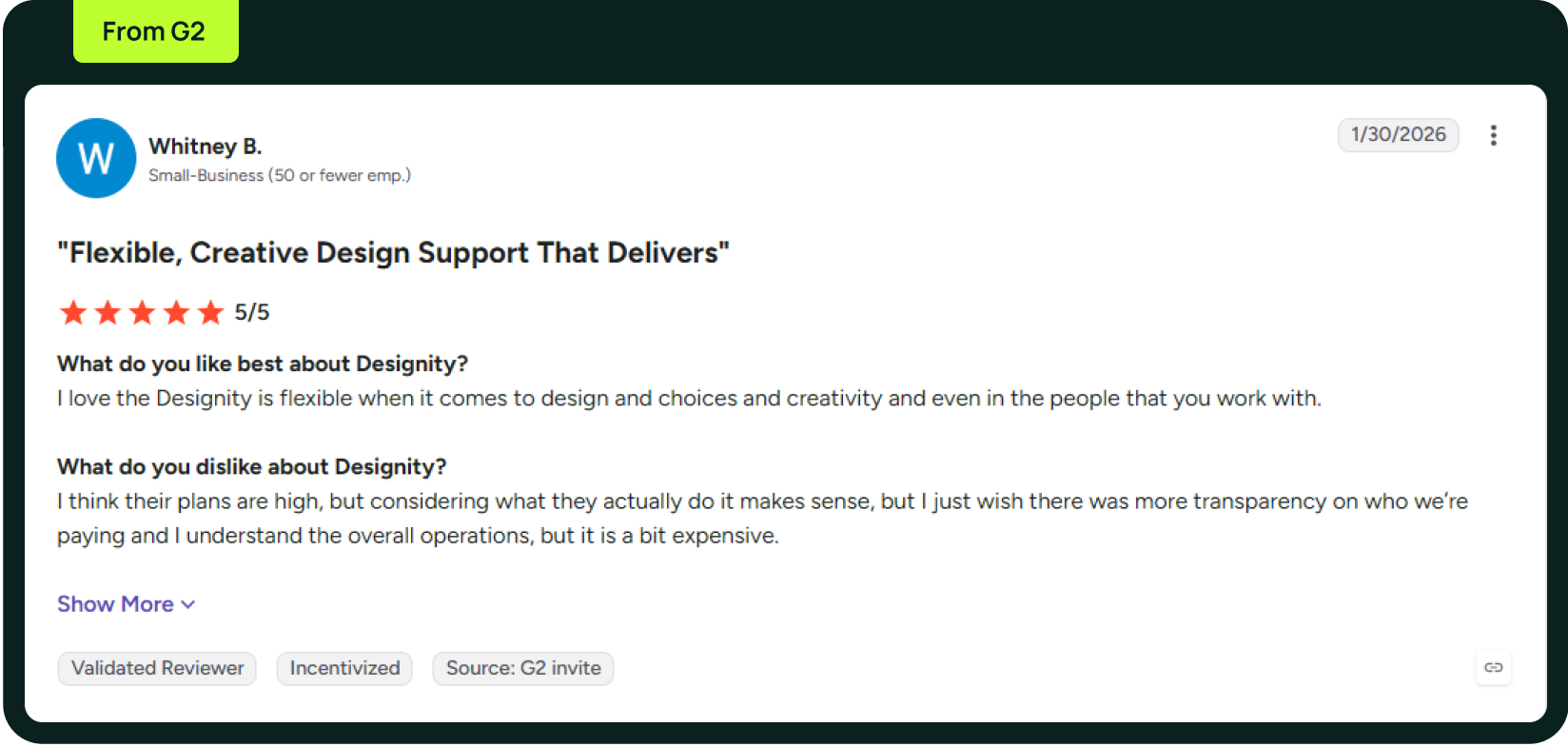
One G2 reviewer, positive overall, still called out the price and wanted more transparency into how the service is structured and where the money goes.
The learning curve around detailed briefs
A verified Clutch review, also positive, points to a learning curve for new clients. To get the most from the service, teams need to arrive with a clear vision and detailed project briefs.

Creative continuity
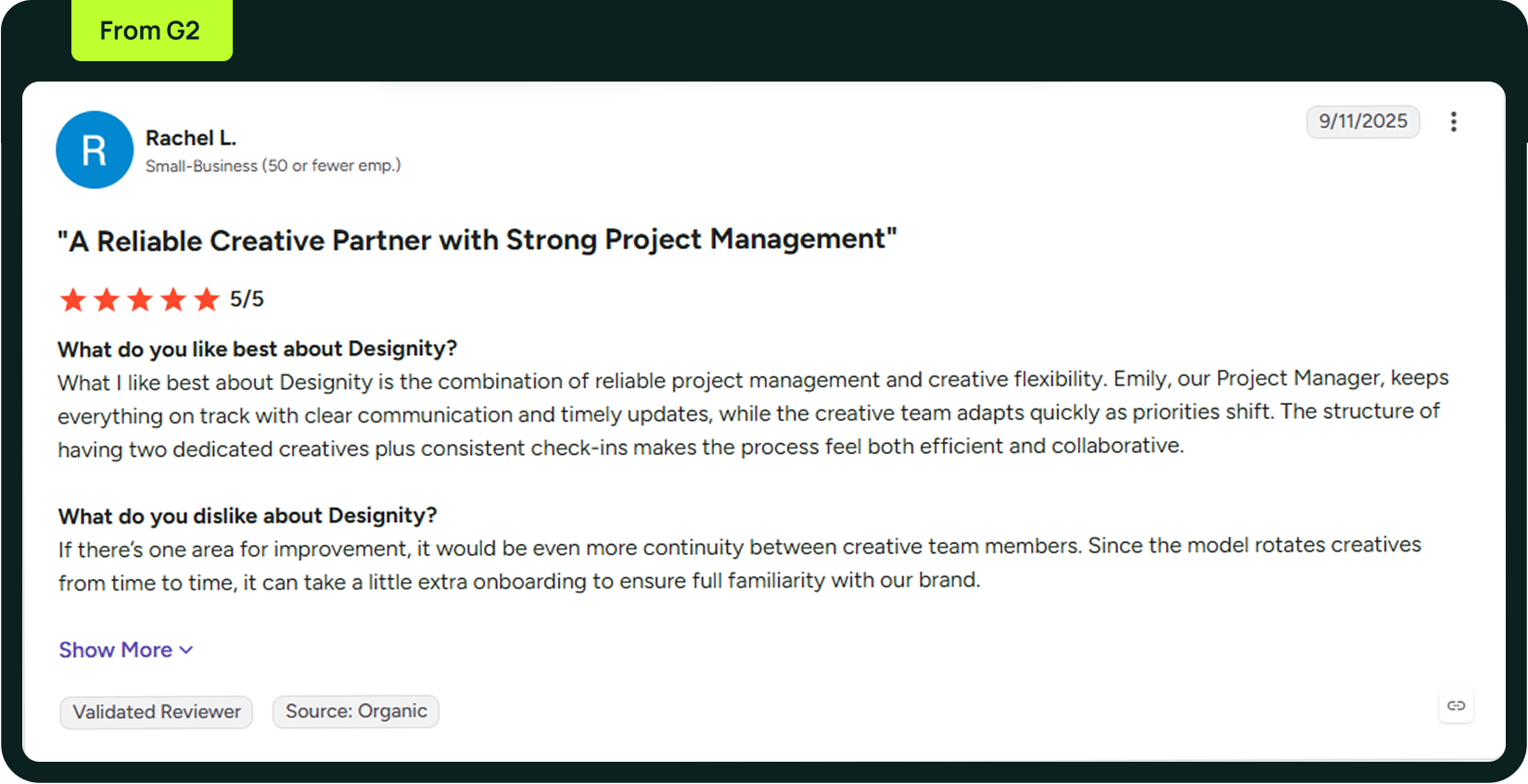
Another G2 reviewer rates Designity highly while noting that creatives can rotate between projects. When someone new joins, that can mean additional onboarding before they fully understand the brand.
None of this points to poor work.
There are trade-offs in the model: you pay more for a managed service, the process works best when briefs are detailed, and a broad specialist roster can mean working with different creatives over time.
If one of those is the reason you are comparing Designity alternatives, it should shape which replacement you consider.
What I Checked, and How
After six years of being in the same business as Designity, I know exactly what it does well.
What I checked for every alternative:
- Is there a director, and is it the same person?
- What happens to unused hours? Rollover, pause, or gone.
- Is it the same team next month? Fixed, assigned on higher tiers, or matched per brief.
- What is the real entry price once introductory rates lapse?
- How many jobs run in parallel, and what is the price of one more?
- What is the exit? Notice, refund, and whether pausing costs.
- What do the reviews say, on whichever platform has a profile, and how many reviews sit behind the score?
I pulled each figure from the provider's own site in September 2026. Several pages ranking for this search still quote Designity at $3,799 to $6,000, which is a year stale. Where nothing is published, I say so.
The 10 Best Designity Alternatives
1. Teamtown: Best for a Dedicated Team Without the $6,000 Floor
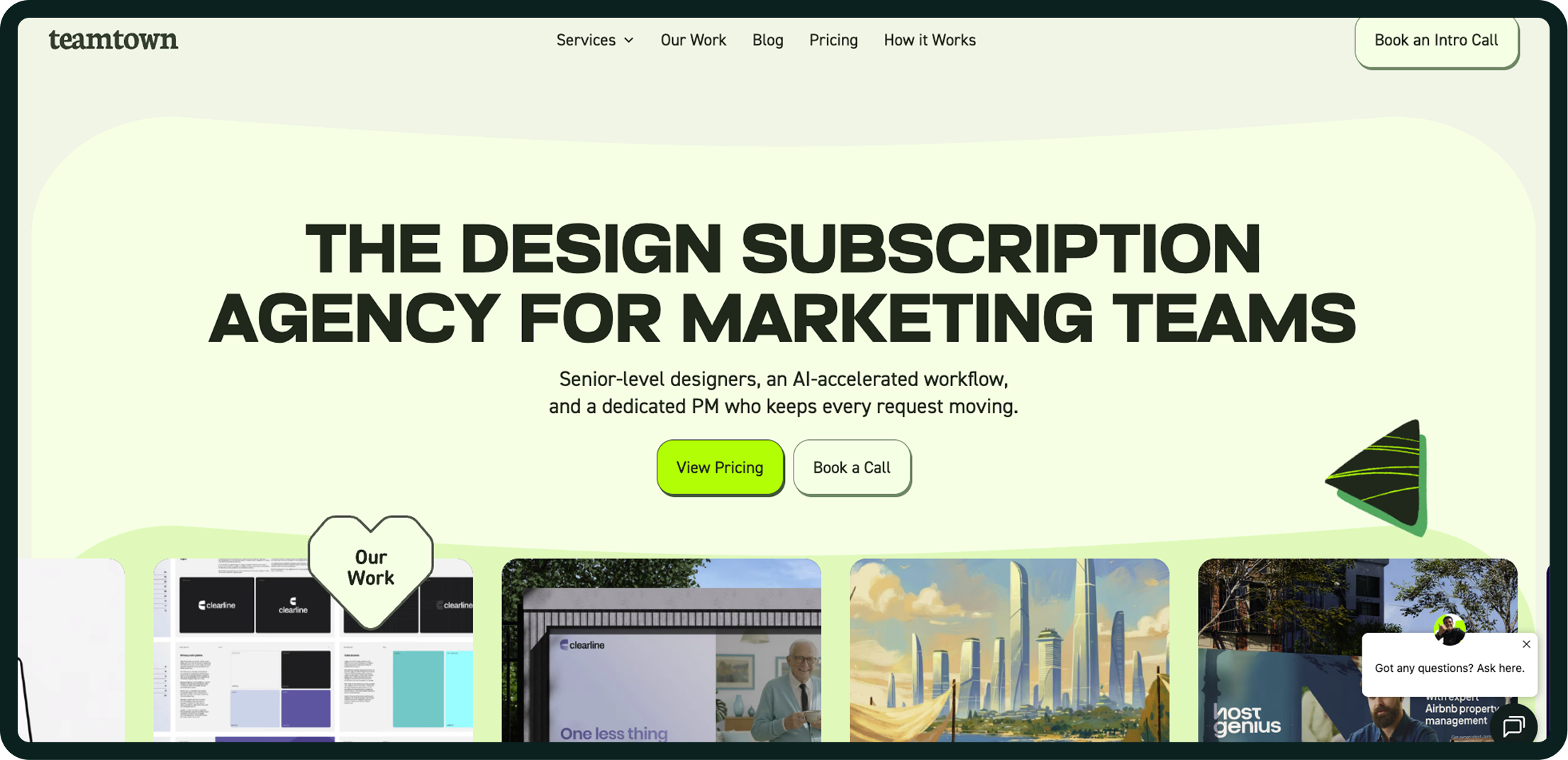
Mine, so hold it to the same standard as the rest.
Teamtown shares Designity's premise: a senior person owns creative direction, a Project Manager runs delivery, and work is managed rather than queued.
Two things differ. The team does not change, so the Creative Lead, Project Manager and designers you meet in month one are the ones you have in month twelve, rather than specialists assigned per brief. And time you do not use carries forward instead of expiring.
For $3,000 a month, Essentials handles web design, branding, ads and social, presentations, and light video and animation. Pro at $4,500 runs five projects in parallel and adds the heavier video, motion and 3D. Communication runs through Slack or the portal, and you get your money back in 15 days.
- Best for: Marketing teams that want a fixed team led by a Creative Lead without the 120-hour commitment.
- Pricing: Essentials $3,000, Pro $4,500, with a Studio tier above that. No annual term; 15 days' notice to leave.
- Rating: 4.6/5 on Trustpilot. Only about 18 reviews sit behind that, so weigh it lightly. What comes up: responsiveness, the standard of decks and marketing materials, and keeping the same team for months.
- Trade-off: With Designity, a Marketing Strategist and consultation hours are part of the plan, so if you want campaign strategy and not just creative direction, Designity's scope is broader. Designity also draws from a larger specialist roster than we field. If the strategic layer is why you signed up, you would be giving it up.
Why rollover matters: across 48 of our own B2B clients, roughly 30% of monthly design time was going unused before we redesigned how we sell it.
That is our data, not Designity's. But if the same 30% pattern occurred on a 120-hour plan, it would mean 36 unused hours, roughly $1,800 a month paid for and not used.
Book a demo and I will go through your last quarter's work and say which way it points. The full head-to-head is on the Designity vs Teamtown comparison.
2. Superside: Best for the Creative Director Model at Enterprise Scale
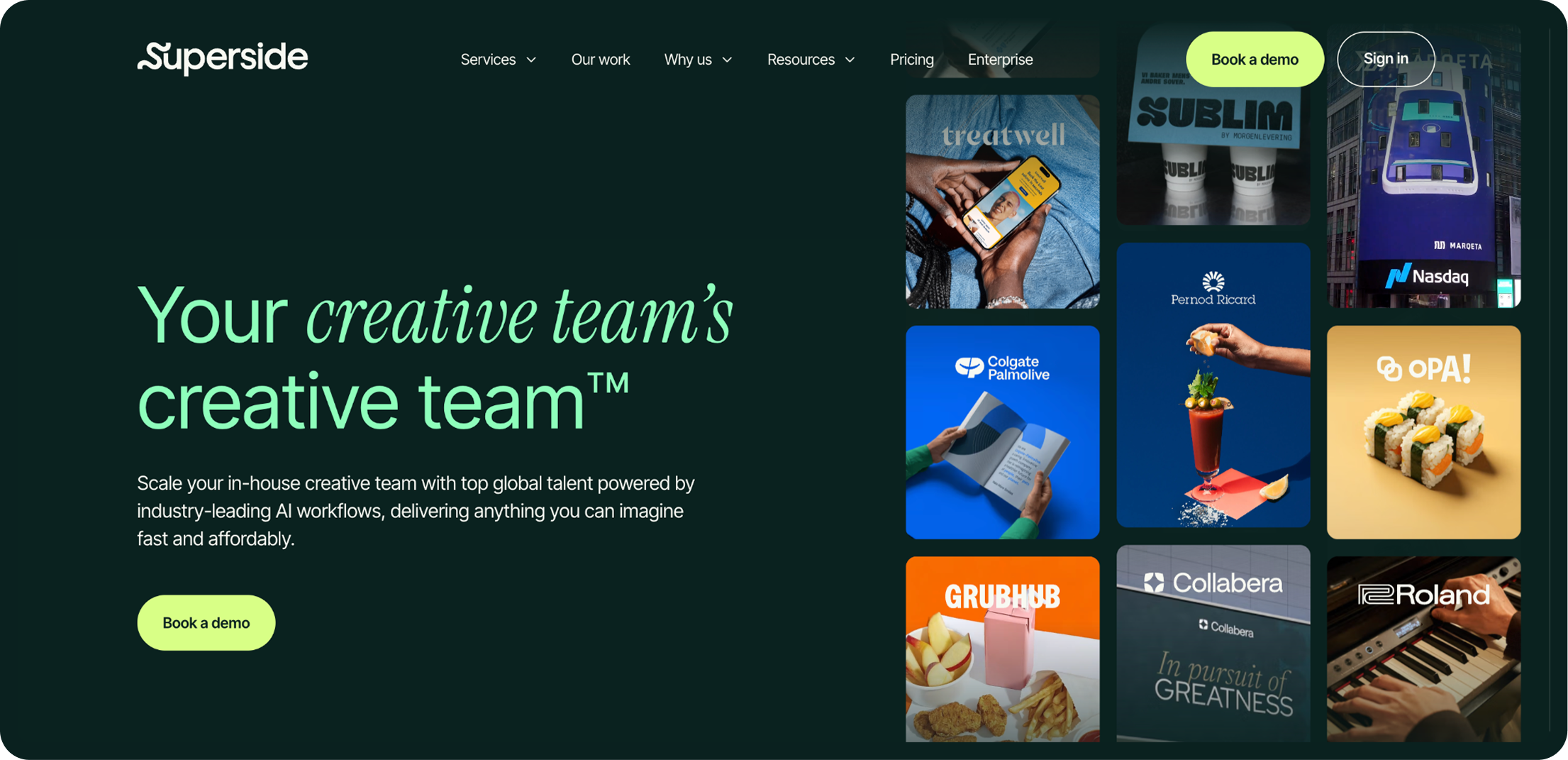
Superside is the Designity model scaled up. A Creative Project Manager is your contact, strategy and concept work come from the same budget, and the range runs to video, motion, 3D, localization and product design, well beyond one director's reach.
- Best for: Enterprise teams that like Designity's managed model but need far more scale, specialist depth or infrastructure.
- Pricing: A $15,000 monthly budget on a 12-month term, plus $1,000 a month for the platform. That is $192,000 committed in year one at the published floor. Budget you do not spend carries for three months.
- Rating: Around 4.5/5 on G2 from 100+ reviews. Quality and creative range get strong marks; critical reviews mention communication and timezone friction, slower delivery on some projects, and price.
- Trade-off: Designity is a third of the monthly cost, month to month, and a fortnight's trial before paying. Anyone leaving over price should not be looking here.
3. Flocksy: Best for Rollover, Copy and Video
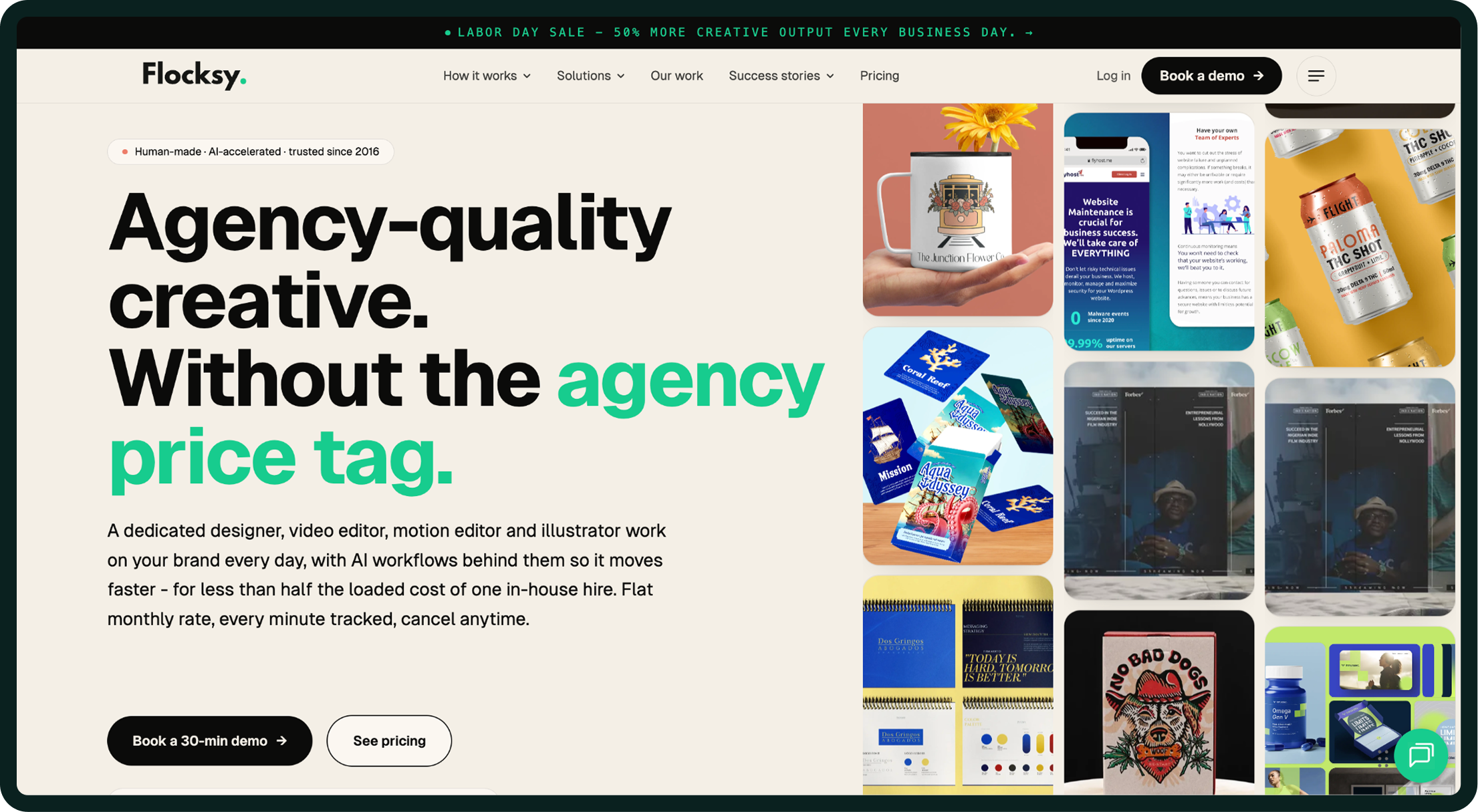
Flocksy answers the hours problem head-on: unused time carries into the next 30 days. The people on your account are fixed rather than matched per brief, and the plan includes design, video editing, motion and illustration, and copywriting.
- Best for: Teams whose main complaint is expiring hours, and who need more than design.
- Pricing: $1,699 a month buys two hours of dedicated time each business day; $5,899 buys eight. Pay yearly and the entry drops to about $1,199. Fourteen-day refund.
- Rating: 4.8/5 on G2 from 40+ reviews. Reviewers frequently praise the quality and professionalism, while recurring criticisms include longer waits on some projects and occasional communication or timezone friction.
- Trade-off: Designity gives you a Creative Director on every plan. Flocksy only introduces art direction from six hours a day.
4. Design Pickle: Best When Production Is All You Need
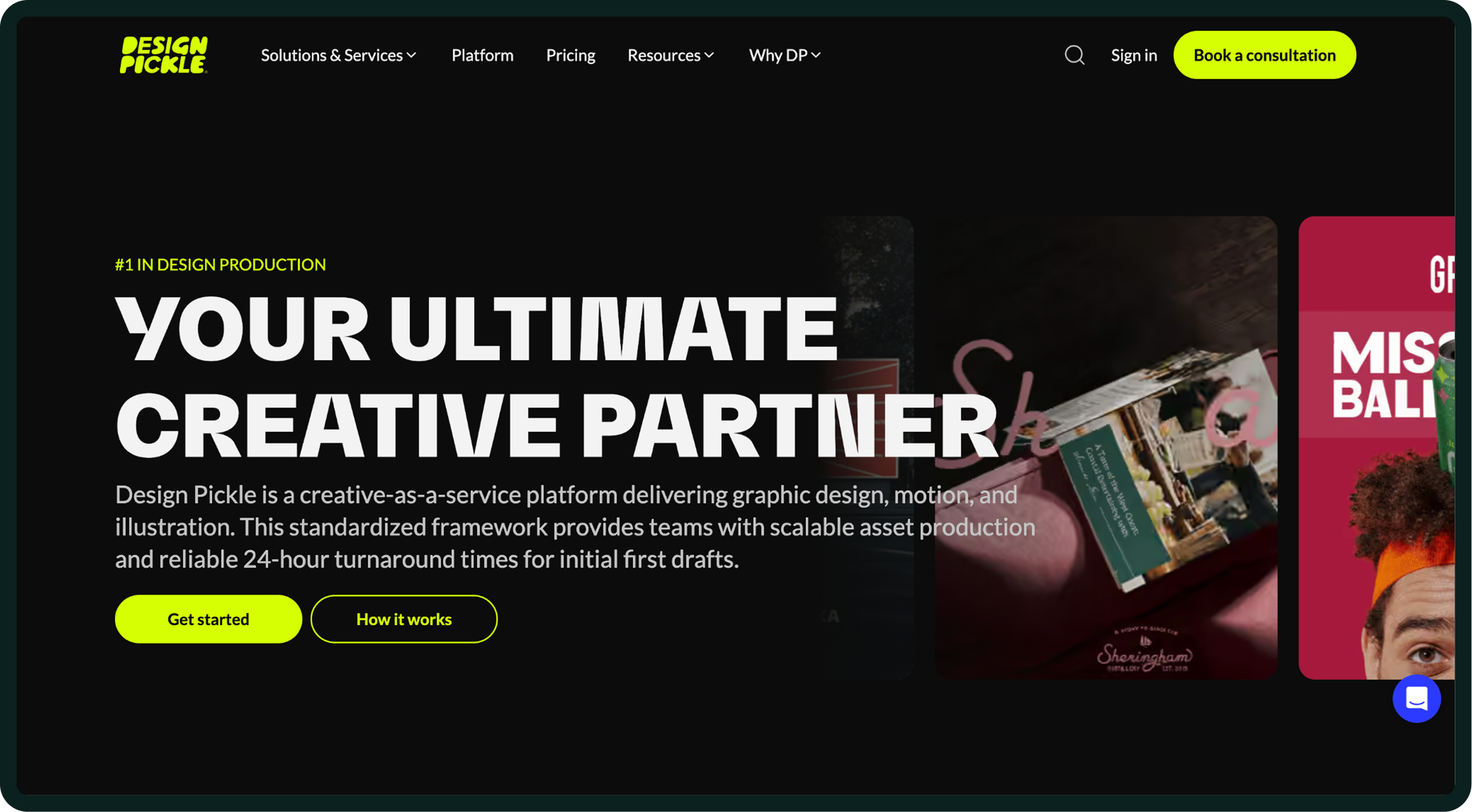
Design Pickle is for teams that have concluded the director was never the point. A brand-trained team is matched to your account with cover if someone is out, and you buy reserved daily hours that overlap your time zone.
Art Director support depends on the capacity you buy. With Design Pickle you get a production engine for steady, repeatable output.
- Best for: Weekly ad versions, social batches and deck updates, produced rather than concepted.
- Pricing: Not published. Design Pickle sets a price after a sales call, working from your volume, turnaround and services, then bills by the quarter or year with nothing back for unused time once a term renews.
- Rating: 4.4/5 on G2 from more than 220 reviews, against 3.4/5 on Trustpilot. That gap is worth a look. G2 reviewers rate the platform and the pace of a first concept; the criticism is around designers changing and details slipping between them.
- Trade-off: You give up a published price, a two-week trial, month-to-month terms and a standing director. This is a step away from managed creative, not a cheaper version of it.
5. Penji: Best for Production With Direction as an Upgrade
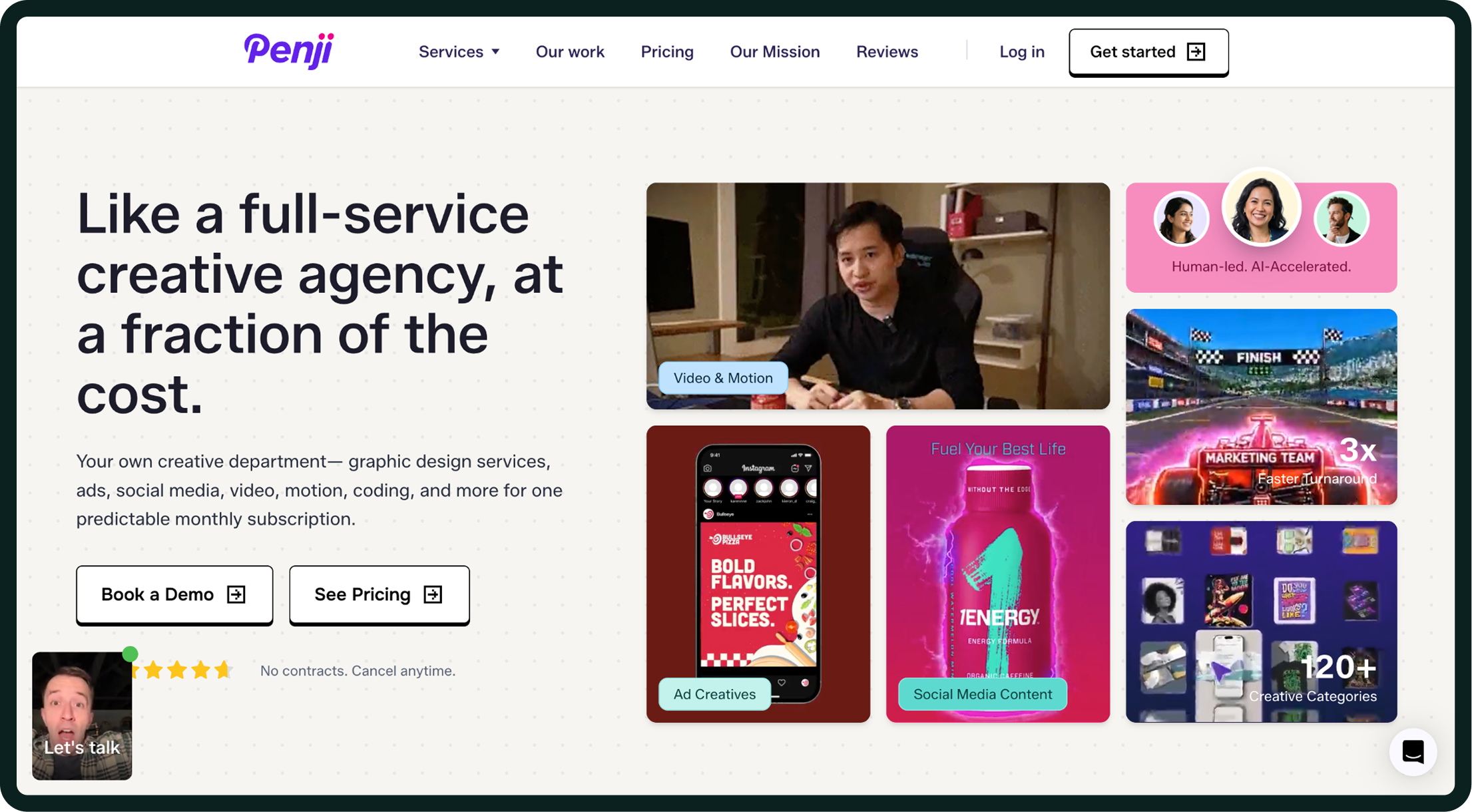
Penji inverts Designity's structure: you begin without the strategic layer and buy it if you need it. Essentials at $995 is self-managed, with a Project Manager on quality. At $1,995 on Agency Partner you add an Art Director, a fixed set of creatives, and video.
- Best for: Teams with an internal creative lead who found Designity's director overlapping them.
- Pricing: Essentials $995, Agency Partner $1,995, Dedicated Team from $4,500. Quarterly billing takes 15% off, yearly 20%. No contract and a 30-day money-back on the first month.
- Rating: 4.7/5 on G2 from 180+ reviews, 4.8/5 on Trustpilot. The value and the portal get the praise; the critical reviews talk about revisions dragging on and quality shifting when a different designer picks up the work.
- Trade-off: At Designity the director scopes the project before anyone starts; Penji's Art Director reviews work already underway. If direction is why you signed with Designity, the comparison is Penji's $1,995 tier, not $995.
6. ManyPixels: Best If the Only Problem Is the Bill
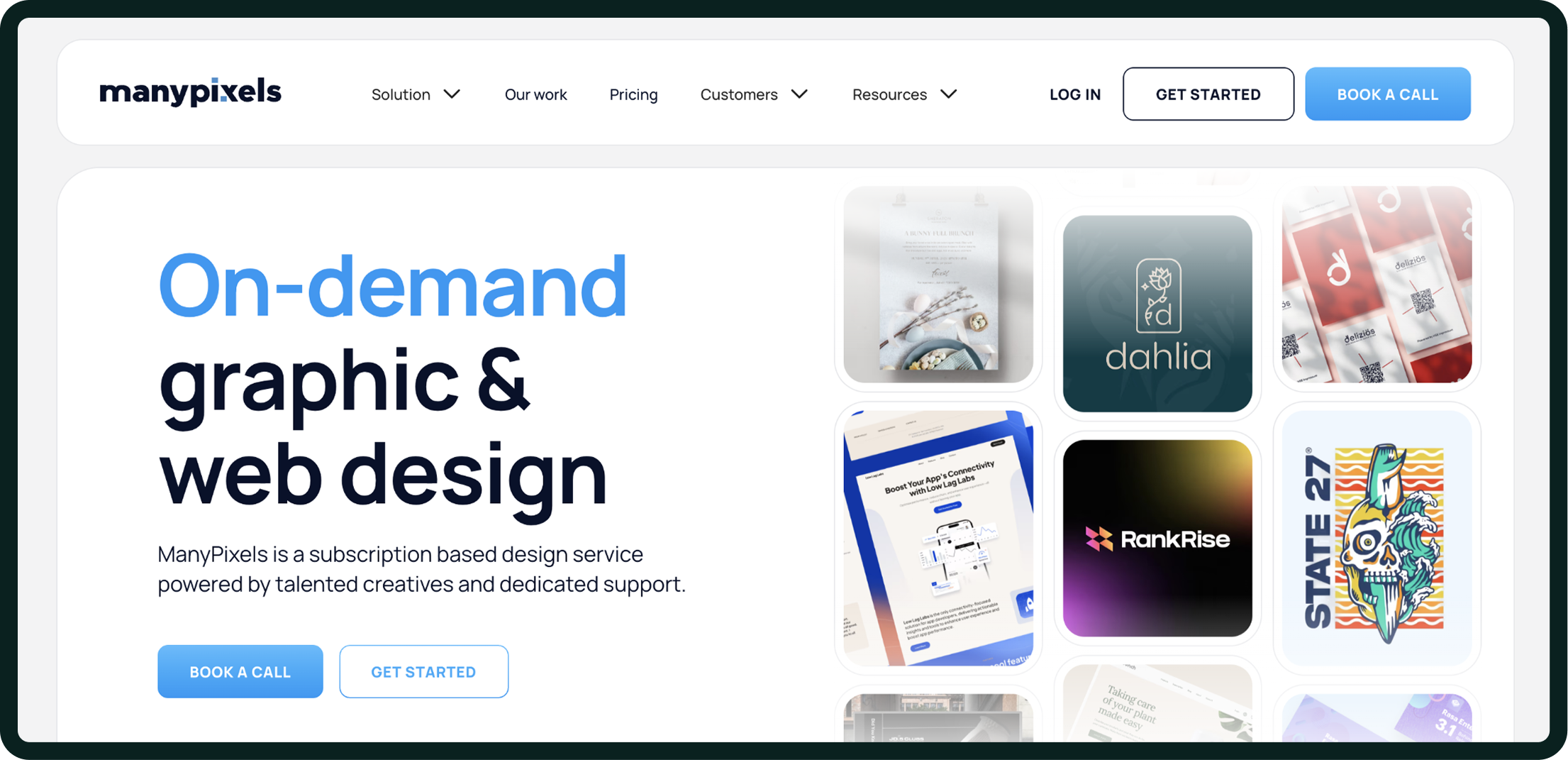
ManyPixels is a managed queue at the lowest defensible price. A project manager and a quality reviewer come with every plan, the entry tier already includes web pages, illustration and presentations, and capacity is quoted as work per day rather than "unlimited." Quiet months pause for $10, not $995.
- Best for: Teams leaving Designity on cost alone, who never leaned on the director.
- Pricing: Advanced $699, Business $1,199, Assigned Designer $1,399, Design Team $2,599, with about 10% off on quarterly billing.
- Rating: 4.8/5 on Trustpilot from roughly 149 reviews, 4.9/5 on G2 from about 30. Fast first drafts and a simple portal are the recurring praise; the value for money comes up almost as often.
- Trade-off: Designity offers strategic direction and a managed process. ManyPixels gives you production and project management but no Creative Director, so a scoped process becomes a queue. Right trade if you never used the director.
7. Designjoy: Best for Taste Over Volume
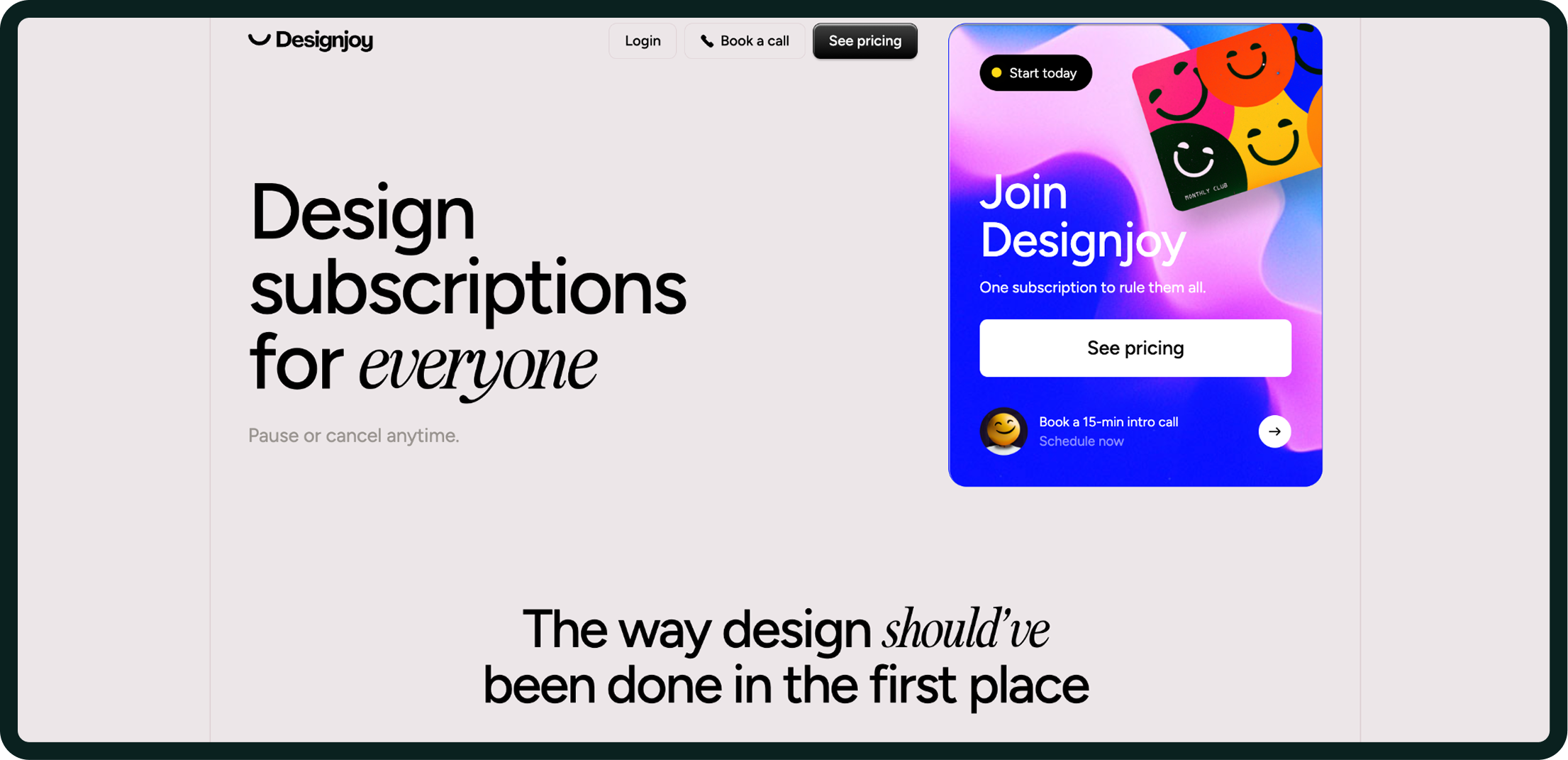
Designjoy is one designer, Brett Williams, handling a single request at a time in about two days. It resembles Designity more than it looks, because in both cases you are buying one senior person's judgement.
Designity wraps that person in a team and 120 hours. Designjoy gives you the person and nothing else.
- Best for: Founders who want one exceptional designer over a managed roster.
- Pricing: $4,995 a month. Pause or cancel at any point, and pausing banks the days you did not use. 75% refund if you leave inside the first week.
- Rating: Not enough third-party reviews for a fair score. Check the portfolio instead.
- Trade-off: 120 hours against one request at a time, a team against one person, and video, which Designjoy does not do. At nearly the same price this is a change of model, not a saving.
8. Kimp: Best When Video Needs Its Own Price
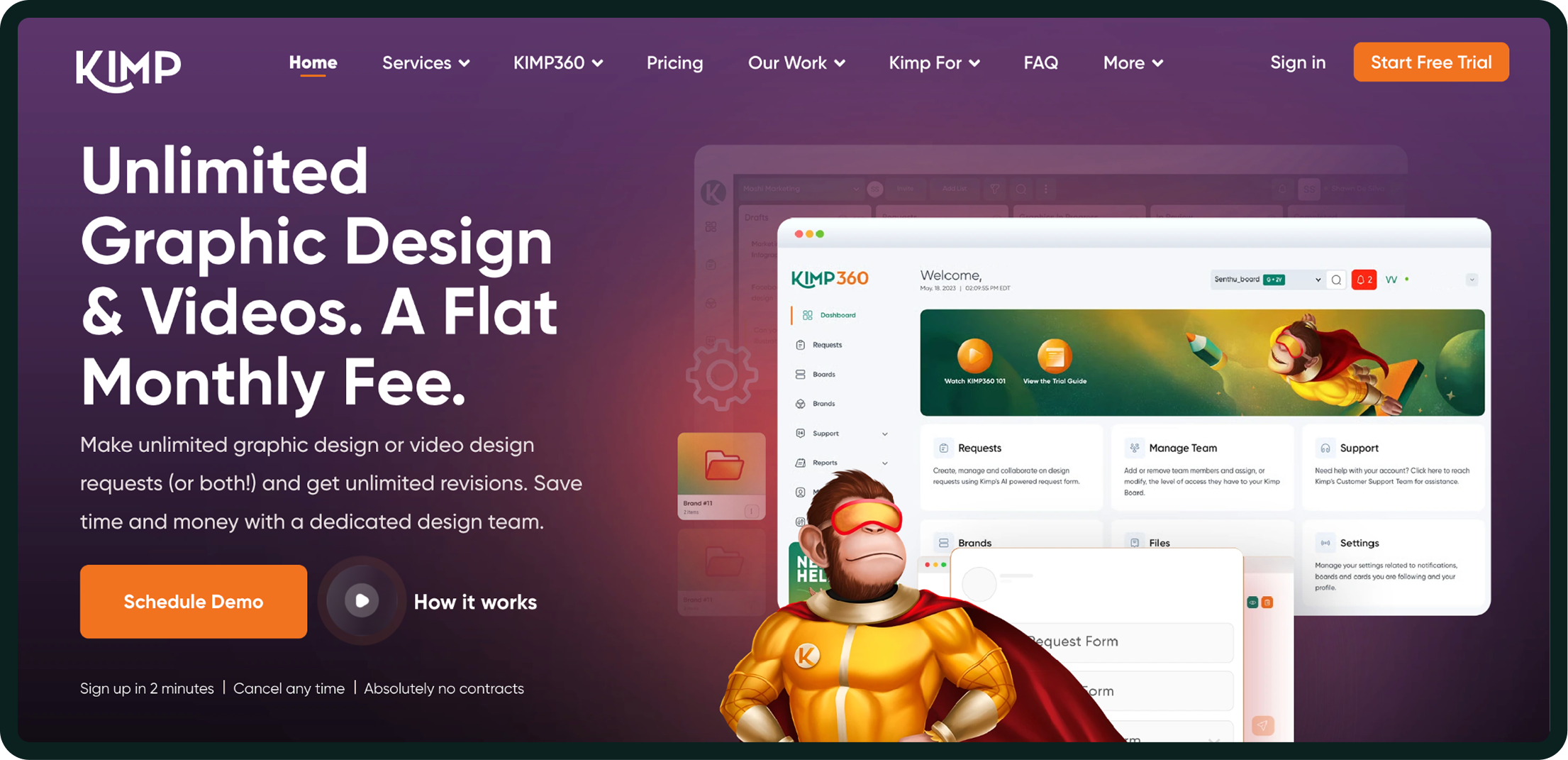
If a large share of your Designity hours went on motion, Kimp puts a separate price on it. You buy Graphics, Video, or both, each staffed with its own creatives and a project manager matched to your region.
- Best for: Content and social teams that produce as much motion as they do stills.
- Pricing: Graphics $1,397, Video $1,397, or $1,697 for the pair. Half price for the opening four months, and a seven-day trial before you are charged.
- Rating: 4.9/5 on Trustpilot from 350+ reviews, 4.1/5 on G2 from a much smaller sample.
- Trade-off: Senior creative direction is what you lose. Kimp includes a dedicated Project Manager and creative team, but its published plans do not include an Art Director or Creative Director.
9. Growmodo: Best When the Page Has to Ship
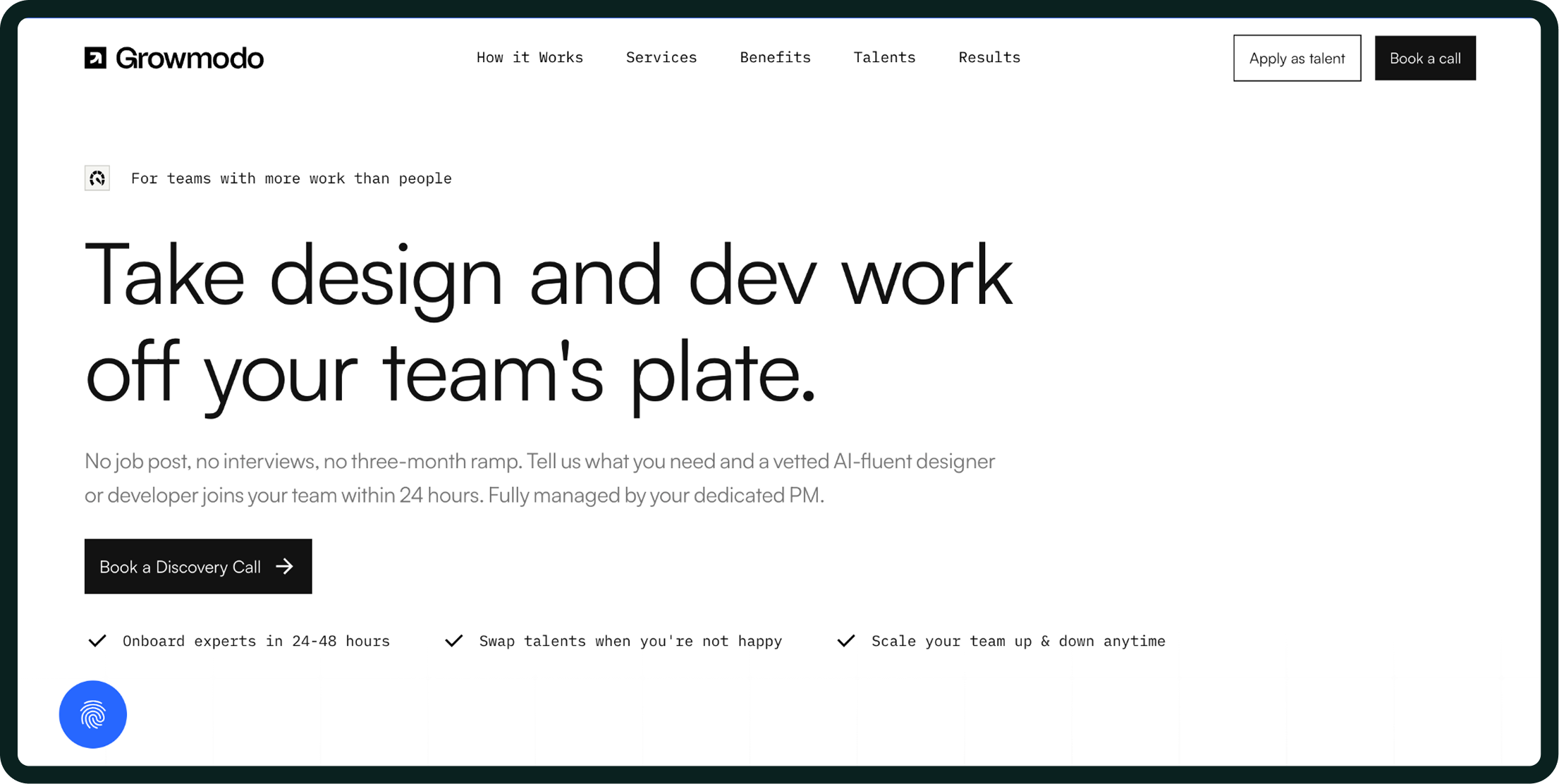
Designity designs web pages; Growmodo builds them. Creative work arrives with the development done, run by a dedicated project manager and delivered under your own brand, and its reviews describe finished Webflow and WordPress sites.
- Best for: Agencies and teams whose brief ends with a live URL, not a design file.
- Pricing: $3,000 a month per talent, including a dedicated Project Manager and QA, with one active project at a time per talent. Add talent for more parallel capacity. Monthly billing, with 5% off on a six-month term and 10% off on twelve.
- Rating: 4.8/5 on Trustpilot from 85+ reviews. Reviewers praise fast, responsive builds and daily PM updates; one repeated note is that scope takes a little learning at the start.
- Trade-off: Designity builds senior creative direction into the standard plan. At Growmodo the Project Manager is included but deeper strategic and creative guidance is a $1,000-a-month Partner add-on.
10. Awesomic: Best Designity Alternative for Startups
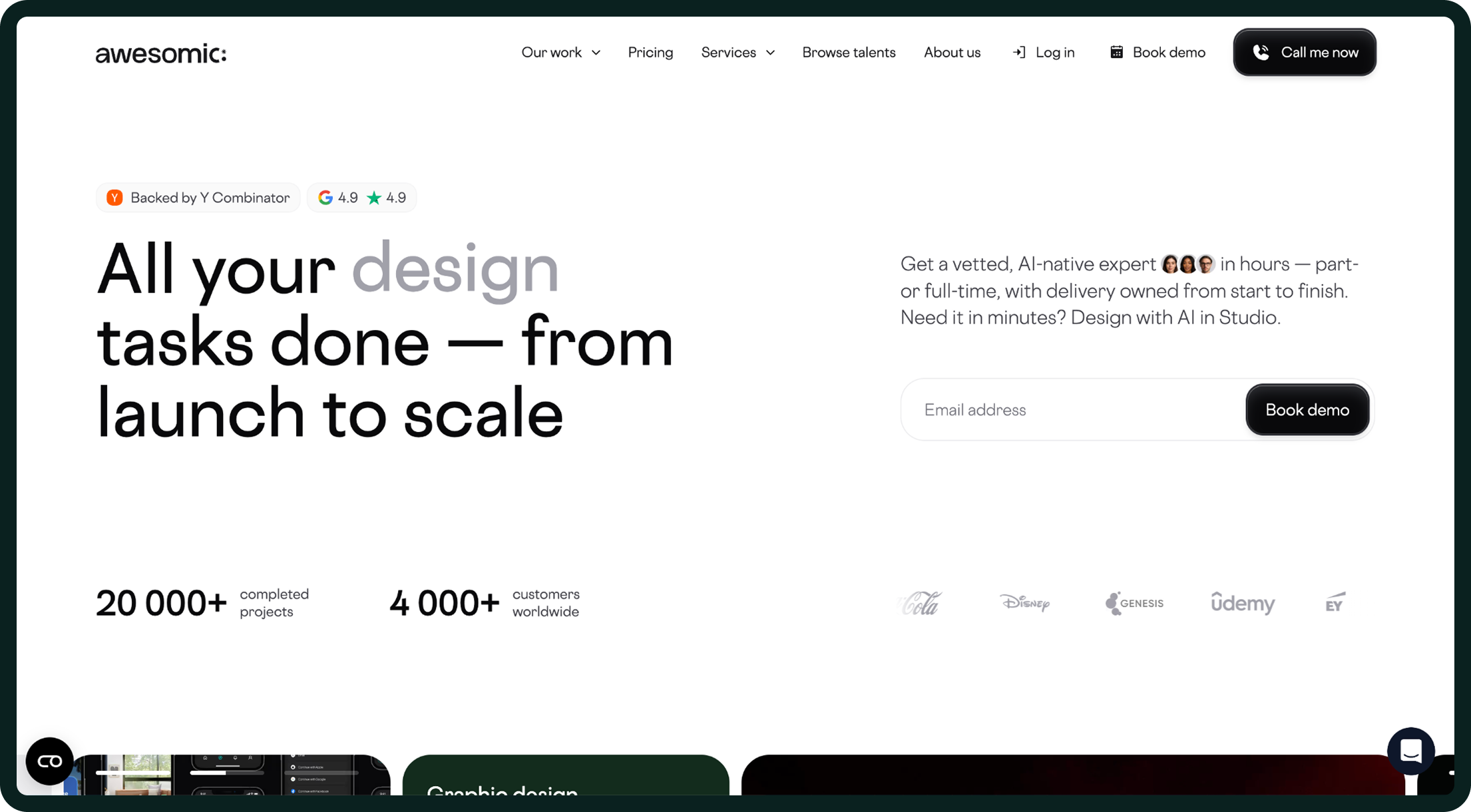
Awesomic tackles continuity from the opposite end: it matches you to a designer within 24 hours and lets you change them free of charge if the match is off. The bench also covers no-code, development and marketing.
- Best for: Early-stage startups that want to begin this week and change direction freely as needs become clear.
- Pricing: $1,490 a month for design, $2,995 for the all-in-one tier, cheaper on a quarterly commitment.
- Rating: 4.8/5 on Trustpilot from 60+ reviews.
- Trade-off: Awesomic does not position its published plans around Creative Director-level strategy or scoping. You provide the brief and the matched talent handles execution, with a Project Manager included on Dedicated Talent. Hours of operation are not listed, and the quarterly plan locks for three months.
What Solving Your Designity Problem Costs
A price table tells you what each service costs, not what solving your particular problem costs or what you lose doing it. This does.
The pattern: most reasons to leave Designity are about the deal, and the fix for the deal usually costs you part of the scope. Two parts are easy to underrate.
- A director from the kickoff. Designity's Creative Director scopes the project before anyone starts. Teamtown and Superside are the closest overall models, although Penji and Flocksy also introduce art direction on higher tiers. The titles differ: Teamtown's Essentials and Pro include a Creative Lead, with a fractional Creative Director on Studio.
- The trial. Two weeks with nothing paid upfront is rare. Kimp offers a week, Penji and Teamtown use money-back guarantees, and Superside and Design Pickle offer neither.
Decide which part you can live without before you compare prices.
How to Choose the Right Designity Alternative
Answer these questions and the list will get smaller depending:
- Do you need senior creative direction, or do you have it? If someone internal sets direction, stop paying for a second layer. If nobody does, Designity, Superside and Teamtown build creative leadership into every plan, with the title and depth varying.
- How many hours did you use last quarter? If you are consistently using under 60 of 120 available hours, a plan without rollover leaves a large share of your paid capacity unused. Look at Teamtown, Flocksy or a queue-based service.
- Do you need the same people on every piece? If re-explaining the brand is the pain, a fixed team beats a matched one: Teamtown or Flocksy.
- Design only, or design plus strategy, copy and video? The wider the scope, the shorter the list: Designity, Superside, Flocksy.
- How do you want to communicate? Slack and a standing team, or a portal and a ticket.
- What is the real monthly budget? Not what you can spend in a good month; what you can commit to for a year.
And test it before you believe it. Give the new one a dull job from the real backlog, then a difficult one, and let Designity's two-week trial double as your overlap.
If you are consistently using around 100 hours a month and getting value from the Creative Director, Designity may still be a strong fit.
If you are closer to 60, half your capacity is going unused, and that is the case Teamtown exists for: one team that does not change, led by a Creative Lead, from $3,000, with unused hours carried forward.
Book a demo with Teamtown. There are 15 days to get your money back, and if the honest answer on the call is that Designity fits you better, I will say so.
Frequently Asked Questions
What is the best Designity alternative?
It depends on why you are leaving.
- One fixed team led by a Creative Lead, at a lower entry point: Teamtown
- The director-led model at enterprise scale: Superside
- Rollover hours plus copy and video: Flocksy
- Production without a strategic layer: Penji or ManyPixels
Designity may still be the stronger fit if you use most of its hours and value having a Marketing Strategist alongside creative direction.
Who are Designity's main competitors?
Teamtown, Superside, Flocksy, Design Pickle, Penji, ManyPixels, Designjoy, Kimp, Growmodo and Awesomic. Closest on model are Teamtown and Superside, since both include creative leadership as standard. The rest compete on price, scope or a specific discipline.
Is there a cheaper alternative to Designity?
Among the alternatives with public pricing, everything here except Superside starts below Designity: ManyPixels from $699, Penji $995, Kimp $1,397, Flocksy $1,699, Teamtown $3,000, Growmodo $3,000 per talent and Designjoy $4,995. Design Pickle sets its price on a sales call, so it cannot be placed on that list.
Cheaper generally means giving up the Creative Director, the Marketing Strategist or both, so match the saving to what you were using.
What are the best Designity alternatives for startups?
It depends on how much recurring creative work you outsource, not on funding stage.
- Early startup, occasional needs: Awesomic, ManyPixels or Penji, since 120 hours a month is far more than you will use
- A marketing hire and steady output: Teamtown or Flocksy, which give you continuity without the $5,995 floor
- Shipping campaigns weekly: Designity's pricing becomes fair, and Superside enters the shortlist
One test: estimate your total monthly creative support, including design, direction, project management, strategy and copy, and set it against the 120-hour minimum. Well under, and you are paying for hours that will sit unused.
Why does Designity cost $5,995 a month?
Because you are buying 120 dedicated hours split across a Creative Director, a Project Manager, a Marketing Strategist and the creatives doing the work, about $50 per included hour.
The cost only becomes a problem if you do not use the hours, since unused time does not roll over and pausing costs $995 for two weeks.